

A GLOSSARY OF
ILLUSTRATED FRACTION DEFINITIONS
For 5th Grade through 12th Grade
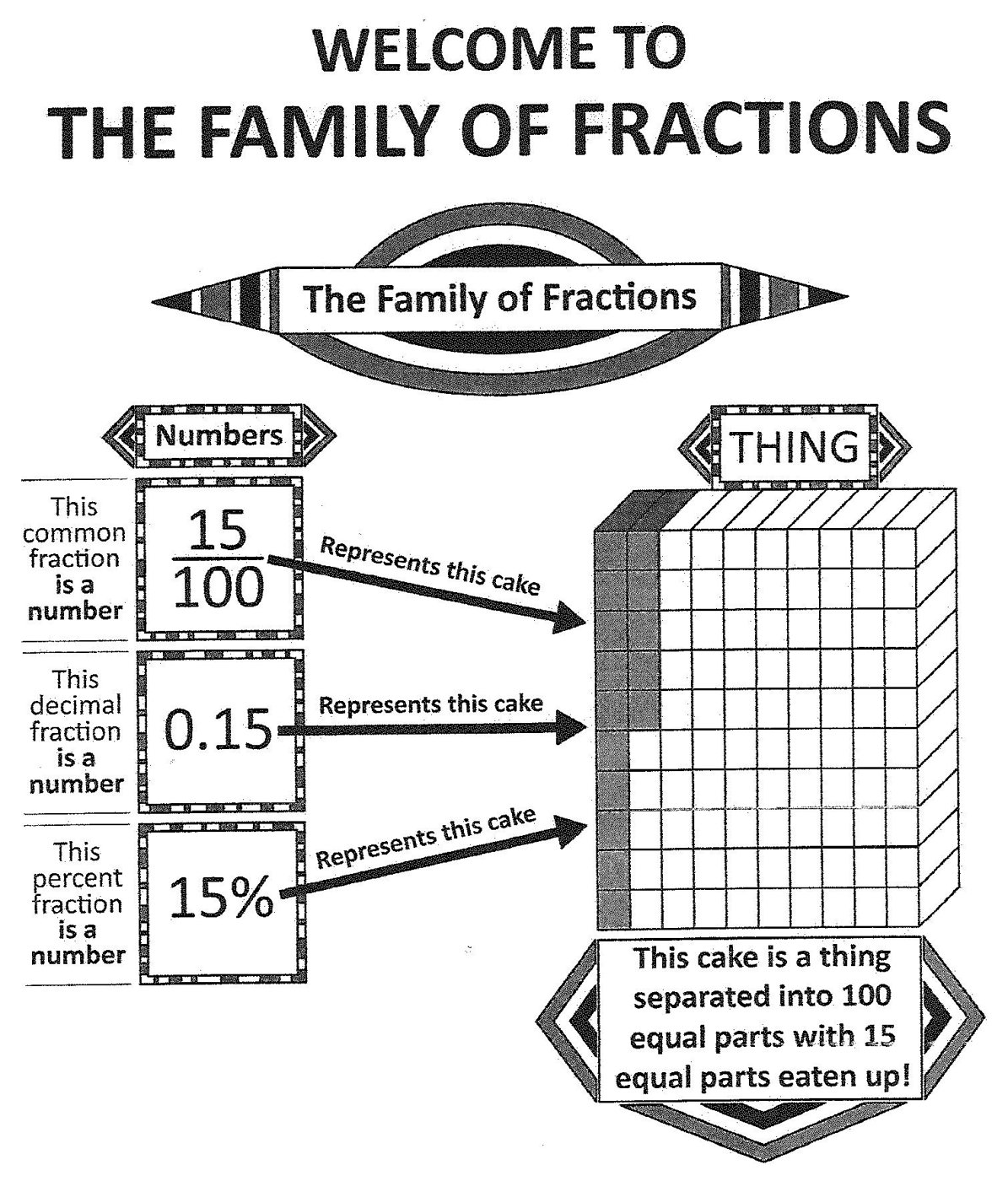
Written and Illustrated by Bruce Silton
PERMISSION
I give permission to all Clearwater Academy International (CAI) faculty and staff (including faculty and staff at other schools which are licensed to use CAI’s curriculum) to copy and distribute my Glossary of Illustrated Fraction Definitions for 5th Grade through 12nd Grade as needed to carry out their educational mission at Clearwater Academy International.
Bruce Silton, September 4, 2022
FIRST EDITION
© 2022 Bruce Silton
Editor: Jane Zurlinden Dryer
SECOND EDITION
© 2026 Bruce Silton
Editor: Jane Zurlinden Dryer
Proofreader: Leslie Silton, Book Doctor
ACKNOWLEDGEMENTS
Jane Dryer, the Lead Tutor at Clearwater Academy International (CAI), knows her math and how to teach it. She and I have worked together at CAI for many years to enhance the math educations our students receive.
In 2022, Jane edited the first edition of my Glossary of Illustrated Fraction Definitions for 5th Grade through 12nd Grade. So, I trust her to find ways to simplify and improve the communication of my mathematical ideas.
It is now 2026 – and she has done it again! A GREAT BIG THANK YOU TO JANE DREYER for her careful, thorough, and accurate editing of this 2026 Second Edition of my glossary! Because of her knowledge and skill, this glossary is a better book for both teaching and learning fraction math.
………………..……………………..
Leslie Silton (also known as “The Book Doctor”) is my lifelong friend and sister. Fortunately, she is also an experienced and thorough proofreader. She has been cheerfully willing to assist my development of new math curriculum with her precise proofreading — of my last five books! A GREAT BIG THANK YOU TO LESLIE SILTON for all her help!
……………………………….
Despite all the help I have received from Jane and Leslie, I am totally responsible for any and all errors that may be found in this glossary, as I continue to write and revise long after they have completed their work.
INTRODUCTION FOR TEACHERS
WHY DID I WRITE THIS GLOSSARY?
AT CLEARWATER ACADEMY, WE HAVE GREAT MATH GLOSSARIES.
Our math glossaries were written in 1997 and 1998 to accompany our math books. I began using our glossaries in March of 2000. It is now 2026. So, I have used them for 26 years to help CAI students master their math lessons. I have learned how truly valuable our math glossaries really are.
But even the best book or glossary sometimes needs to be improved. In 2006, I realized that confusion about “fractions” was the most common reason students had trouble learning their math lessons. So, I decided to make the subject of fractions easier to learn.
I discovered the following important fact: There are two different kinds of fraction words in our math books: (1) FRACTION FUNDAMENTALS WORDS and (2) FRACTION ARITHMETIC WORDS.
• FRACTION FUNDAMENTALS are the most basic fractions ideas that are needed by all students before they can master FRACTION ARITHMETIC.
• FRACTION ARITHMETIC is the addition, subtraction, multiplication and division of fractions.
• FRACTION FUNDAMENTALS come first. To master FRACTION ARITHMETIC, you must first understand the ideas of FRACTION FUNDAMENTALS.
This Glossary of Illustrated Fraction Definitions for 5th Grade through 12nd Grade names and defines only the ideas of FRACTION FUNDAMENTALS. You can see a list of FRACTION FUNDAMENTALS words on pages 8, 9, and 10 of this glossary. To be really good at FRACTION ARITHMETIC you must first understand the words of Fraction Fundamentals.
MOST OF THE FRACTION FUNDAMENTAL WORDS IN THIS GLOSSARY ARE SIMPLY MISSING FROM OUR REGULAR GLOSSARY!
A student should use this Glossary of Illustrated Fraction Definitions for 5th Grade through 12nd Grade to answer such questions as: “What is a fraction?”, “What are the three different kinds of fractions?”, and “What are the different parts of each of the three kinds of fractions?” The answers to these and similar questions open the door to learning how to apply FRACTION ARITHMETIC when you graduate from school and enter the real world.
EVERY DEFINITION AND ILLUSTRATION OF FRACTION FUNDAMENTALS WORDS GIVEN IN THIS NEW GLOSSARY IS MORE COMPLETE AND MORE ACCURATE THAN THE DEFINITIONS FOUND IN OUR ORIGINAL MATH GLOSSARIES.
So, when you are studying about fractions, first use this Glossary of Illustrated Fraction Definitions for 5th Grade through 12nd Grade. The definitions and illustrations in it will help you learn fractions at the highest level.
Then be sure to use our regular math glossary as well as the excellent glossaries in Saxon’s math textbooks to learn the Fraction Arithmetic words.
GETTING HELP
These definitions are written for students in 5th grade through 12th grade. But if you need extra help understanding a definition, ask your teacher. Your teacher will help you.
You can also get help by contacting me, Bruce Silton, the author. My contact data is at the very end of this glossary. You can even come to my office on the first floor of Clearwater Academy International. If the door is closed, please knock.
TO QUICKLY FIND A WORD
Use the alphabetical list of words on pages 8, 9, and 10` to quickly find the words defined in this glossary. THE PAGE NUMBER AFTER EACH WORD TELLS YOU WHERE TO FIND THE WORD, ITS DEFINITION, AND ILLUSTRATION.
HOW TO USE THIS GLOSSARY
Most glossaries list the words in alphabetical order.
But the words in this glossary are arranged in the best order for learning the fraction fundamentals. I recommend that you study and learn these definitions in the order given in this glossary.
Teachers, tutors, and parents can also study this glossary from beginning to end to gain a full understanding of the Fraction Fundamentals.
THE DEFINITIONS
IN THIS GLOSSARY, WHEN YOU SEE THIS DESIGN,
THE VERY NEXT WORDS ARE A DEFINITION.
Also, there is a sentence after each definition that shows the correct way to use the word when writing and speaking. Both the definitions and sentences are written in extra black, capital letters.
ALPHABETICAL LIST OF WORDS DEFINED AND ILLUSTRATED IN THIS GLOSSARY
Common Fraction: first (simple) definition – 49
Common Fraction: second (complete) definition – 55
Decimal Fraction – 74
Decimal Point – 76
Definition – 16
Denominator – 52
Digit – 25
Digit Value – 67
Family of Fractions – 118
Family of Fractions Five Fraction Facts (FFFFF) – 121
Fraction – 31
Fraction (more complete definitions) – 35, 39, 122
Fraction Line – 54
Fraction of a Group – 33
Fraction-Thing – 43
Fraction-Thing: Top Definition – 132
Fraction: Most Important Definition – 125
Hundreds – 70
Hundreds’ Place – 70
Hundredths – 87, 101
Hundredths’ Place – 102
Mathematics – 16
Math – 19 Math Place – 63
Meaning – 14
Non-Math Definitions of Fraction – 58
Number (main definition) – 20
1) Idea Number – 21
2) Sound Number – 22
3) Letter Number – 23
4) Numeral – 226
Numerator – 54
Ones – 69
Ones’ Place – 69
Place Value – 68, 100
Percent Fraction – 105
Represent – 38
Tens – 70
Tens’ Place – 70
Tenth – 84, 101
Tenths’ Place – 99
Ten-Thousandth – 98
Thousandth – 93, Thousandths – 102
Thousandths’ Place – 102
Value – 65
Word:
1) Letter Word – 11
2) Spoken Word – 13
3) Meaning – 14
4) Definition – 15
Whole Number – 29
ILLUSTRATED FRACTION DEFINITIONS FOR 5th through 12th GRADES
● WHAT IS A WORD
●WHAT IS A MEANING?
● WHAT IS A DEFINITION?
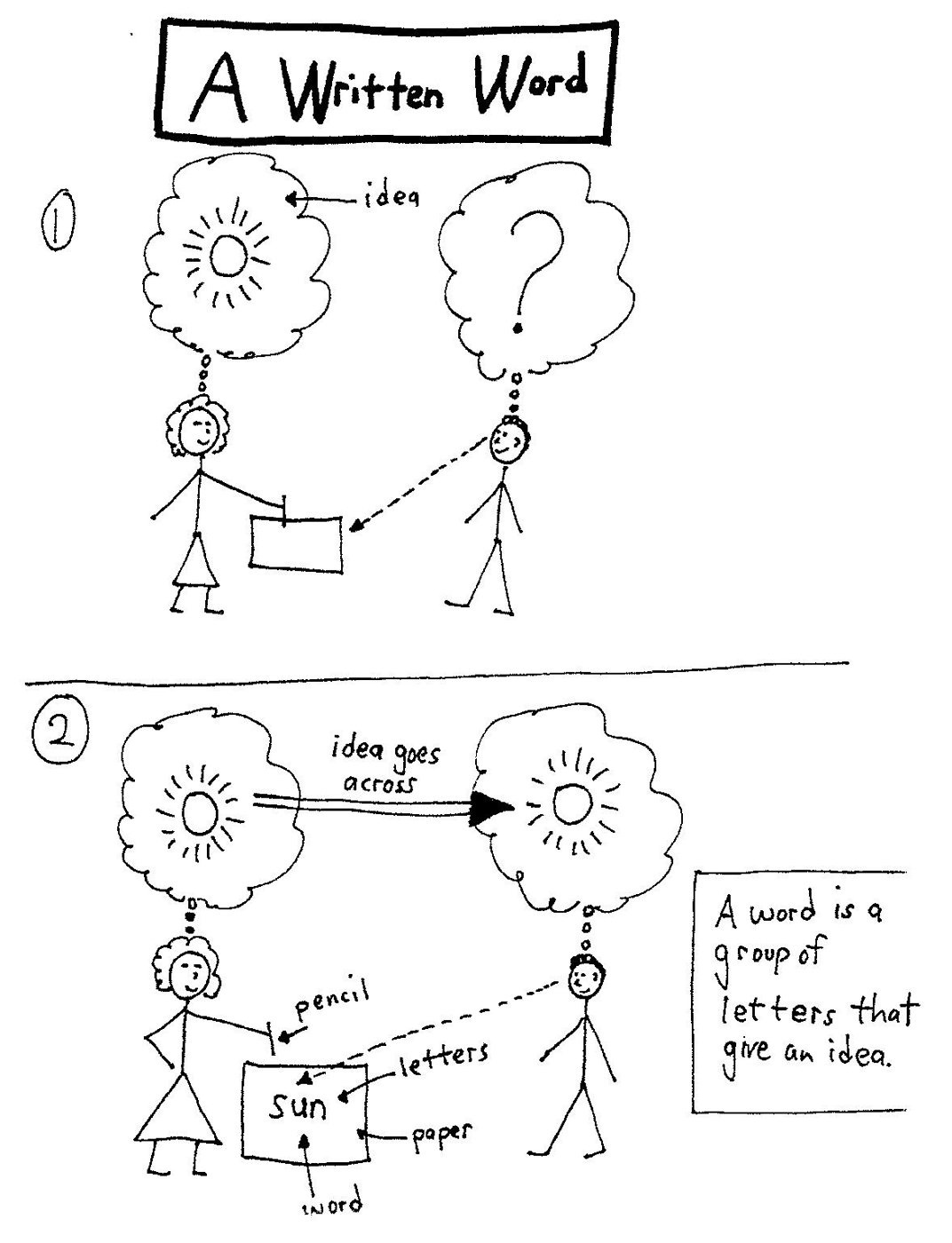
We use spoken words and written words to communicate our ideas to other people. There are two kinds of words:
• written words
• spoken words
Let’s start by defining and illustrating both kinds.
▒ DEFINITION OF “WORD”: A WORD” IS A GROUP OF LETTERS PUT TOGETHER THAT COMMUNICATE AN IDEA. YOU CAN CALL THIS A “LETTER WORD” OR A “WRITTEN WORD.”
SENTENCE: Beth wrote the word “CAT” using capital letters.
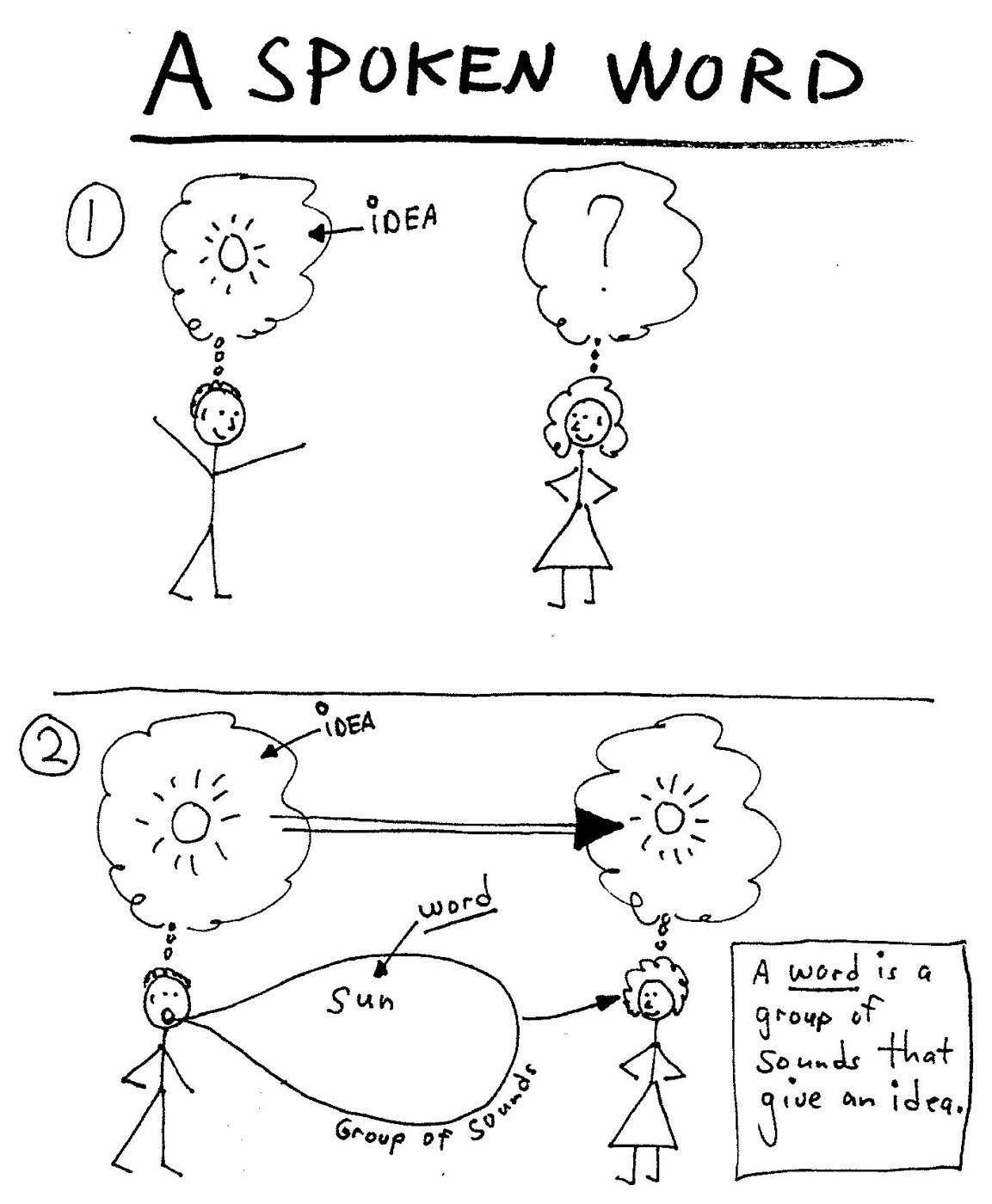
▒ DEFINITION OF “WORD”: A “WORD” IS A GROUP OF SOUNDS PUT TOGETHER THAT COMMUNICATE AN IDEA.
SENTENCE: STUDENTS LEARN TO SAY WORDS CORRECTLY BY READING STORIES ALOUD.
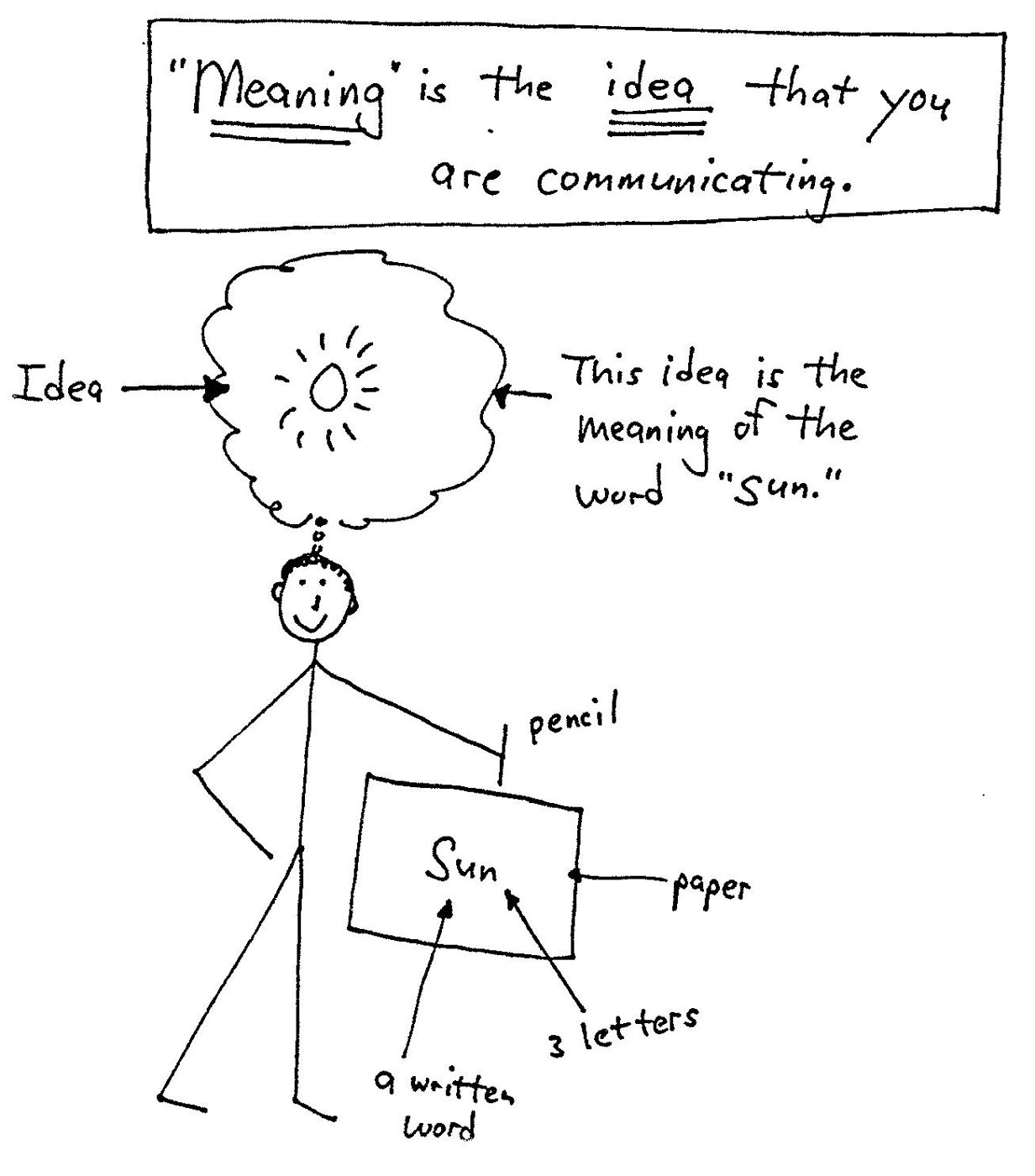
▒ DEFINITION OF “MEANING”: THE “MEANING” OF A WORD IS THE IDEA THAT THE WORD COMMUNICATES.
SENTENCE: STUDENTS LEARN THE MEANINGS OF THE WORDS “CAT” AND “DOG” IN KINDERGARTEN.
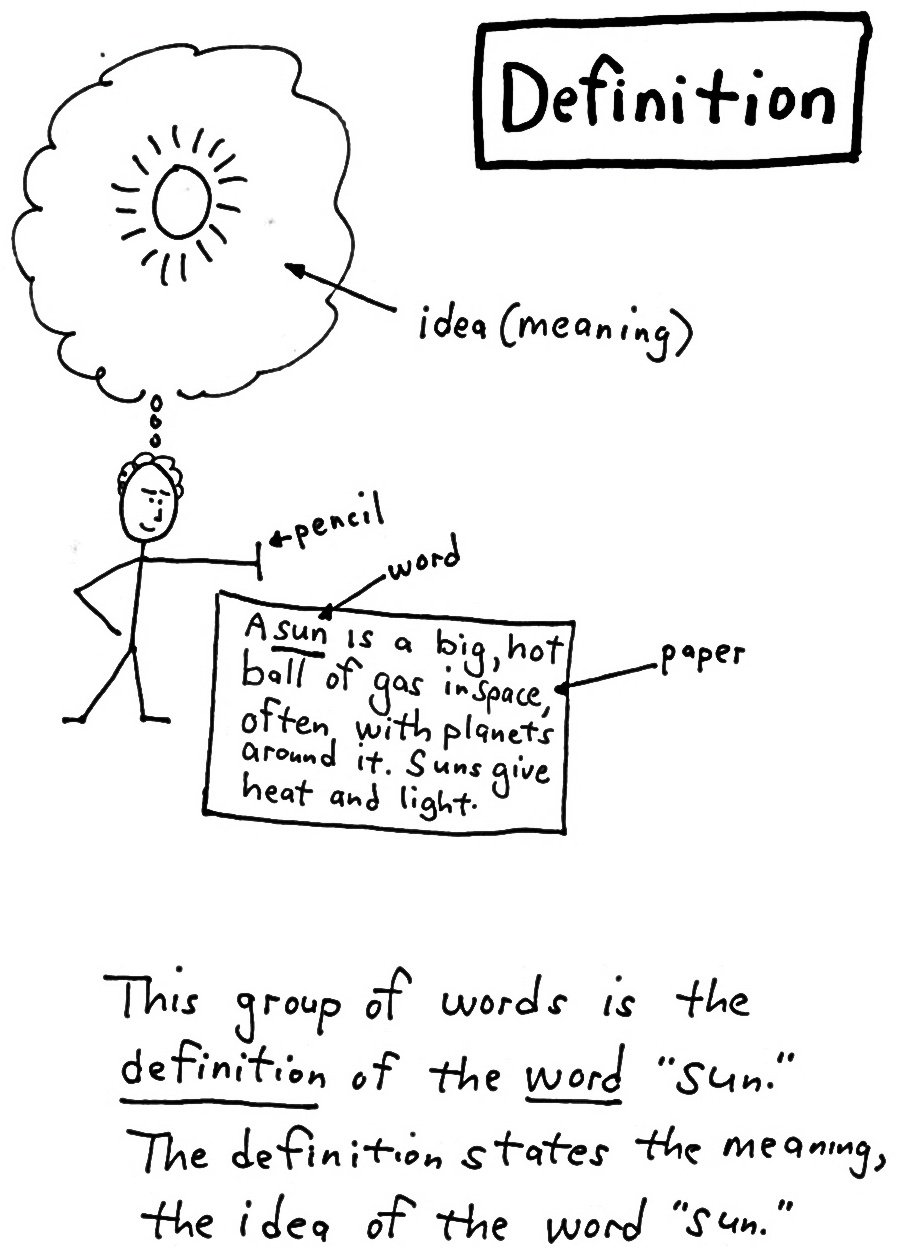
▒ WHAT IS A “DEFINITION”?: A “DEFINITION” IS A GROUP OF WORDS THAT TELLS THE MEANING (THE IDEA) OF A WORD.
SENTENCE: HERE IS A GOOD DEFINITION OF THE WORD “CAT” — A CAT IS A SMALL, SOFT, FURRY ANIMAL THAT SAYS MEOW, CATCHES MICE AND BIRDS, AND PEOPLE KEEP THEM AS PETS.
WHAT IS MATHEMATICS?
A Student’s VERY FIRST Definition
Here is a simple definition of math. This definition can be understood by anyone. Little kids and old people and everyone in between can understand this idea. This simple definition will help you get started really understanding mathematics.
Of course, there are more difficult definitions, but let’s learn this simple one before the difficult definitions.
▒ DEFINITION OF “MATHEMATICS”: MATHEMATICS (OR MATH) IS USING NUMBERS TO FIND OUT HOW MUCH OR HOW MANY THINGS. MATH INCLUDES ALL THE DIFFERENT WAYS OF FINDING OUT HOW MUCH AND HOW MANY THINGS.
SENTENCE: EVERYONE NEEDS MATH TO QUICKLY ADD UP HOW MUCH MONEY THEY HAVE.
Maybe you are thinking, “This definition of math is too simple to be true!” No, it really is just that simple.
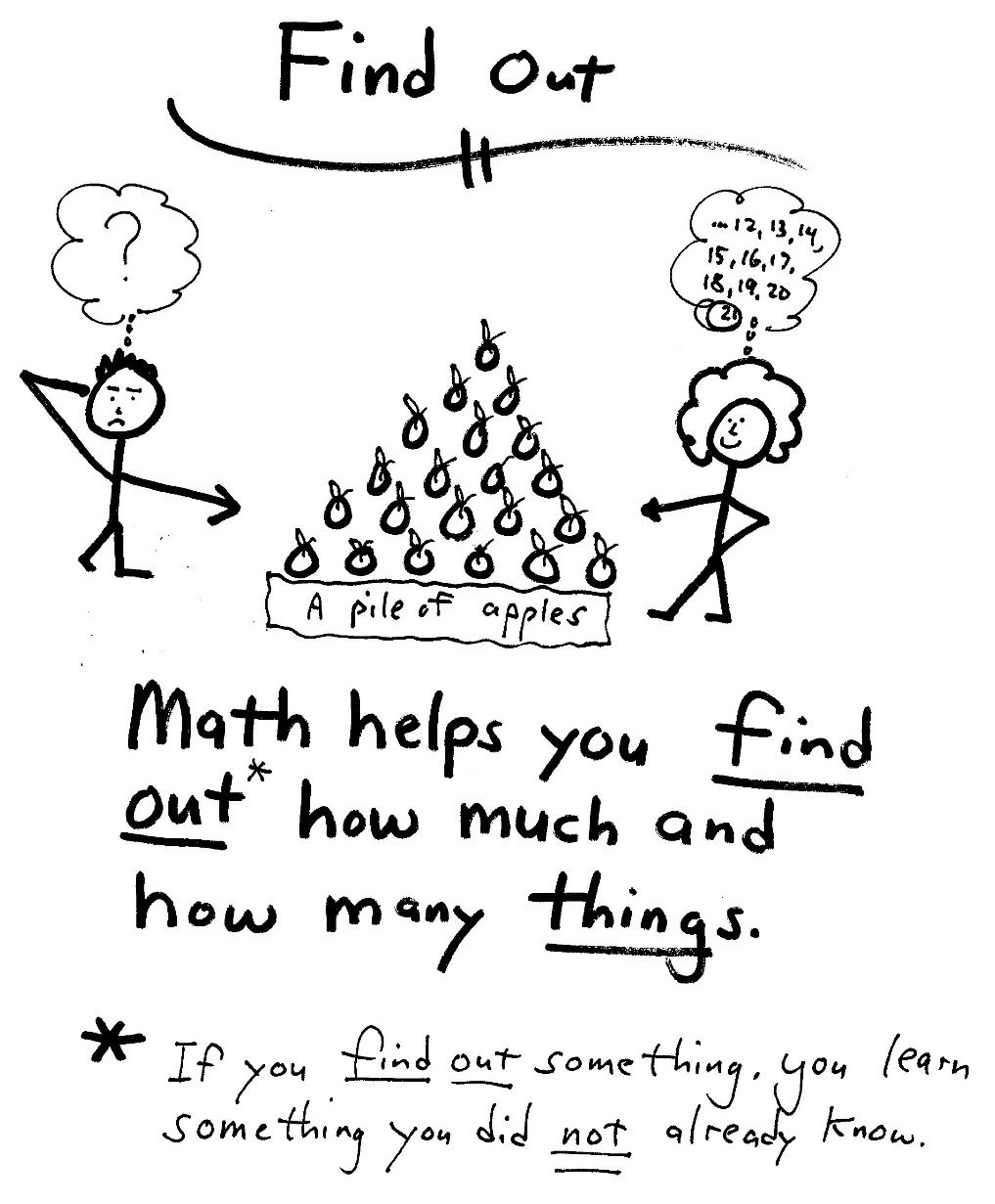
And this definition of math is useful. When you are counting, adding, subtracting, multiplying and dividing apples or dollars, you are using numbers to find out how many apples or how much money.
Jeffrey does not know his math. But Maria is good at math. She uses numbers to count the pile of apples.
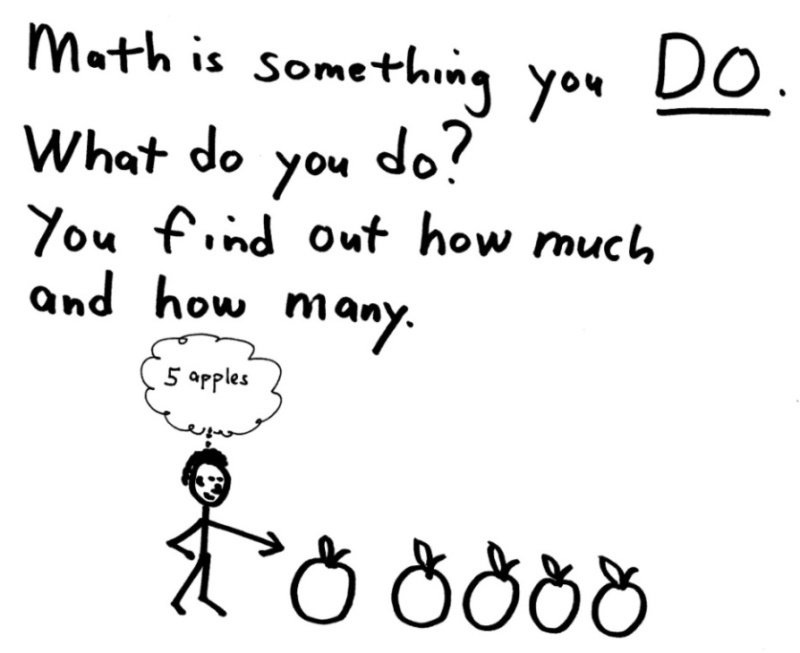
Bobby is doing math. He is using numbers
to find out how many apples he has.
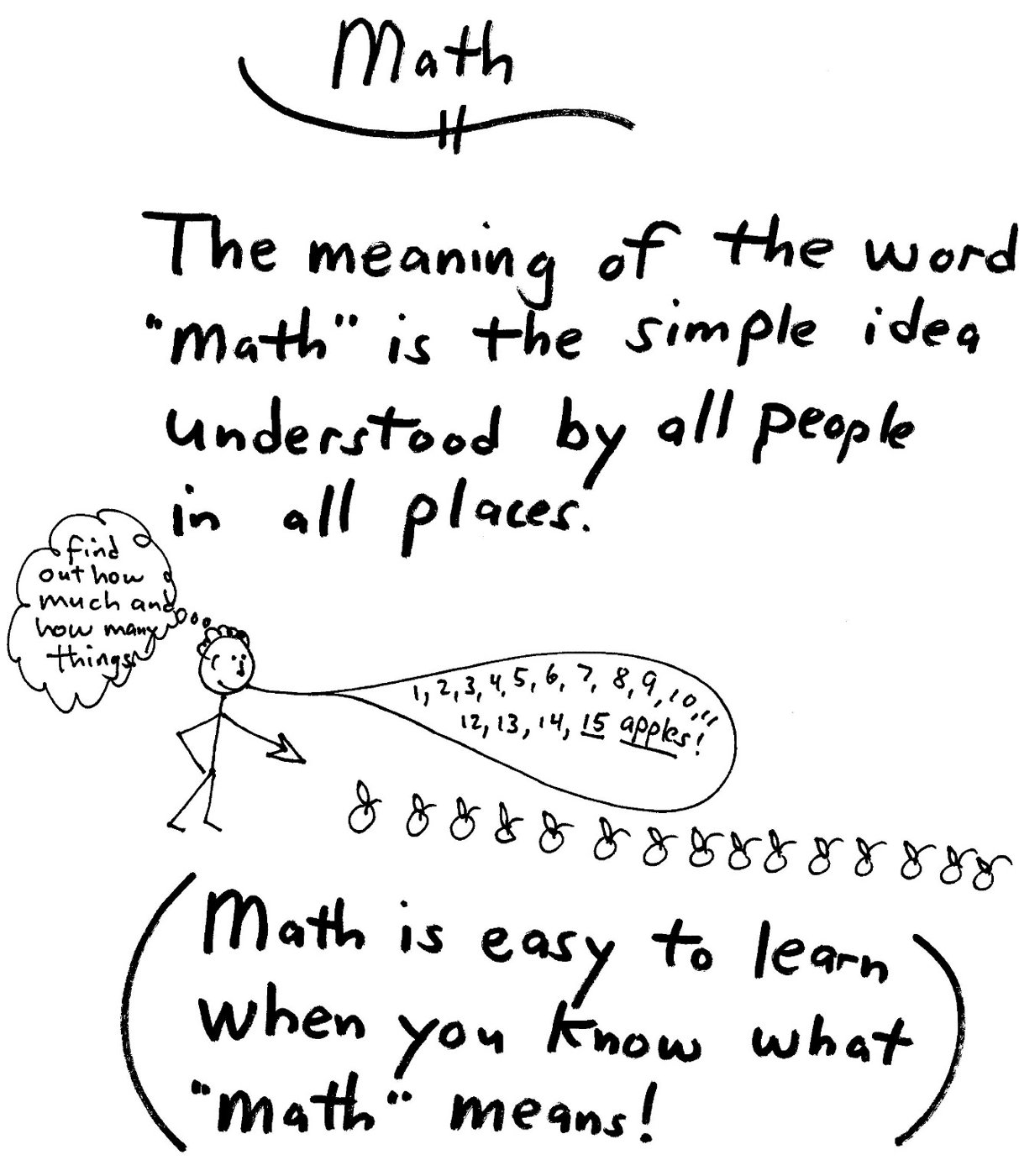
DEFINITION OF “MATH”: “MATH” AND “MATHEMATICS” MEAN EXACTLY THE SAME THING. “MATH” IS A SHORT WORD (4 LETTERS). “MATHEMATICS” IS A LONG WORD (11 LETTERS). SAYING OR WRITING “MATH” IS EASIER THAN SAYING OR WRITING “MATHEMATICS.” SO, “MATH” (the shorter word) GETS USED MORE OFTEN THAN “MATHEMATICS” (the longer word).
SENTENCE: I USE MY MATH TO FIND OUT HOW MUCH MONEY I HAVE SAVED.
Bill uses the short way to talk about mathematics.
Bill uses “math” to find out how many apples.
WHAT IS A NUMBER?
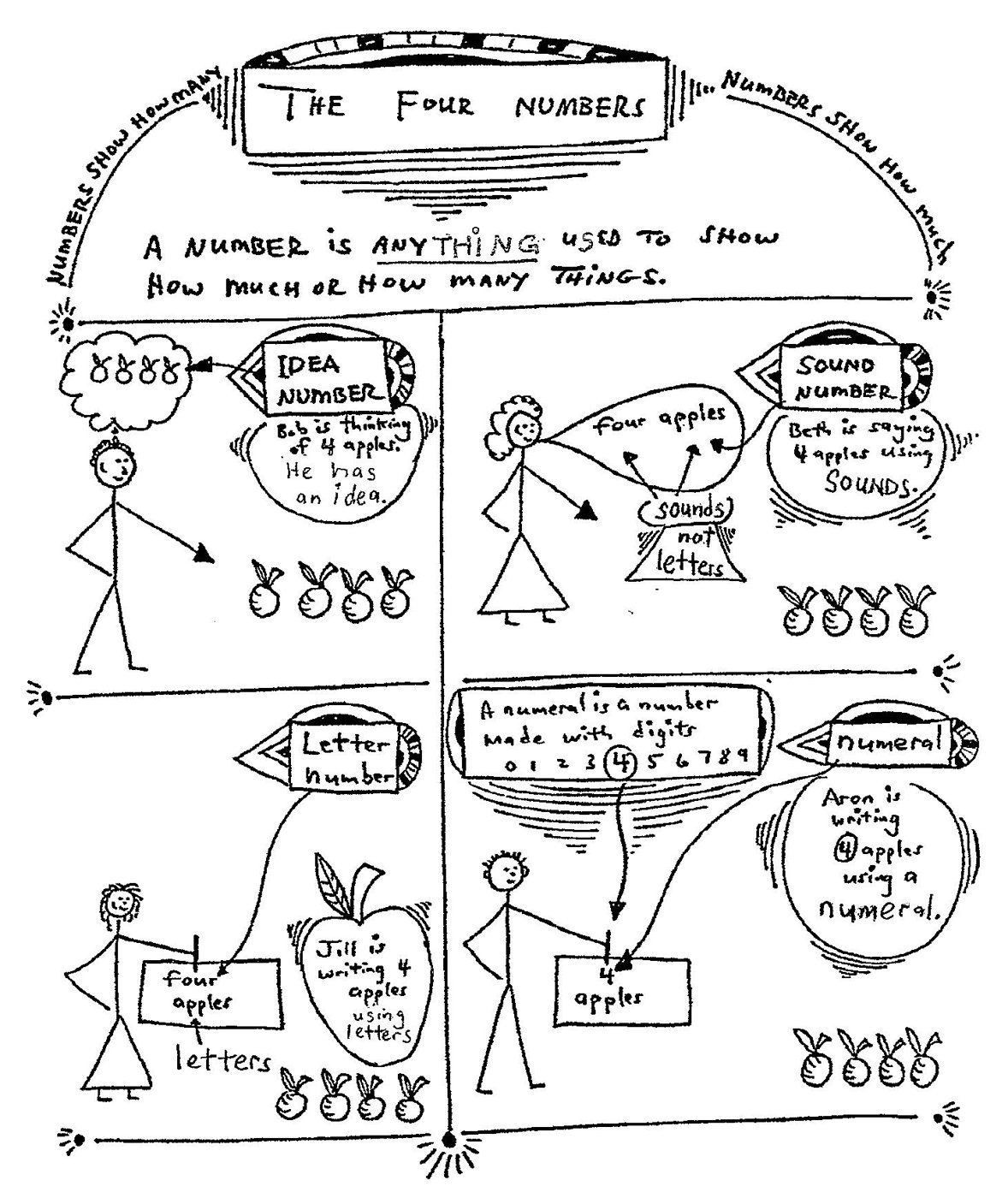
▒ DEFINITION OF “NUMBER”: A NUMBER IS ANYTHING (REALLY, ANYTHING!) THAT SHOWS HOW MUCH OR HOW MANY THINGS.
SENTENCE: IN 1ST GRADE, MOST STUDENTS LEARN TO SAY AND WRITE THE NUMBERS 1 TO 100 QUICKLY AND EASILY.
THE FOUR USUAL KINDS OF NUMBERS
Most of the time, we use these four kinds of numbers:
• Idea numbers (our ideas about how many)
• Sound numbers (made of speaking sounds)
• Letter numbers (made of letters)
• Numerals (made of digits)
Let’s study each of the four main kinds of numbers. We will start with “idea numbers.”
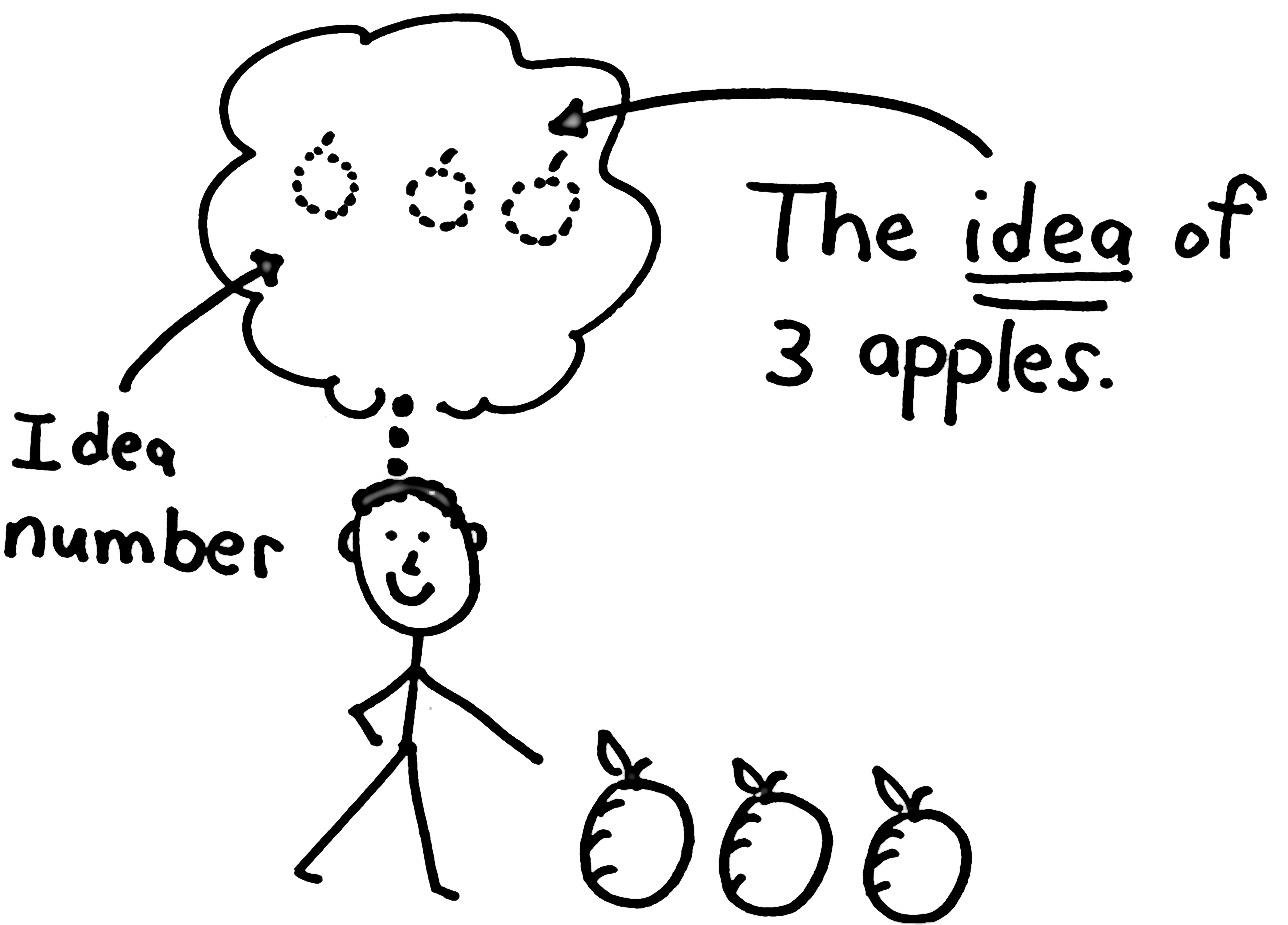
▒ DEFINITION OF “IDEA NUMBER”: YOU ARE USING IDEA NUMBERS WHEN YOU THINK ABOUT HOW MUCH OR HOW MANY THINGS. YOU ARE USING IDEA NUMBERS WHEN YOU HAVE YOUR OWN IDEAS OF HOW MUCH OR HOW MANY THINGS.
SENTENCE: WHEN BILLY LOOKED AT THE THREE APPLES, HE THOUGHT THE IDEA NUMBER “THREE.”
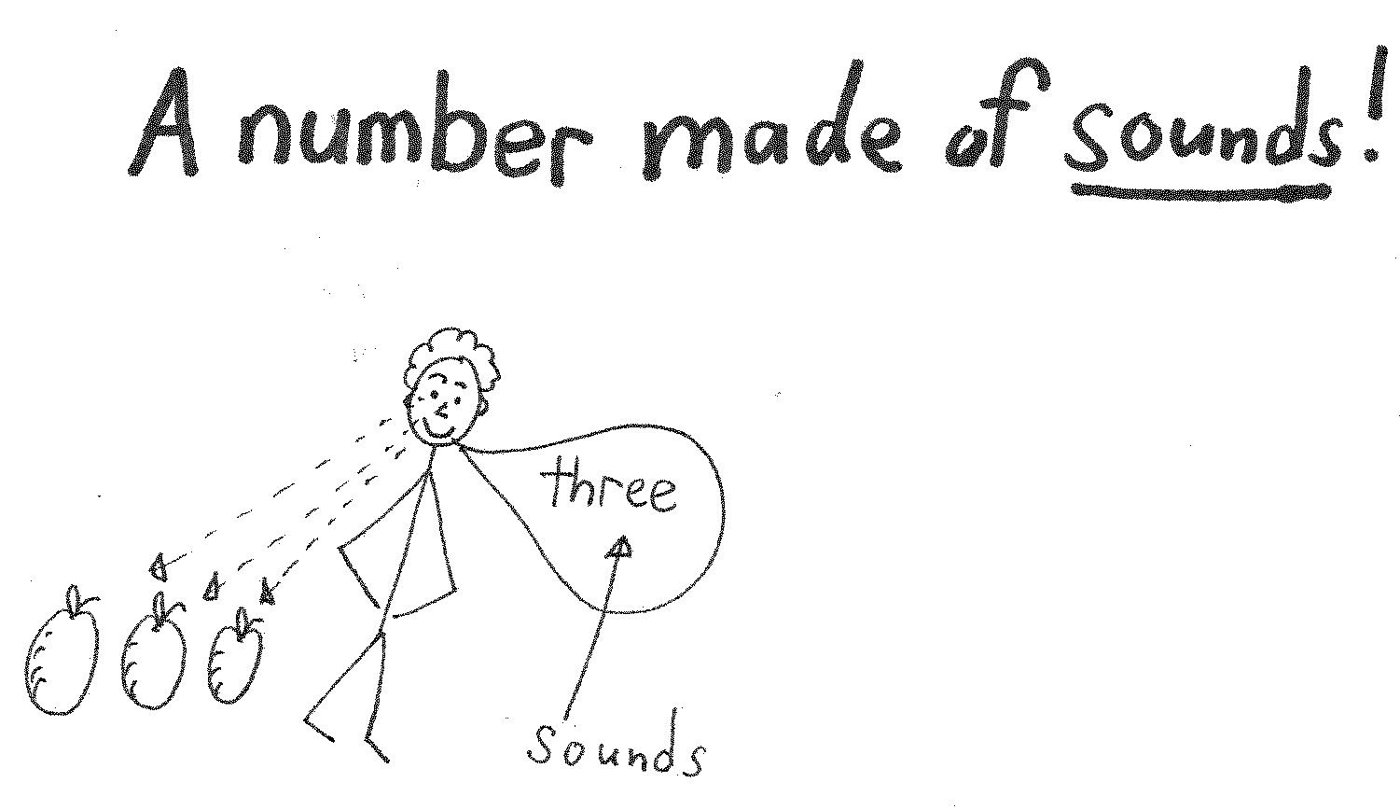
▒ DEFINITION OF “SOUND NUMBER”: SOME NUMBERS ARE MADE USING SPEAKING SOUNDS. WE USE SOUNDS TO COMMUNICATE OUR IDEAS OF HOW MANY. WE OPEN OUR MOUTHS AND MAKE SPECIAL SPEAKING SOUNDS.
SENTENCE: THE BOY SAID THE SOUND NUMBER “THREE” LOUDLY.
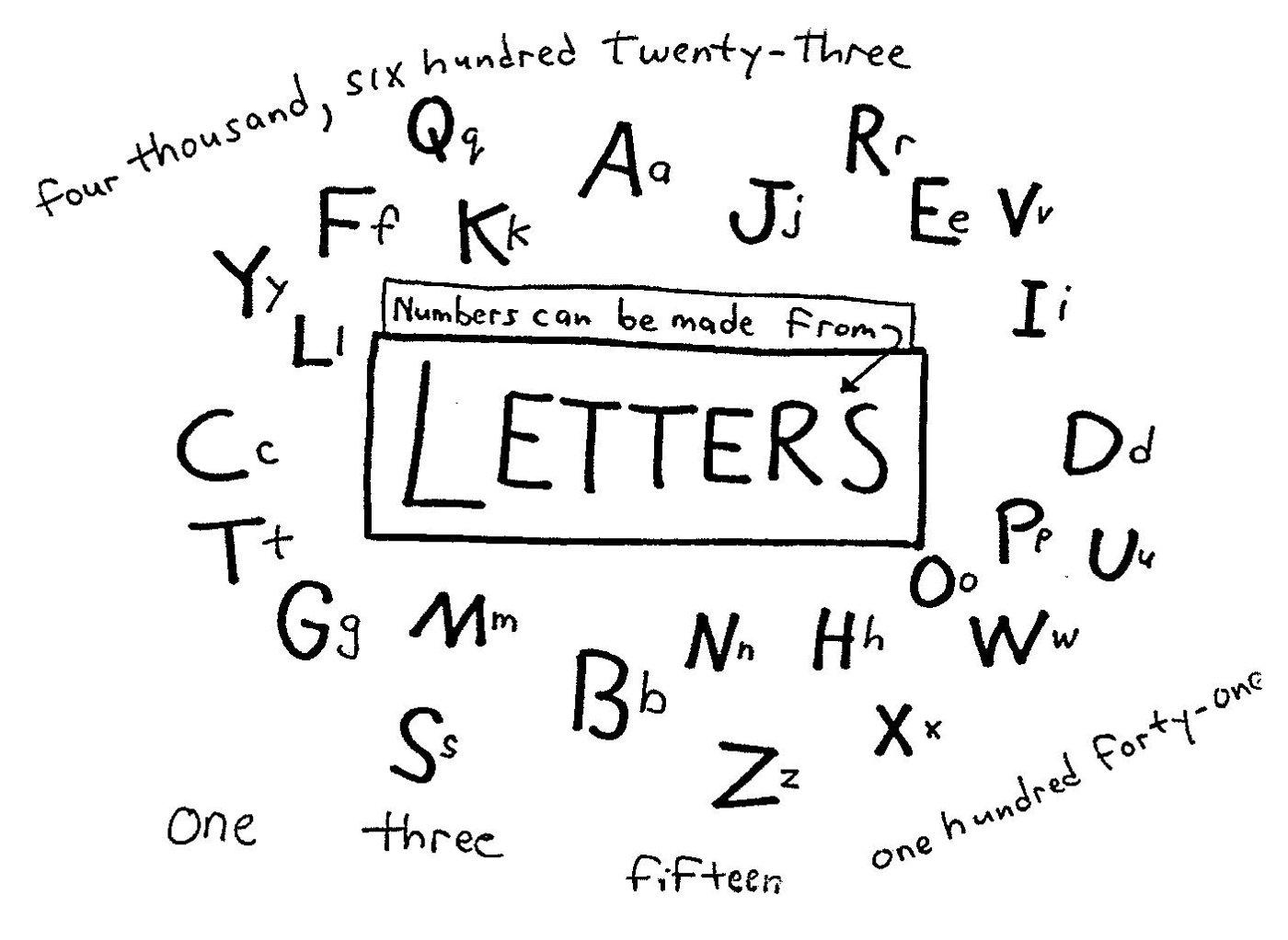
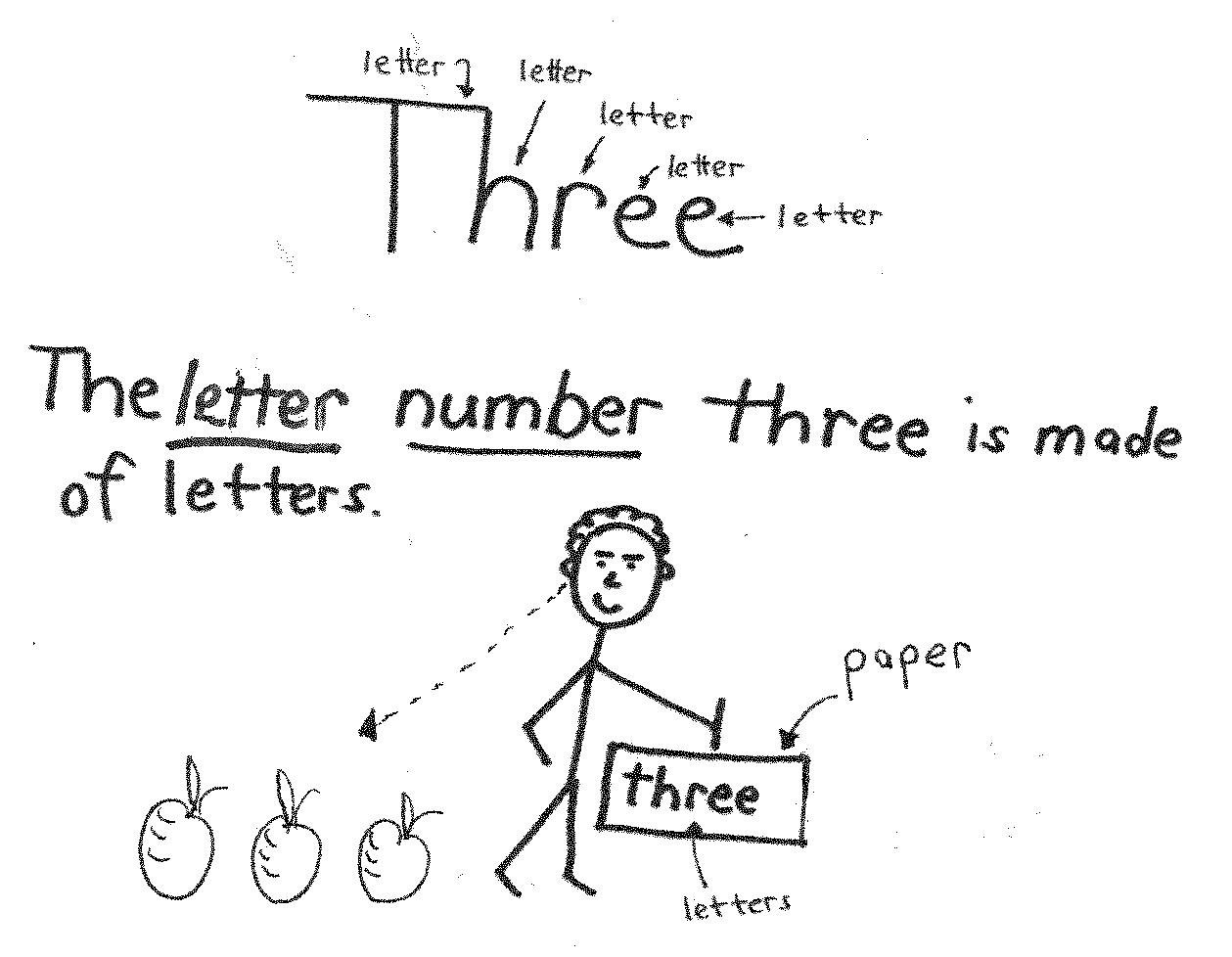
▒ DEFINITION OF “LETTER NUMBERS”: WRITTEN WORDS THAT TELL HOW MANY ARE ALSO NUMBERS. WE CALL THEM “LETTER NUMBERS” BECAUSE THEY ARE MADE OF LETTERS. LETTER NUMBERS SHOW HOW MUCH OR HOW MANY THINGS.
SENTENCE: ZERO, ONE, EIGHT, FIFTEEN, TWENTY-EIGHT, AND ONE HUNDRED FORTY-ONE ARE ALL LETTER NUMBERS.
SENTENCE: WHEN YOU WRITE THE LETTERS “T-E-N”, YOU HAVE WRITTEN A LETTER NUMBER.
▒ DEFINITION OF “DIGIT”: THE WRITTEN NUMBERS 0, 1, 2, 3, 4, 5, 6, 7, 8, 9 ARE THE DIGITS. DIGITS ARE USUALLY WRITTEN ON PAPER.
SENTENCE: THE TEN DIGITS ARE THE FIRST NUMBERS A STUDENT LEARNS IN KINDERGARTEN.
These ten numbers are called digits. The digits are ONLY these ten exact written numbers: 0, 1, 2, 3, 4, 5, 6, 7, 8, 9. We use these ten digits to write down how much or how many things.
THERE ARE NO OTHER DIGITS. NONE!
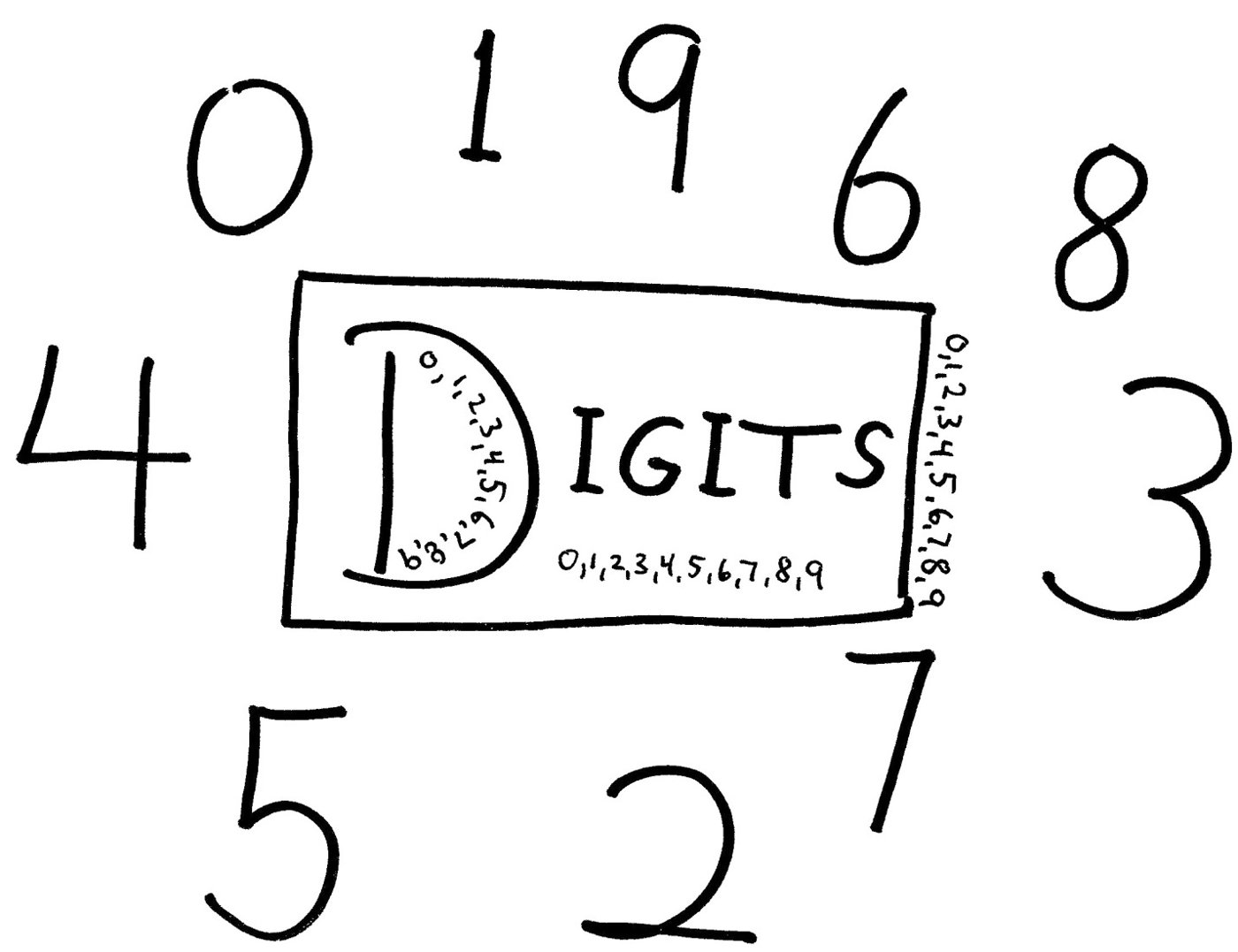
▒ DEFINITION OF “NUMERAL”: NUMERALS ARE THE NUMBERS MADE USING THE TEN SPECIAL LINE DRAWINGS WE CALL “DIGITS”: 0. 1, 2, 3, 4, 5, 6, 7, 8, 9. EXAMPLES: WE PUT THE DIGITS 2 AND 7 TOGETHER TO WRITE THE NUMERAL 27. WE PUT THE DIGITS 3, 6, AND 2 TOGETHER TO WRITE THE NUMERAL 362.
SENTENCE: NUMERALS ARE EASIER TO USE THAN LETTER NUMBERS WHEN SOLVING MATH PROBLEMS.
To make any numeral, no matter how big or small, we just combine the same ten digits in different ways. We use the same ten digits over and over and over again to make bigger and bigger numerals. Here are some different numerals:
0 1 3 15 75 160 423
9,204 14,600
REMEMBER,
A NUMBER IS
ANYTHING
THAT SHOWS
HOW MUCH OR
HOW MANY THINGS.
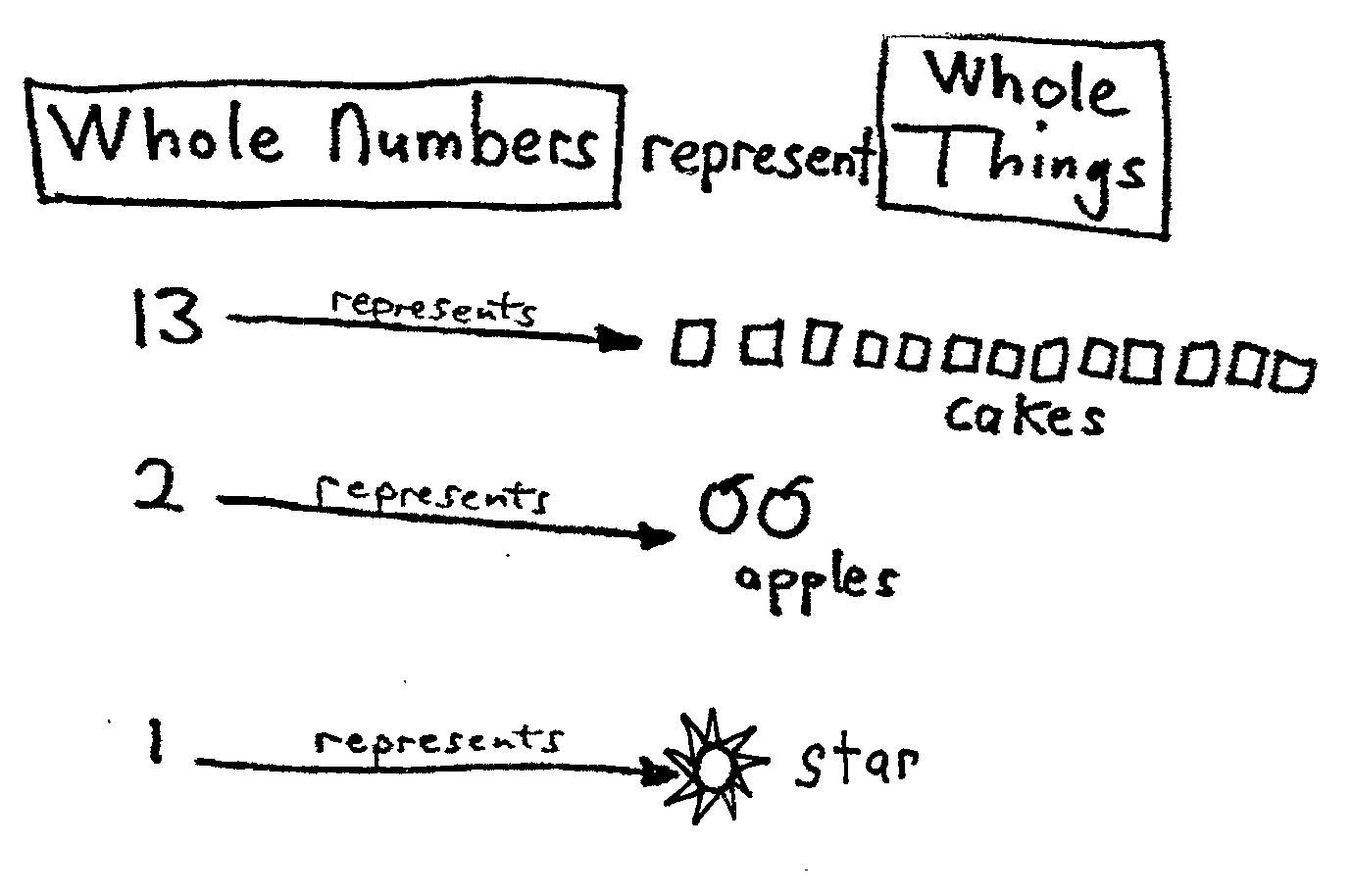
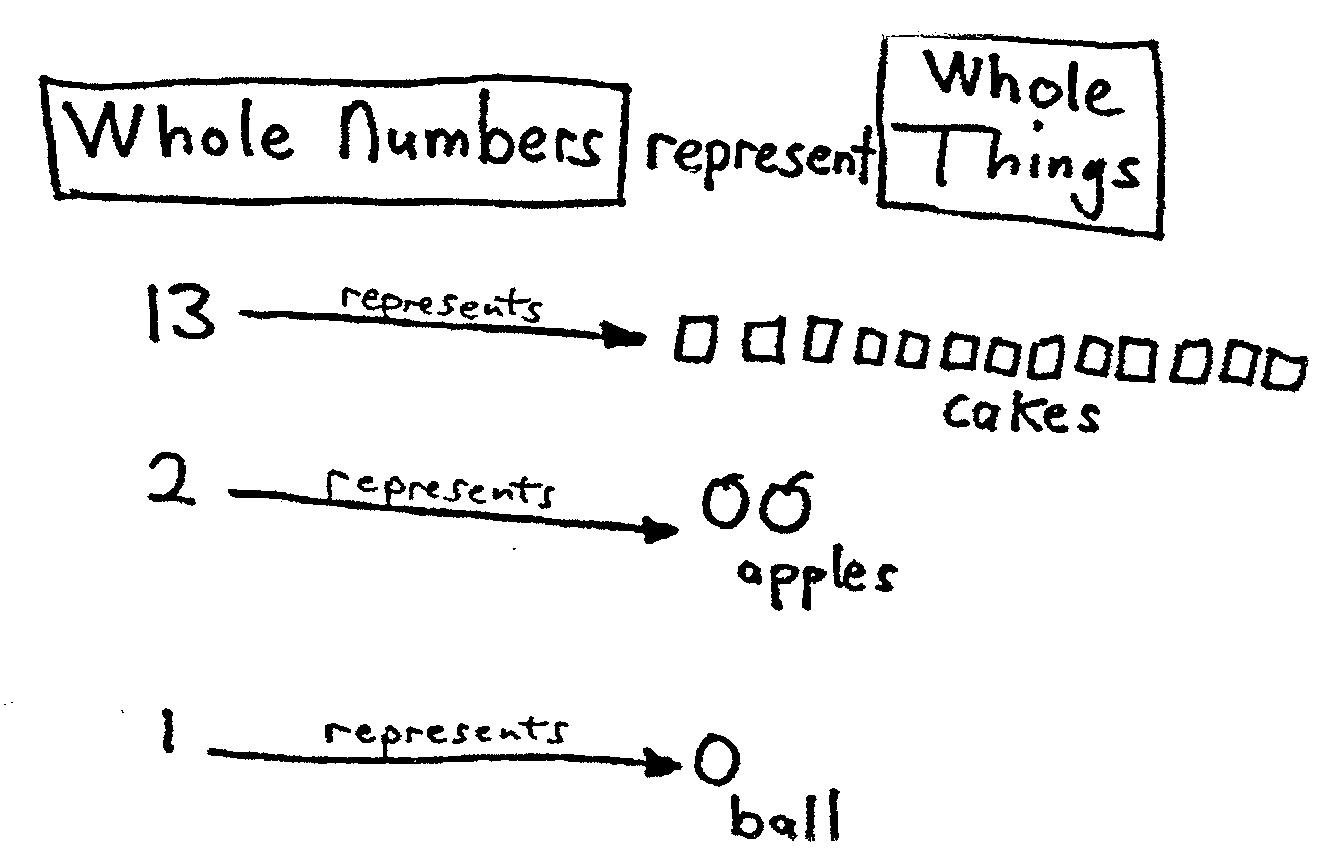
WHOLE THINGS NEED WHOLE NUMBERS
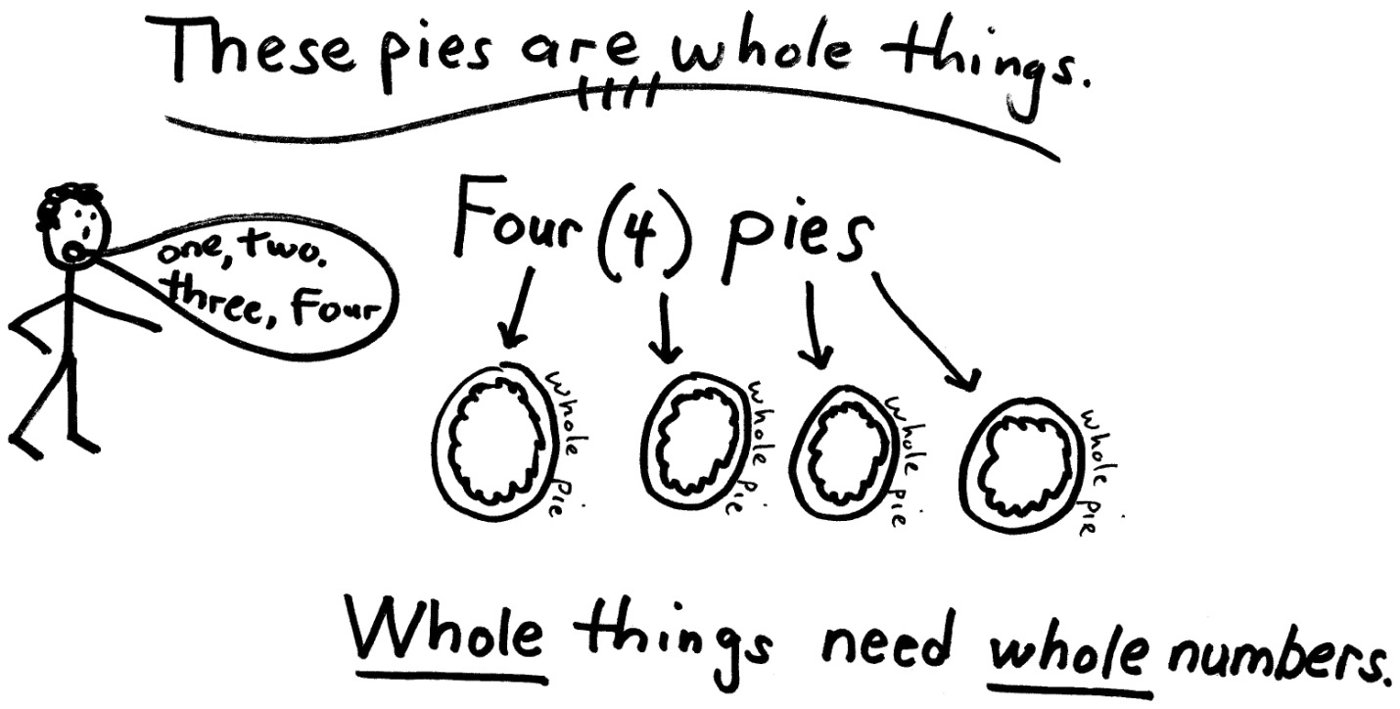
Some numbers show whole things.
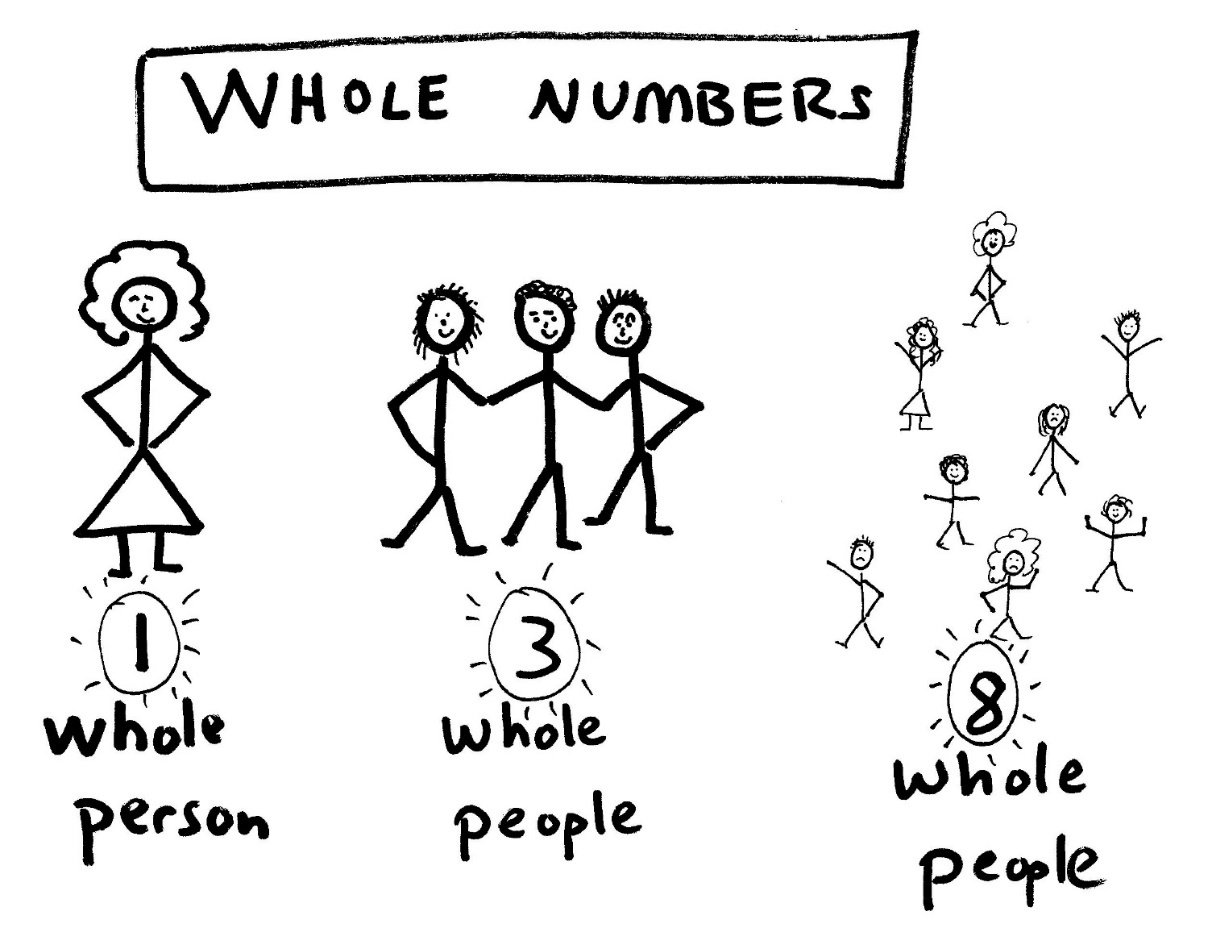
WHOLE NUMBERS
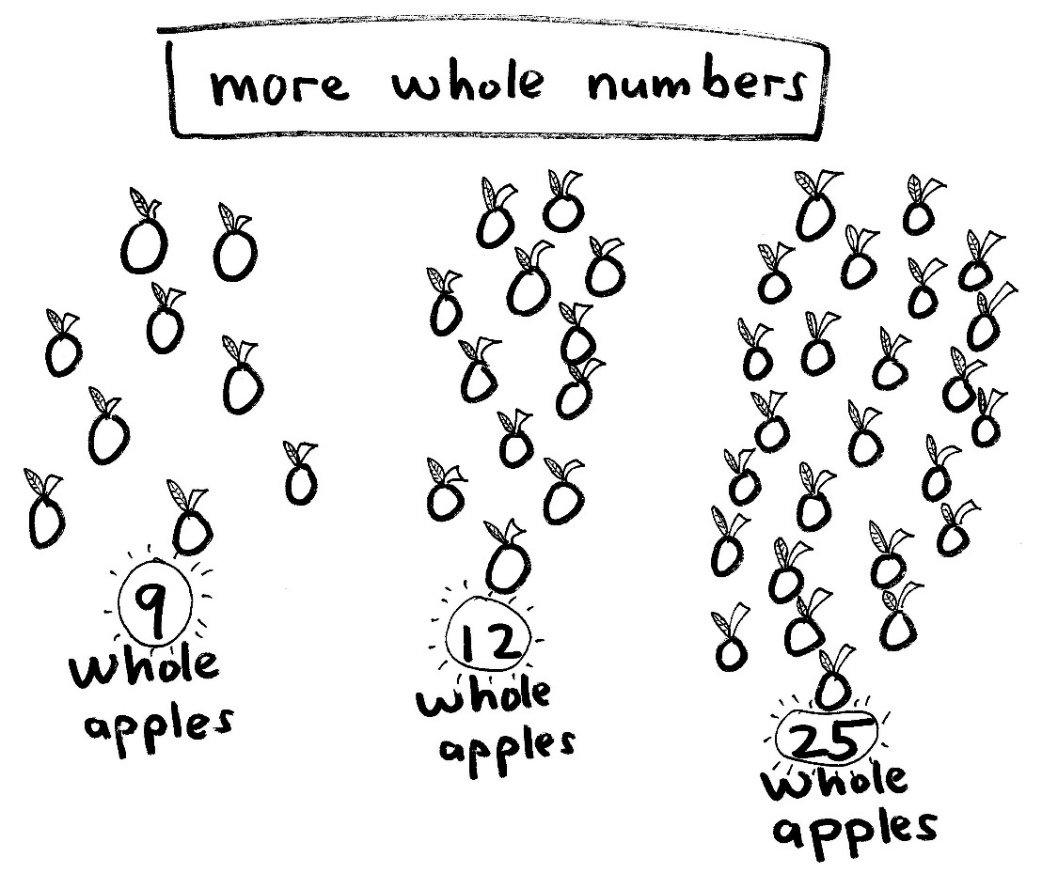
▒ DEFINITION OF “WHOLE NUMBER”: A WHOLE NUMBER IS A NUMBER THAT SHOWS HOW MANY WHOLE THINGS.
SENTENCE: THE NUMBER FOUR (4) IS A WHOLE NUMBER BECAUSE THE FOUR PIES ARE ALL WHOLE PIES.
The numerals 1 (dog), 4 (pies), 55 (kids), 620 (cows), 2,099 (planes), 43,800 (houses), and 181,225 (stars) are all whole numbers.
EQUAL PARTS AND FRACTIONS
WHEN A THING IS SEPARATED INTO EQUAL PARTS, WE CAN’T USE WHOLE NUMBERS TO TALK ABOUT HOW MANY THINGS. WHEN A THING IS SEPARATED INTO EQUAL PARTS, WE NEED TO USE ANOTHER KIND OF NUMBER TO THINK AND TALK ABOUT HOW MANY EQUAL PARTS: WE USE…
FRACTIONS
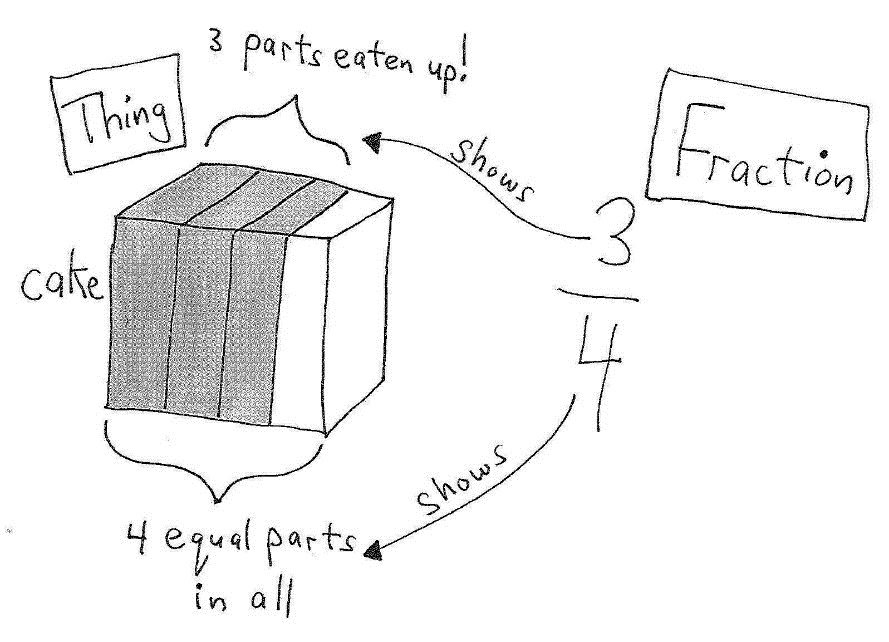
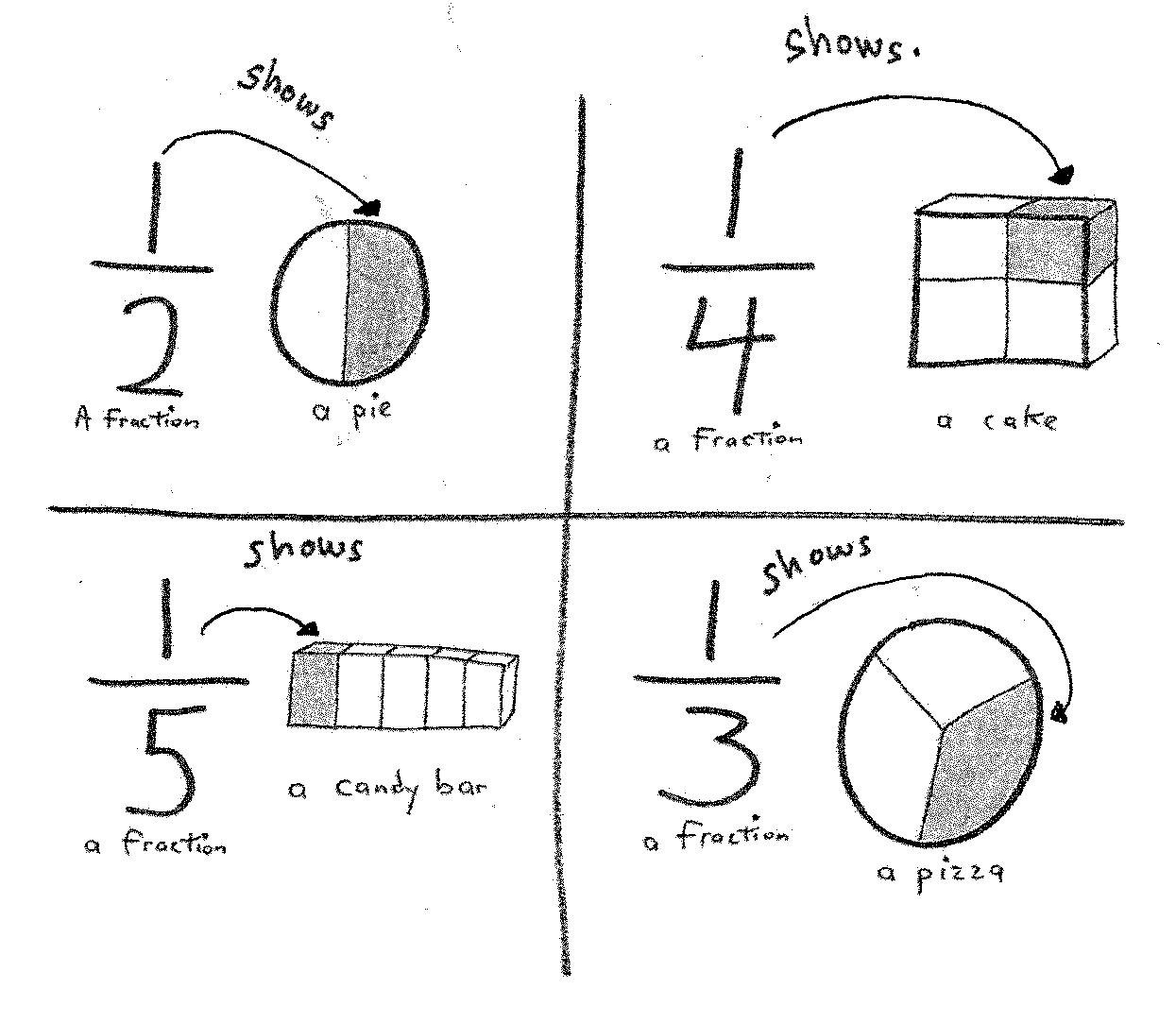
▒ DEFINITION OF A “FRACTION”: A FRACTION IS ANY NUMBER THAT SHOWS THE EQUAL PARTS OF SOMETHING.
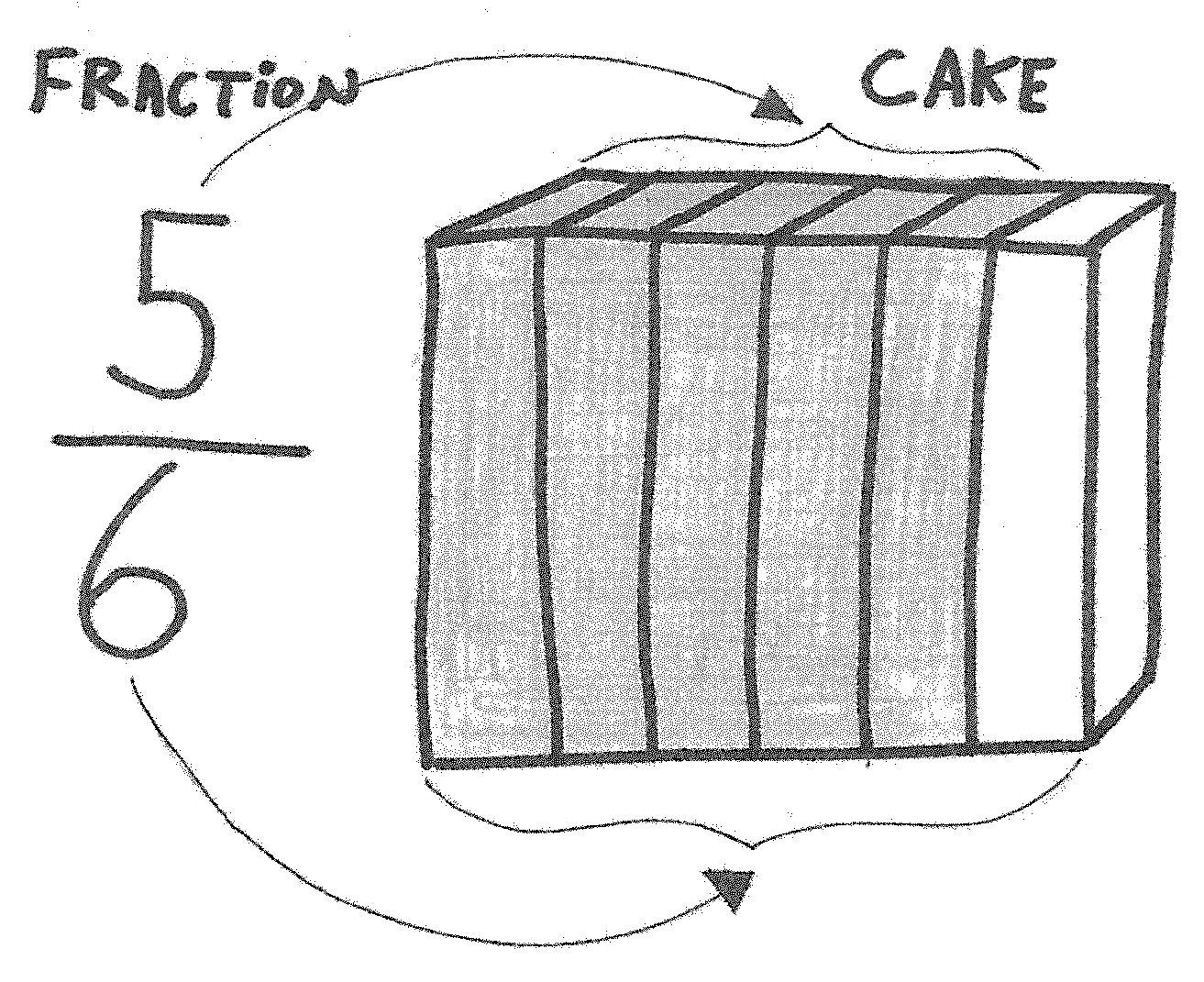
SENTENCE: THE FRACTION34 SHOWS A CAKE SEPARATED INTO 4 EQUAL PIECES WITH 3 PIECES EATEN UP!
FACT: FRACTIONS ARE NOT WHOLE NUMBERS.
● WHY ARE FRACTIONS NOT WHOLE NUMBERS?
● BECAUSE FRACTIONS DO NOT SHOW HOW MANY WHOLE THINGS.
● FRACTIONS SHOW EQUAL PARTS OF THINGS.
FRACTION OF A GROUP
Fractions are used to show the equal parts of single things separated into equal parts.
FRACTIONS ARE ALSO USED TO SHOW THE EQUAL PARTS OF GROUPS OF THINGS.
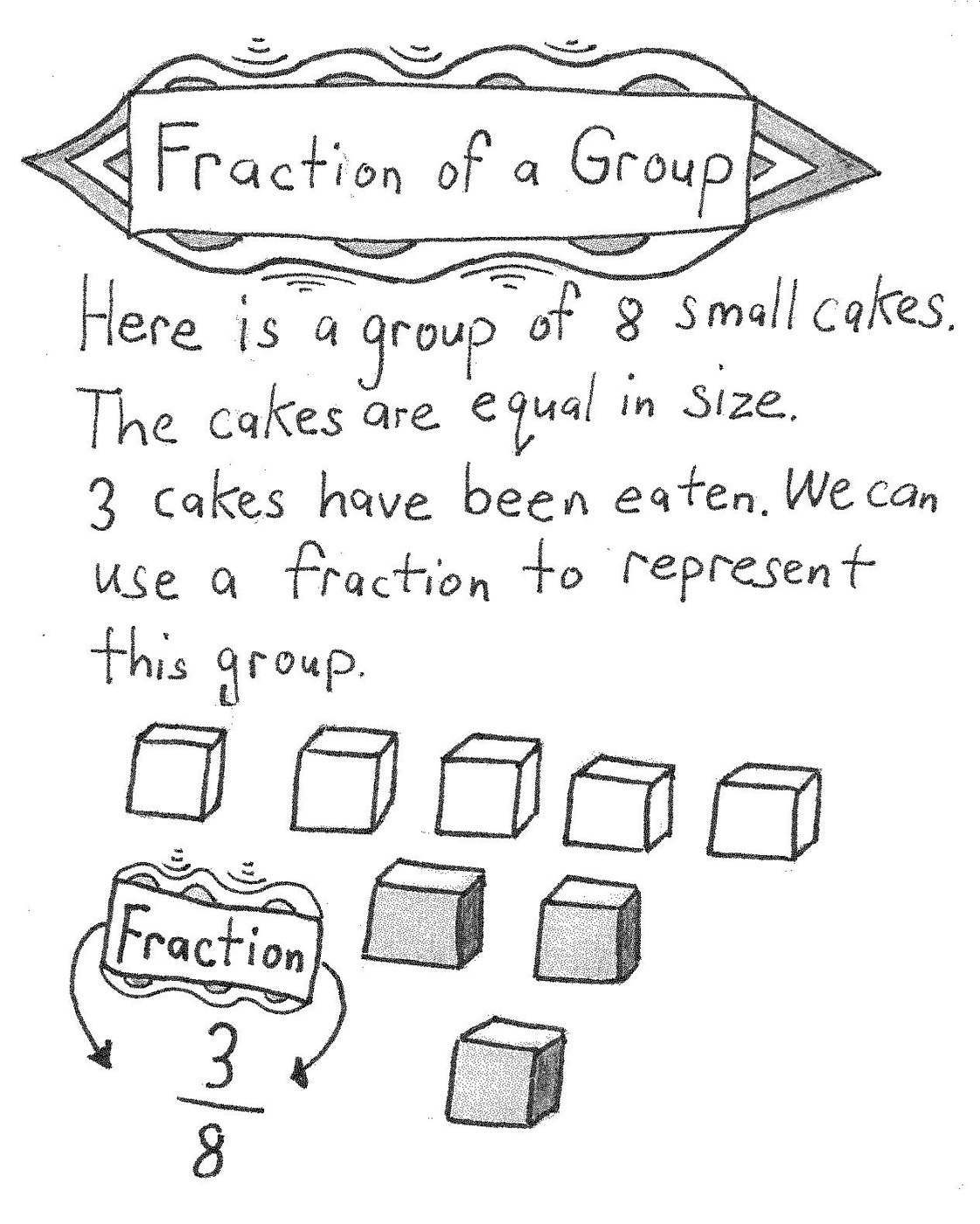
▒ DEFINITION OF “FRACTION OF A GROUP”: A FRACTION IS A NUMBER THAT SHOWS THE EQUAL PARTS OF A GROUP OF THINGS.
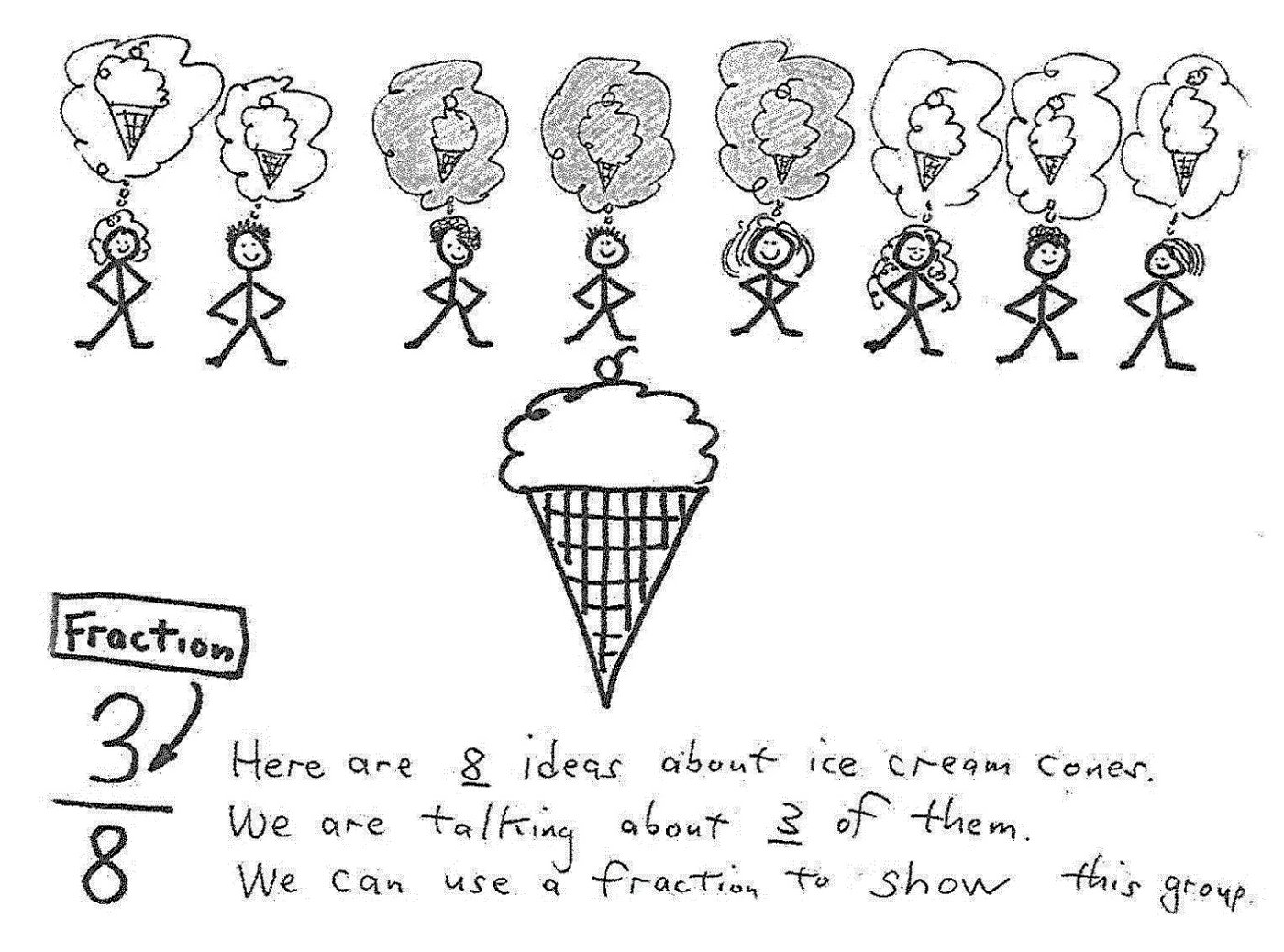
SENTENCE: THE FRACTION 38 SHOWS WE ARE TALKING ABOUT 3 OF THE GROUP OF 8 SMALL CAKES.
The following definition combines two ideas:
(1) Fractions that show equal parts of a single thing
(2) Fractions that show equal parts of a group of things
▒ DEFINITION OF “FRACTION”: A FRACTION IS ANY NUMBER THAT SHOWS THE EQUAL PARTS OF A SINGLE THING OR THE EQUAL PARTS OF A GROUP OF THINGS.
A FRACTION SHOWS (1) THE TOTAL NUMBER OF EQUAL PARTS (2) AND HOW MANY EQUAL PARTS ARE EATEN OR USED OR TALKED ABOUT.
SENTENCE: FRACTIONS CAN SHOW THE EQUAL PARTS OF A GROUP OF SMALL CAKES SEPARATED INTO EIGHT EQUAL PARTS.
SENTENCE: FRACTIONS CAN SHOW A SINGLE CAKE SEPARATED INTO FOUR EQUAL PARTS.
Now we have two useful definitions of the word “fraction”:
▒ A FRACTION IS A NUMBER THAT SHOWS A SINGLE THING SEPARATED INTO EQUAL PARTS.
▒ A FRACTION IS ALSO A NUMBER THAT SHOWS A GROUP OF THINGS SEPARATED INTO EQUAL PARTS.
These next two pictures show the two kinds of fractions:
A SINGLE CAKE SEPARATED INTO EQUAL PARTS:
HERE IS A GROUP OF 8 HUNGRY BOYS. THE BOYS SEE AN ICE CREAM CONE. EACH BOY GETS AN IDEA OF AN ICE CREAM CONE.
THREE OF THE BOYS REALLY WANT AN ICE CREAM CONE.
THE WORD “REPRESENT”
The word “represent” can help us gain a better understanding of fractions.
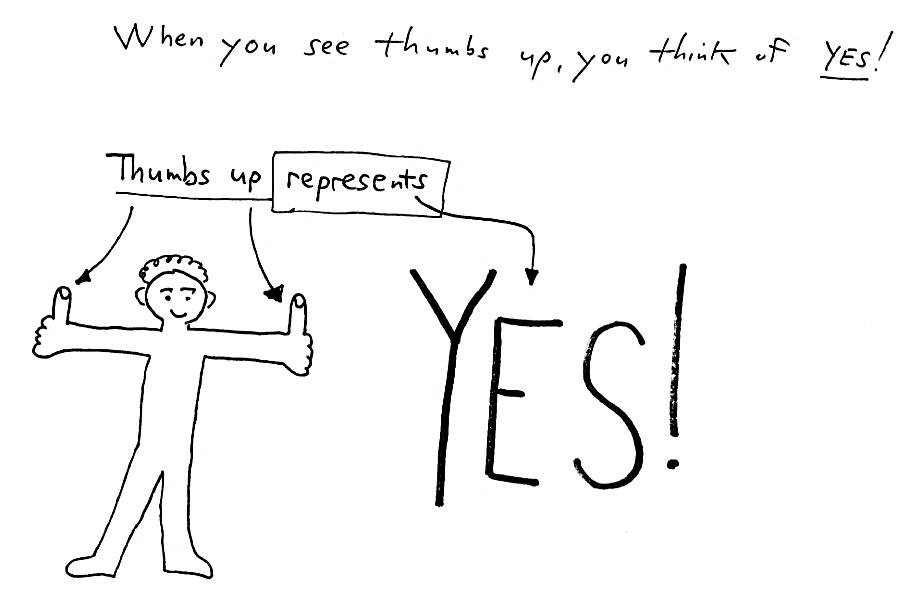
▒ DEFINITION OF “REPRESENT”: WHEN ONE THING REPRESENTS ANOTHER THING, IT SHOWS THAT OTHER THING.
SENTENCE: WHEN WE SEE THE AMERICAN FLAG, WE THINK OF AMERICA BECAUSE THE AMERICAN FLAG REPRESENTS THE REAL AMERICA – THE PHYSICAL UNIVERSE AMERICA, THE LAND, ITS PEOPLE, LAKES, MOUNTAINS, CITIES, SCHOOLS, ETC.
We know that the flag is just a small thing made of cloth with a design of stars and stripes on it. People from America use their flag to remind themselves of their country. The cloth flag represents the real country of America. Is the flag America? No. But we think of the real America when we see the flag.
Another example: When you want to communicate the idea that something is really good, you can point one or two thumbs up. The thumb (or thumbs) pointed up represents the idea that “It’s good!” or “I like it!” You don’t even have to say anything! All you have to do is point one or two thumbs up and the other person will understand that you really liked something.
One or two thumbs pointed up represent the idea of “It’s good!”
Let’s use the word “represent” in the definition of a fraction:
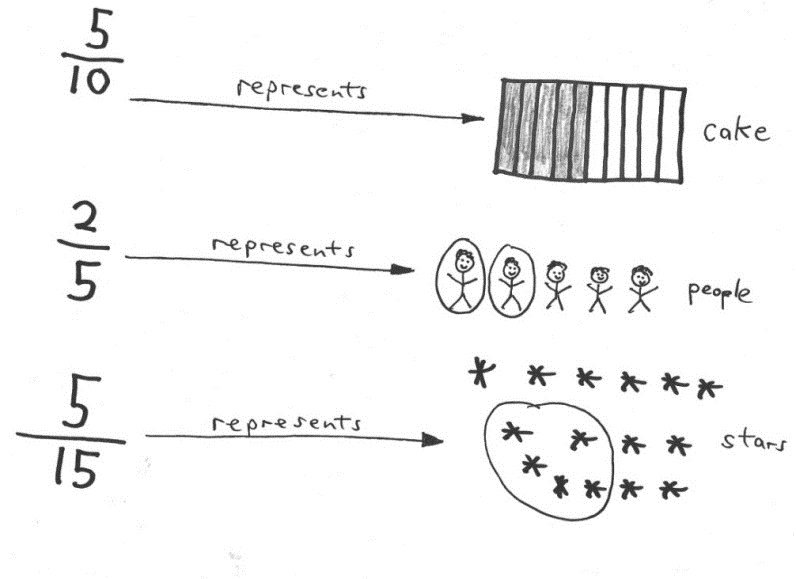
HERE IS A MORE COMPLETE DEFINITION OF FRACTION: A FRACTION IS ANY NUMBER THAT REPRESENTS THE EQUAL PARTS OF A THING OR A GROUP OF THINGS. A FRACTION SHOWS (1) THE TOTAL NUMBER OF EQUAL PARTS (2) AND HOW MANY EQUAL PARTS ARE EATEN OR USED OR TALKED ABOUT.
SENTENCE: A FRACTION CAN BE USED TO REPRESENT THE EQUAL PARTS OF A CAKE SEPARATED INTO 10 EQUAL PARTS.
THE MISSING WORD
There is a missing word in both the English language and the language of mathematics. THERE IS NO NAME FOR THE EQUAL PARTS OF THE REAL THING OR GROUP OF REAL THINGS THAT A FRACTION SHOWS.
THERE IS A MISSING WORD IN THE LANGUAGE OF MATH!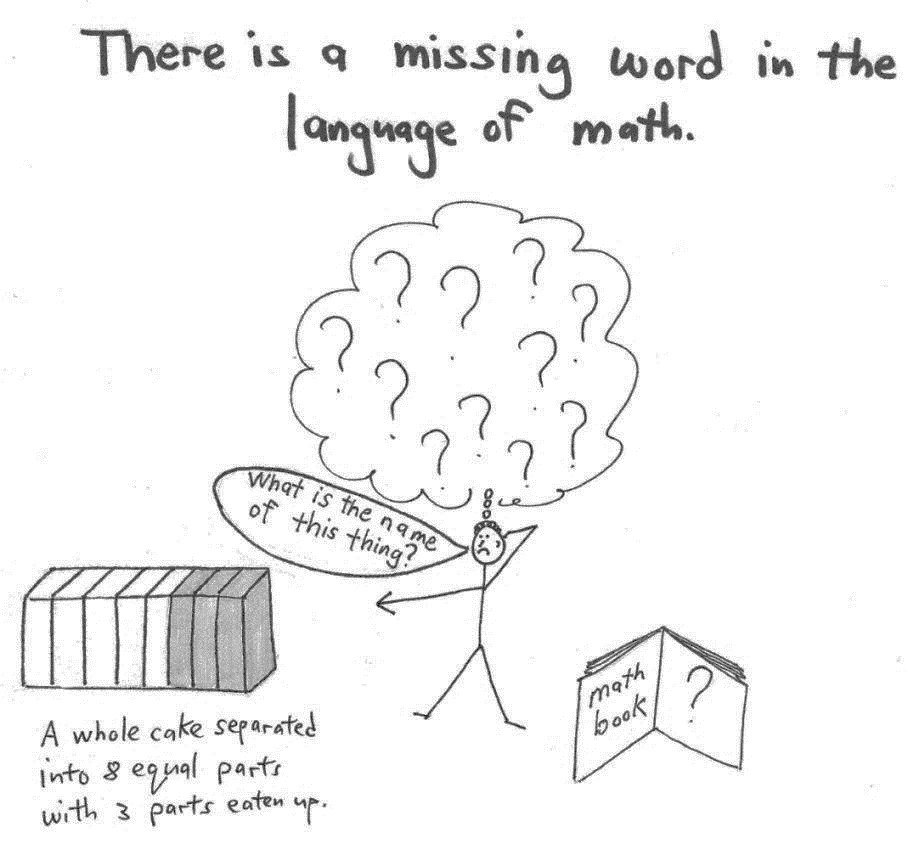
THERE IS A MISSING WORD IN THE LANGUAGE OF MATH…
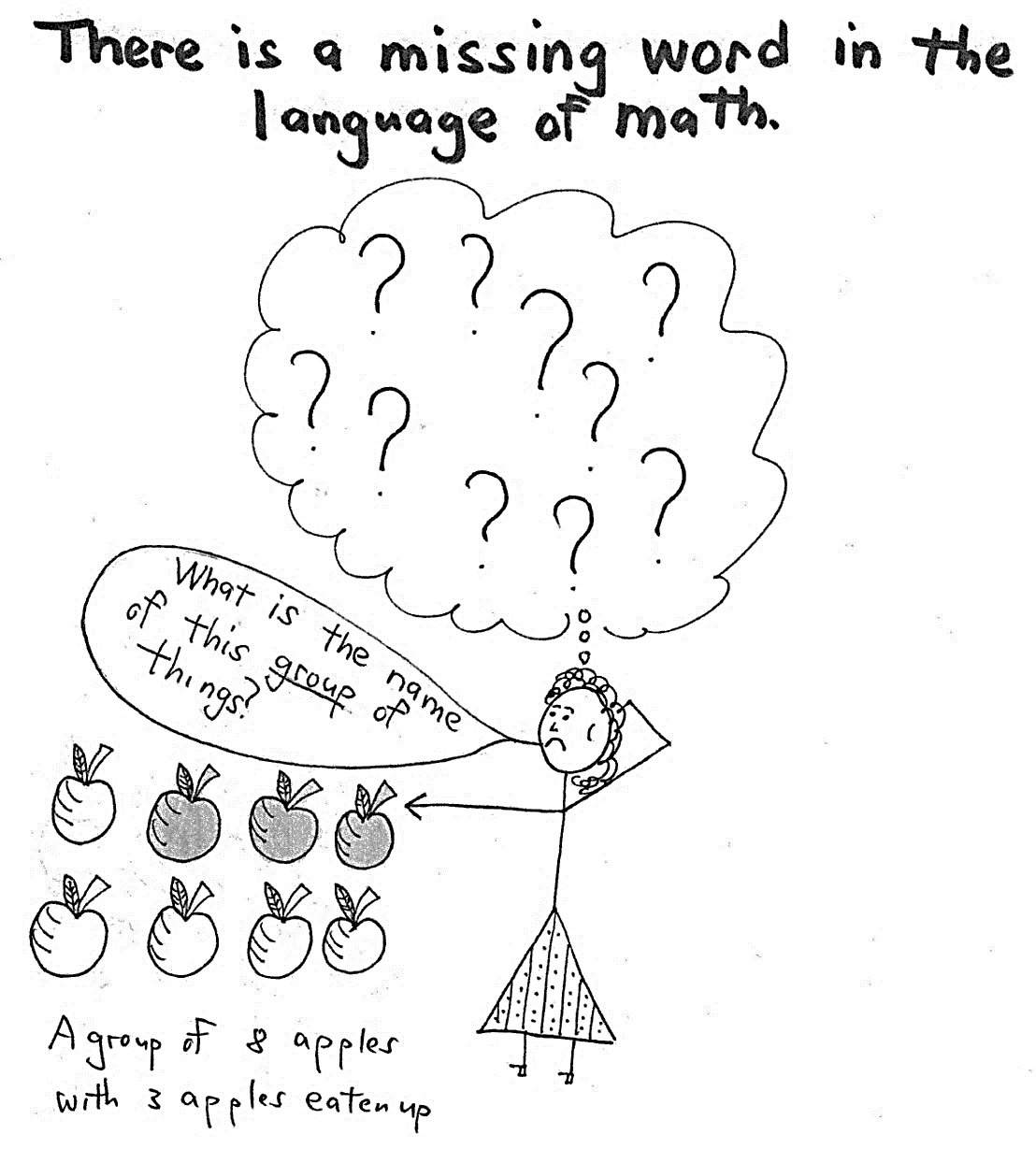
A fraction is a special number. We remember that a fraction is a number that represents the equal parts of a single thing or the equal parts of a group of things.
NOW, WHAT MIGHT BE A GOOD NAME FOR THE THING AND ITS EQUAL PARTS THAT A FRACTION REPRESENTS?
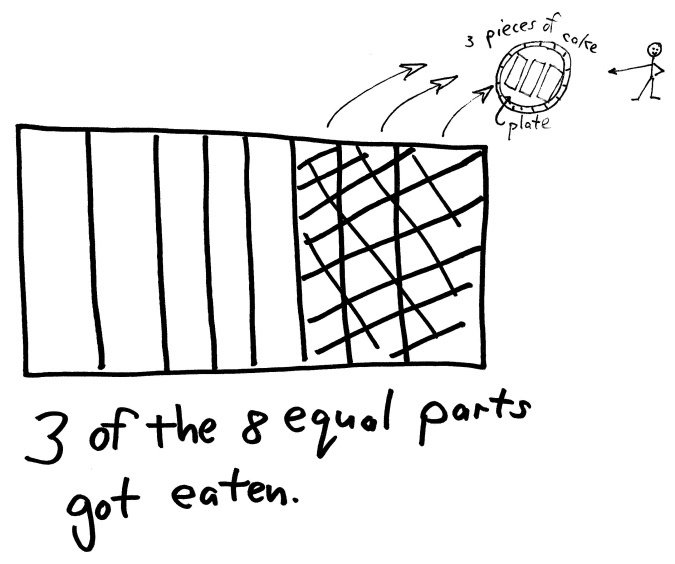
Let’s give a simple name to the thing that a math fraction represents. Let’s give a name that is easy to remember. Let’s use a name that fits. Let’s call it a…
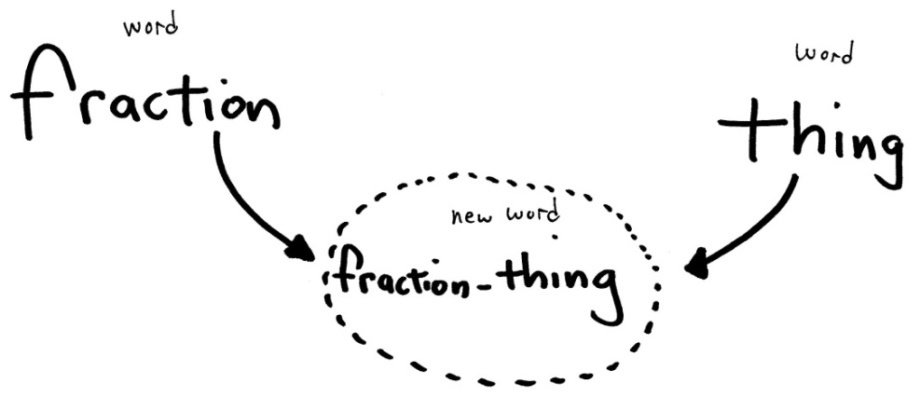
FRACTION-THING!
“FRACTION-THING” is simple and easy to remember.
But why is there a little line between the words “fraction” and “thing?” The line makes two words into one word.
▒ DEFINITION OF “FRACTION-THING”: A “FRACTION-THING” IS THE REAL THING THAT THE FRACTION REPRESENTS.
● THE FRACTION-THING INCLUDES ALL THE EQUAL PARTS OF THE REAL THING
● PLUS THOSE EQUAL PARTS OF THE REAL THING WE ARE TALKING ABOUT.
SENTENCE: THE FRACTION 38 SHOWS A FRACTION-THING (A CAKE) SEPARATED INTO 8 EQUAL PARTS WITH 3 PARTS EATEN UP!
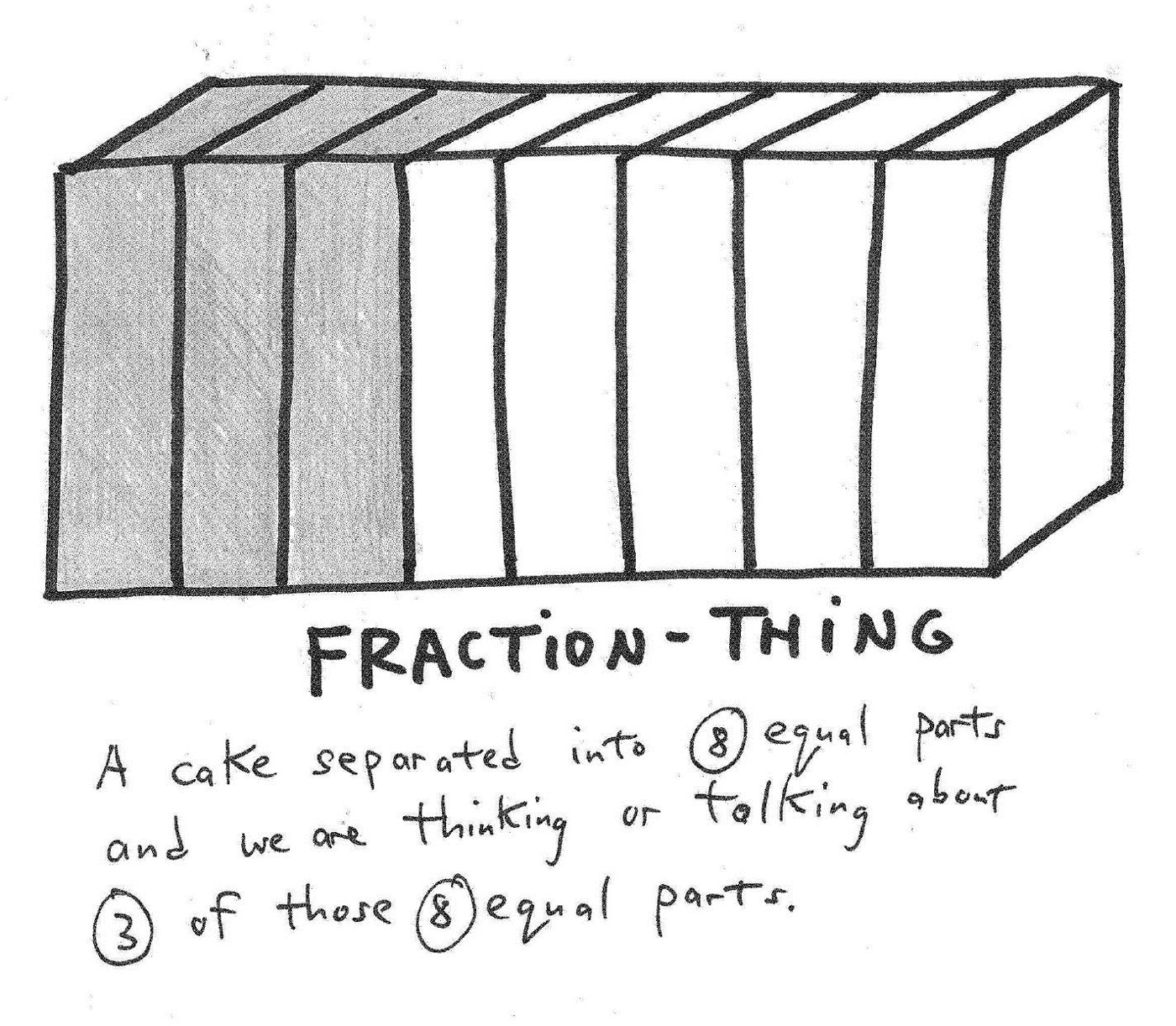
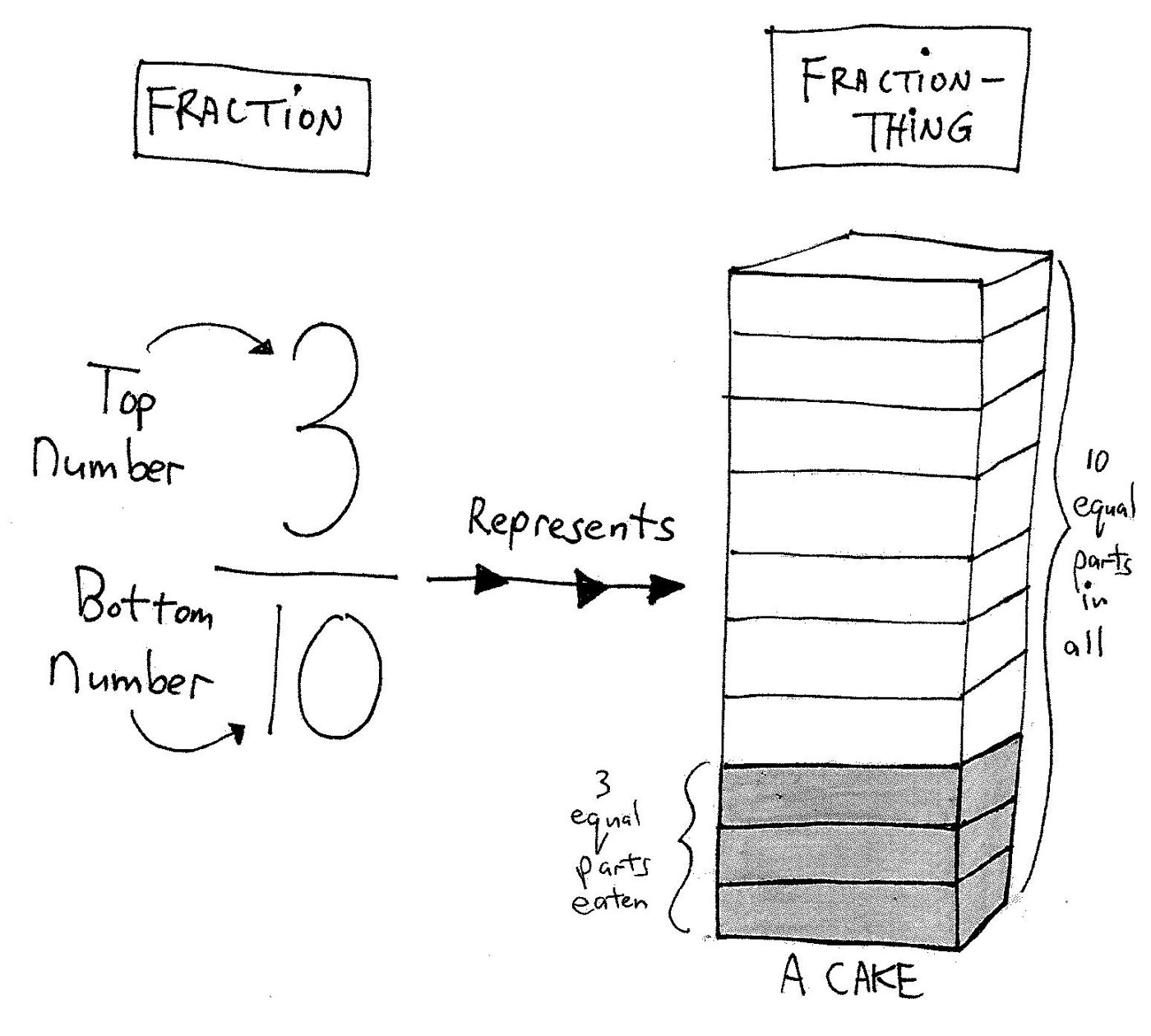
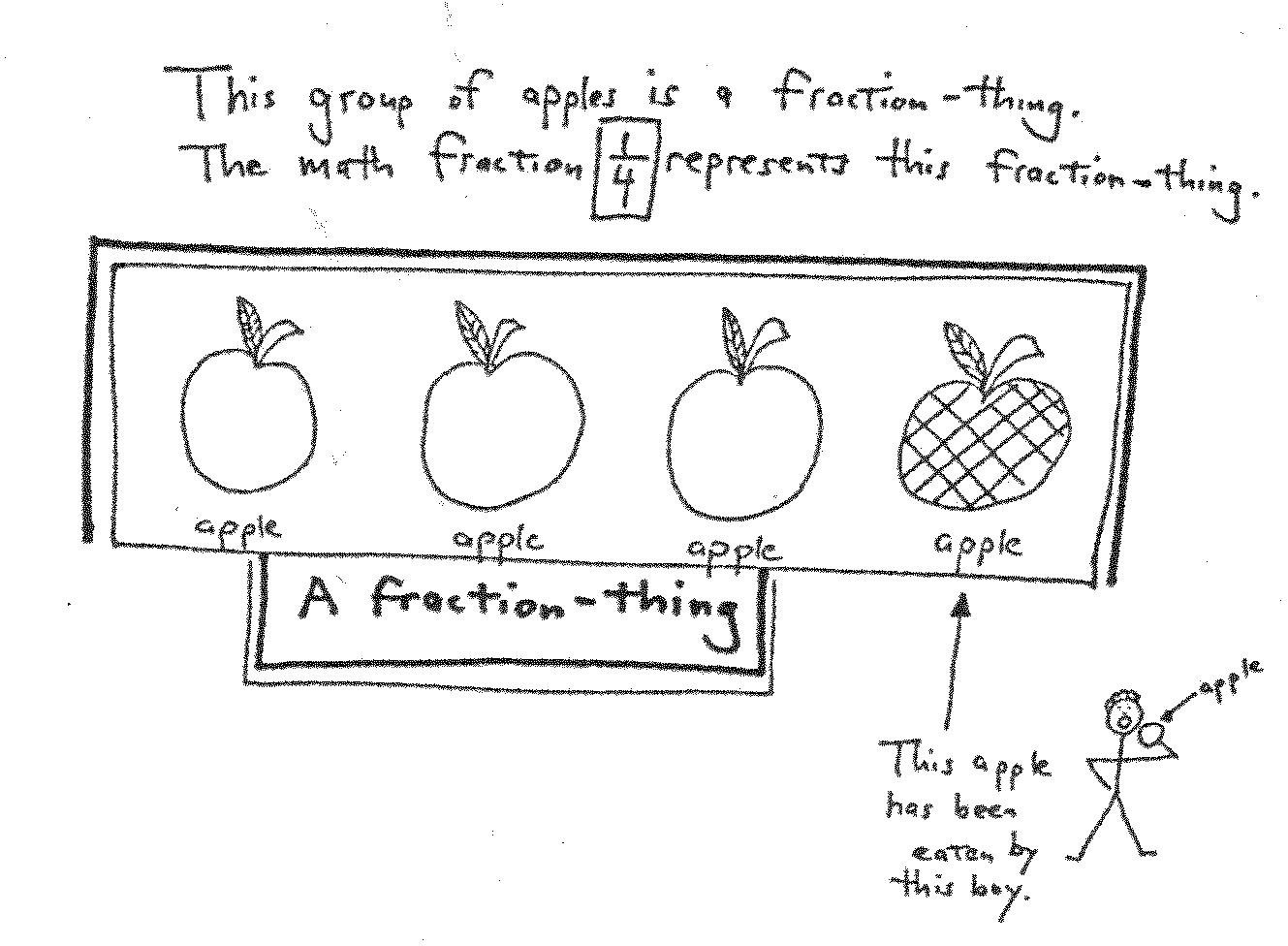
So, the fraction-thing includes all the equal parts of the real thing plus the specific equal parts we are talking about.
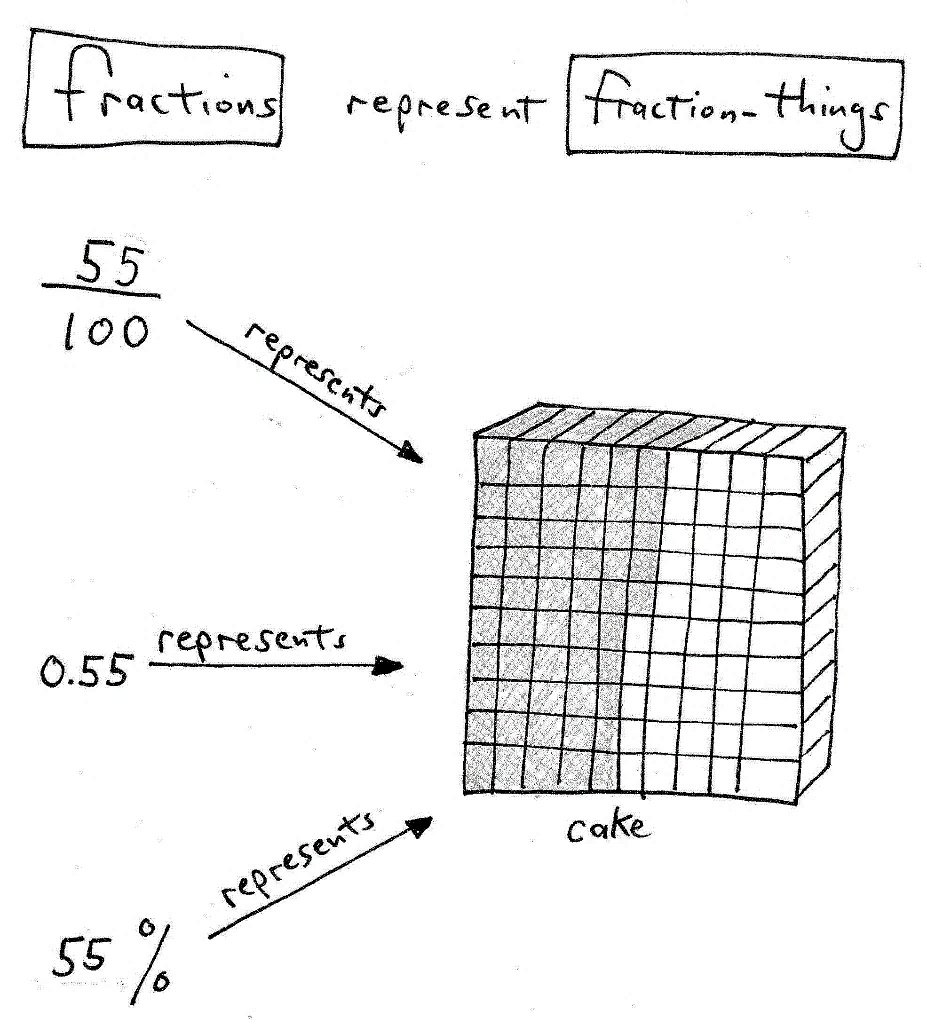
WHOLE NUMBERS REPRESENT WHOLE THINGS
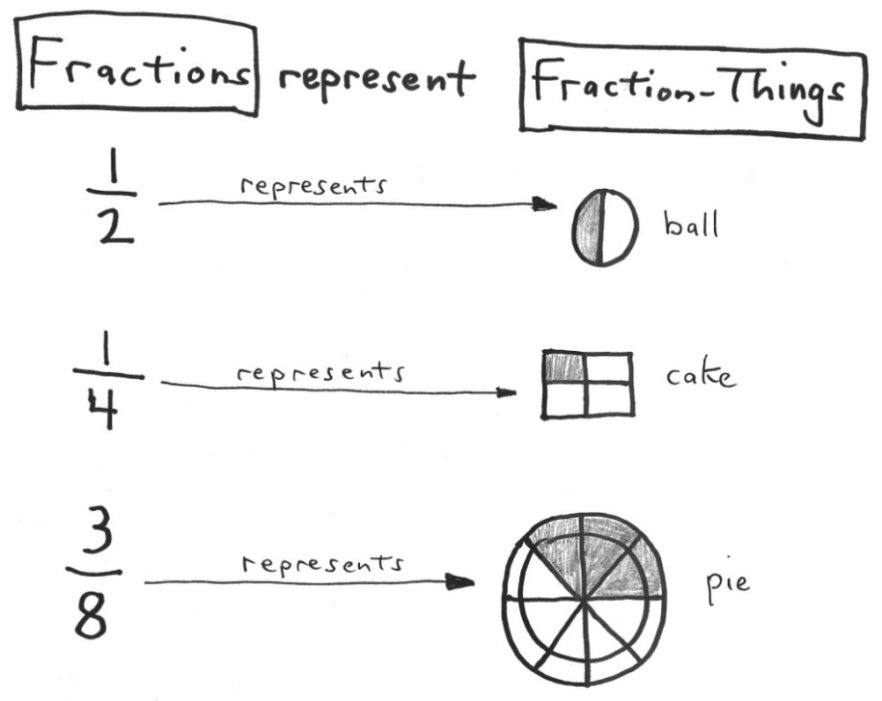
FRACTIONS REPRESENT FRACTION-THINGS
THREE KINDS FRACTIONS
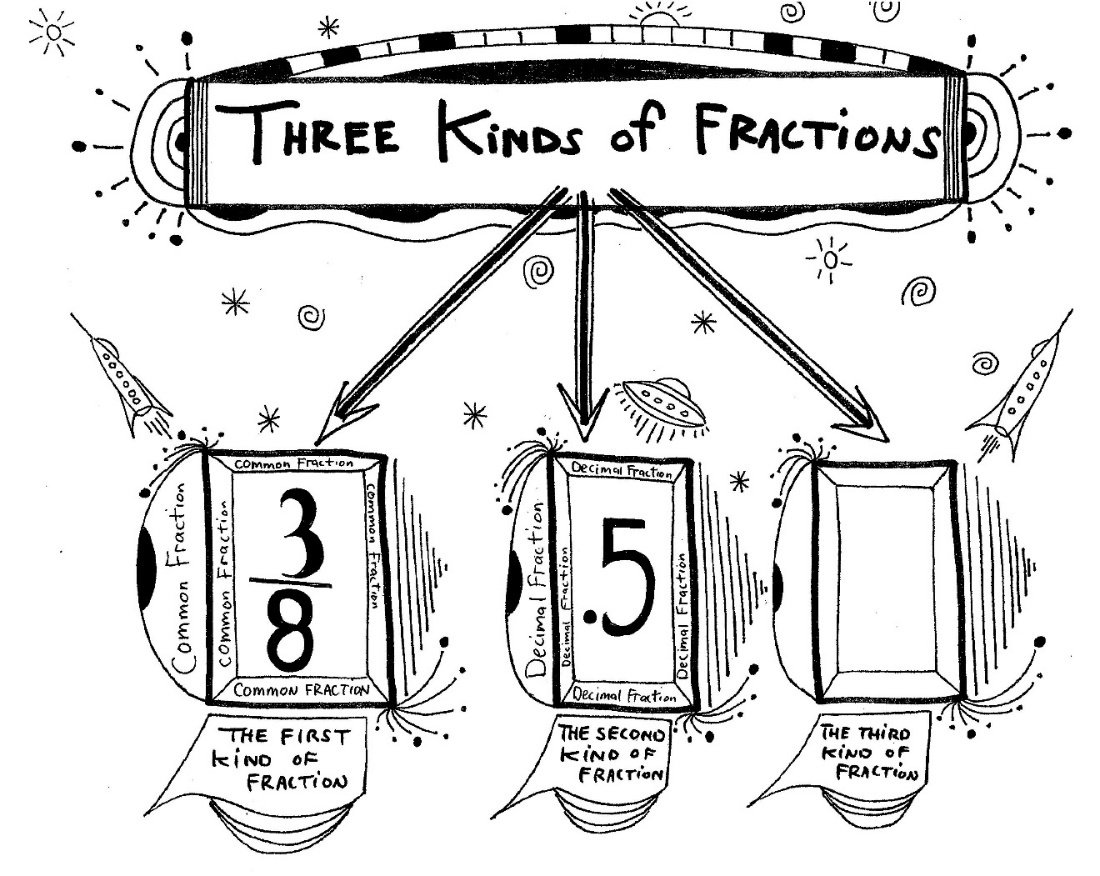
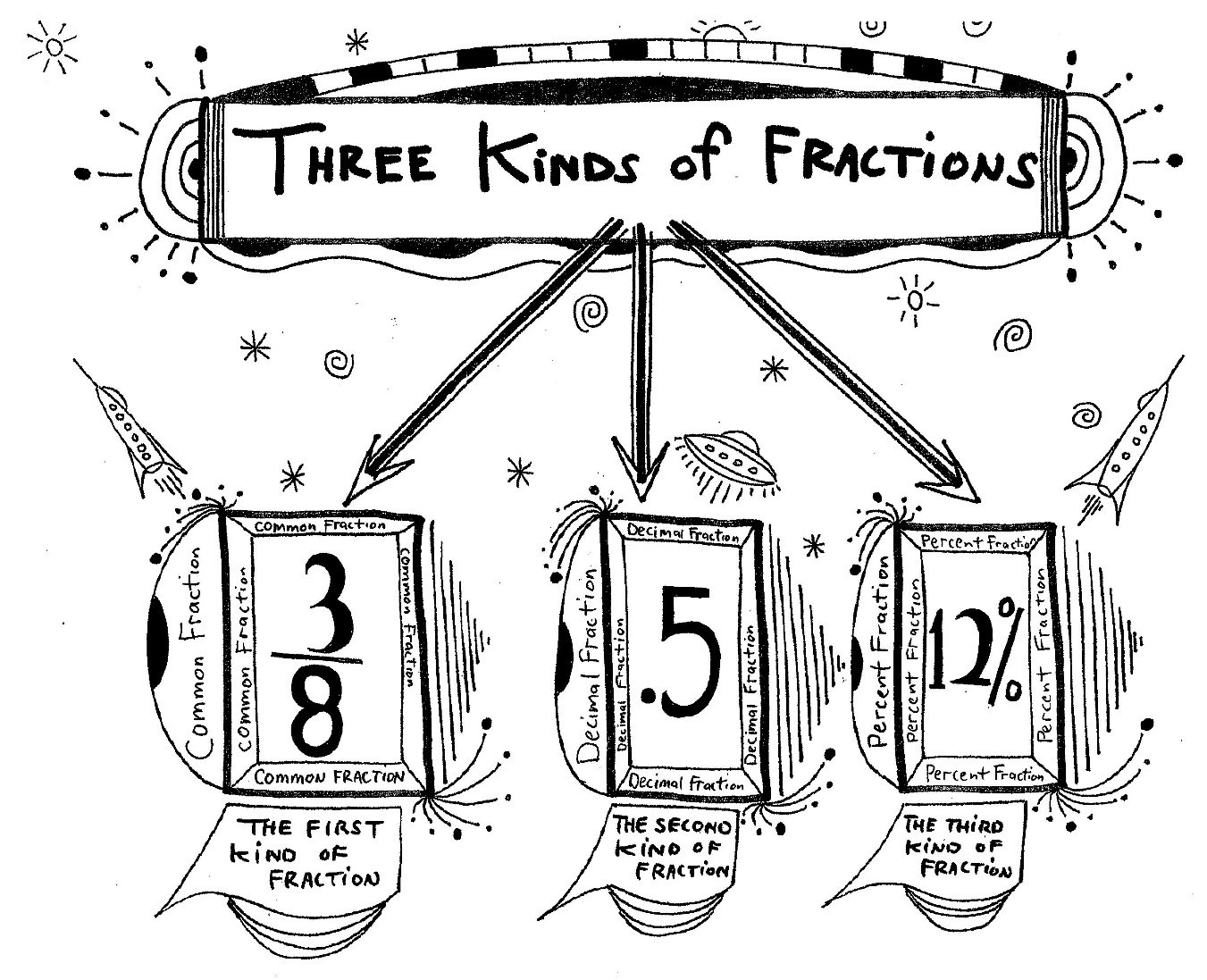
There are actually THREE different kinds of math fractions. You learn about two kinds of fractions in 3rd grade. You learn about the third kind of fraction in 5th grade.
The fraction with a top number, a bottom number, and a line between them is only one of the three kinds of fractions.
Here is the full and correct name of the first kind of fraction.
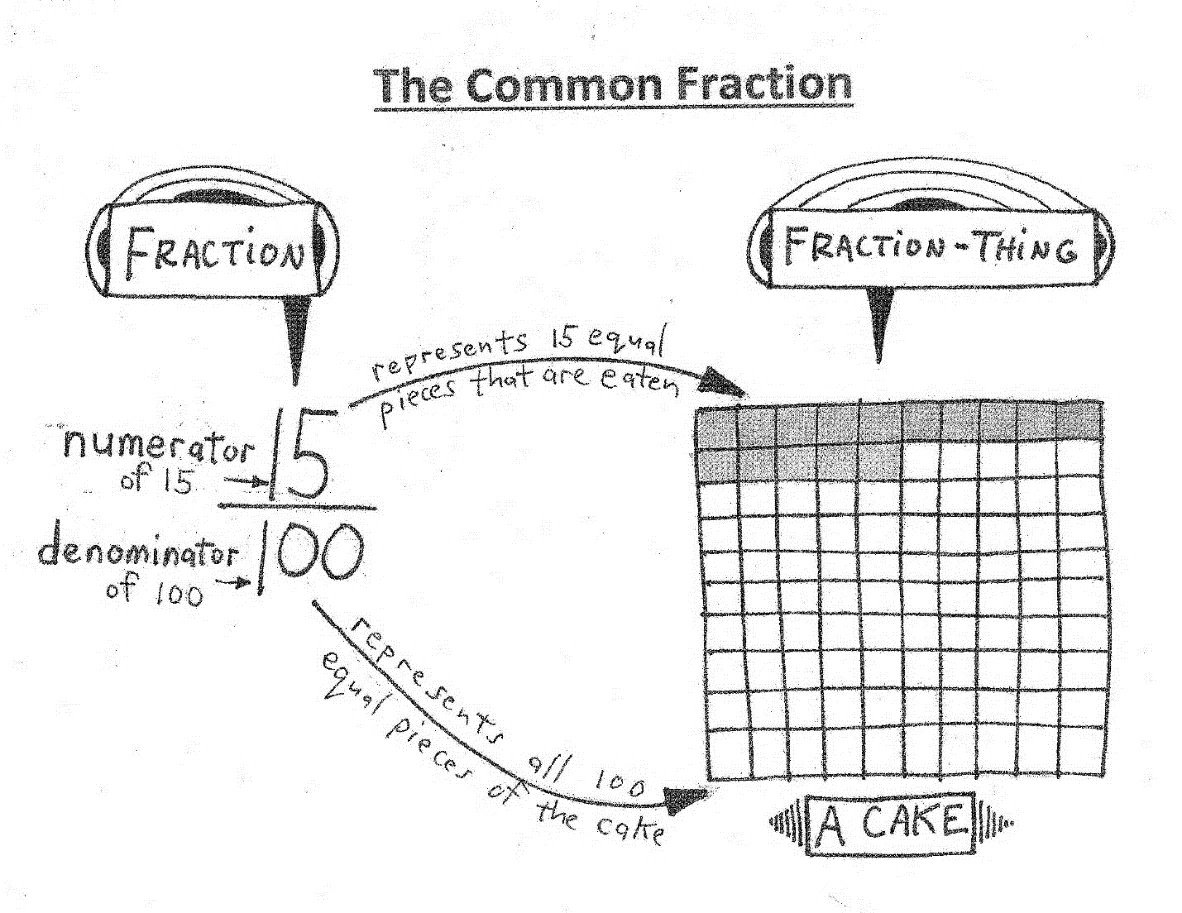
THE COMMON FRACTION
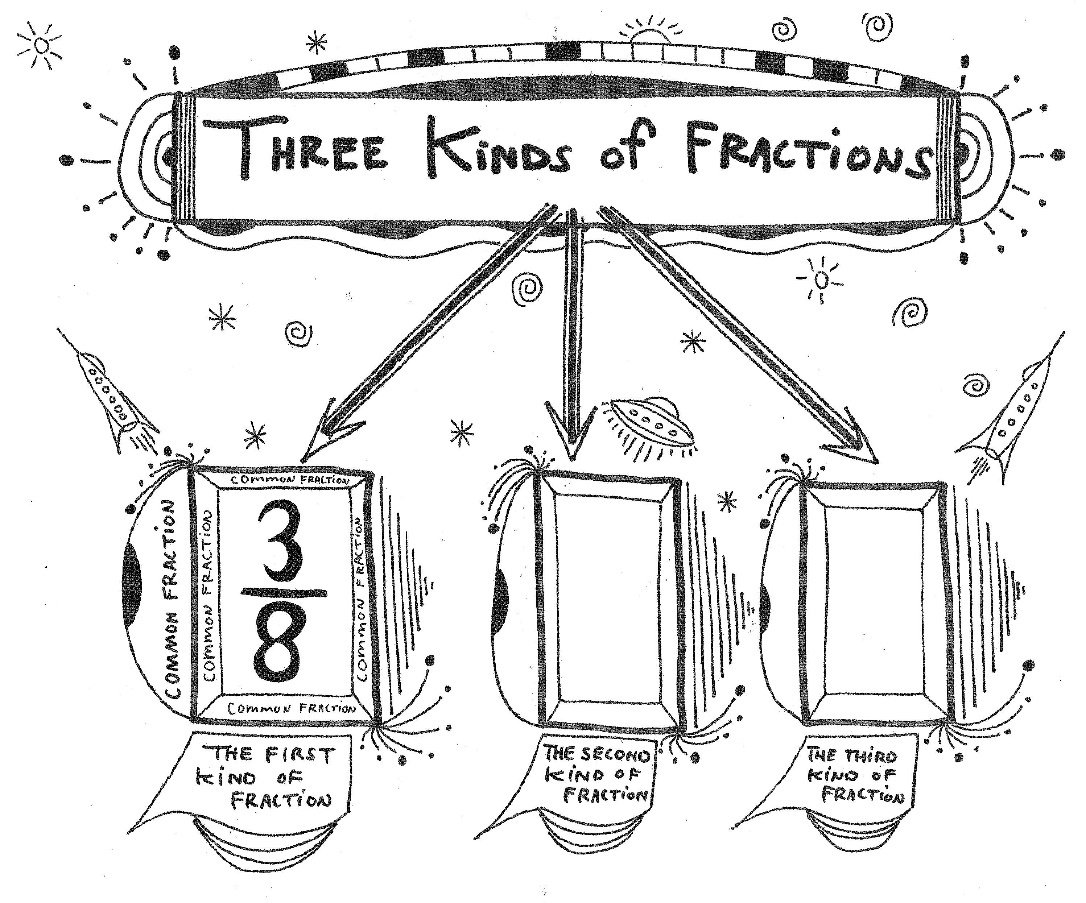
This is a common fraction:
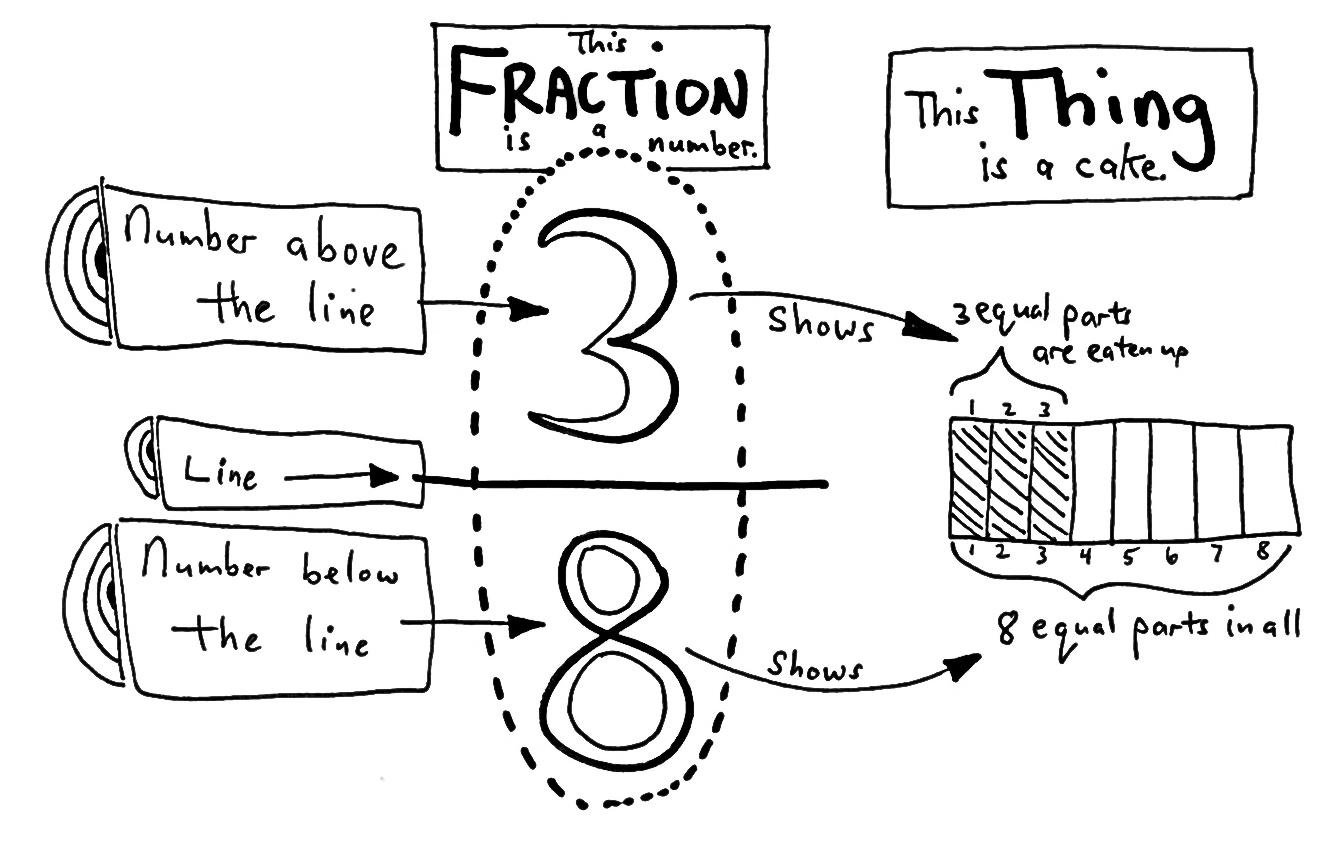
▒ DEFINITION OF A COMMON FRACTION:
A COMMON FRACTION IS A NUMBER WITH THREE PARTS:
● A NUMBER WRITTEN ABOVE A LINE
● A NUMBER WRITTEN BELOW A LINE
● A LINE SEPARATING THE TOP NUMBER FROM THE BOTTOM NUMBER
● A COMMON FRACTION SHOWS THE EQUAL PARTS OF A FRACTION-THING
SENTENCE: RECIPE BOOKS ARE FILLED WITH COMMON FRACTIONS.
NUMERATORS AND DENOMINATORS
“Top number” and “bottom number” are not the real math names of the top and bottom numbers of the common fraction. The real math names are “numerator” and “denominator.”
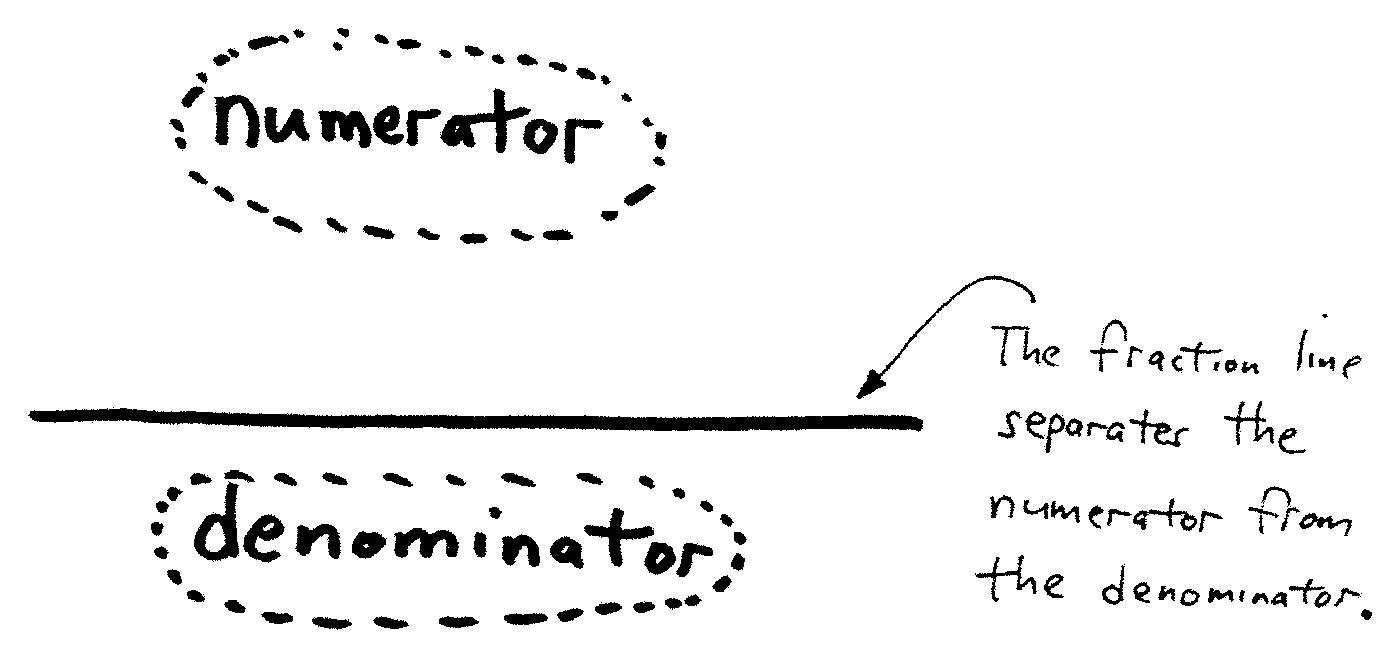
THE THREE PARTS OF A COMMON FRACTION:
● NUMERATOR
● DENOMINATOR
● FRACTION LINE
THE DENOMINATOR
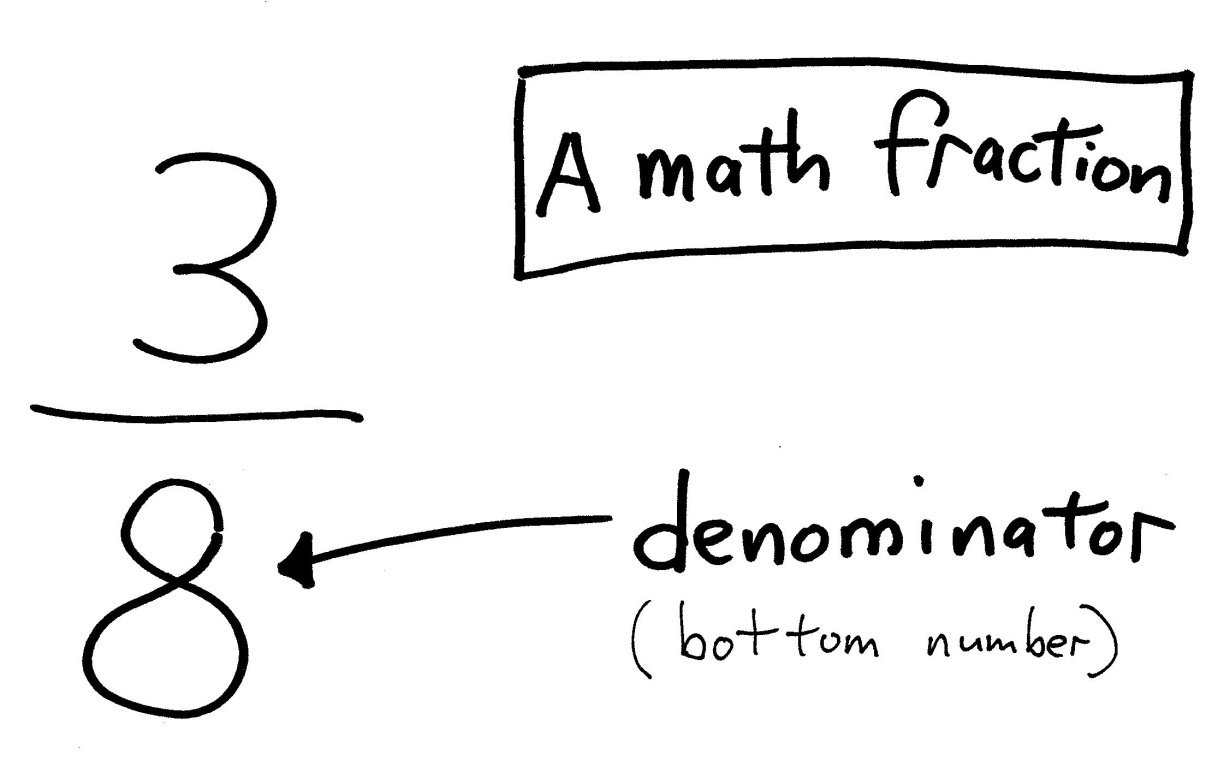
A common fraction has three (and only three) parts.
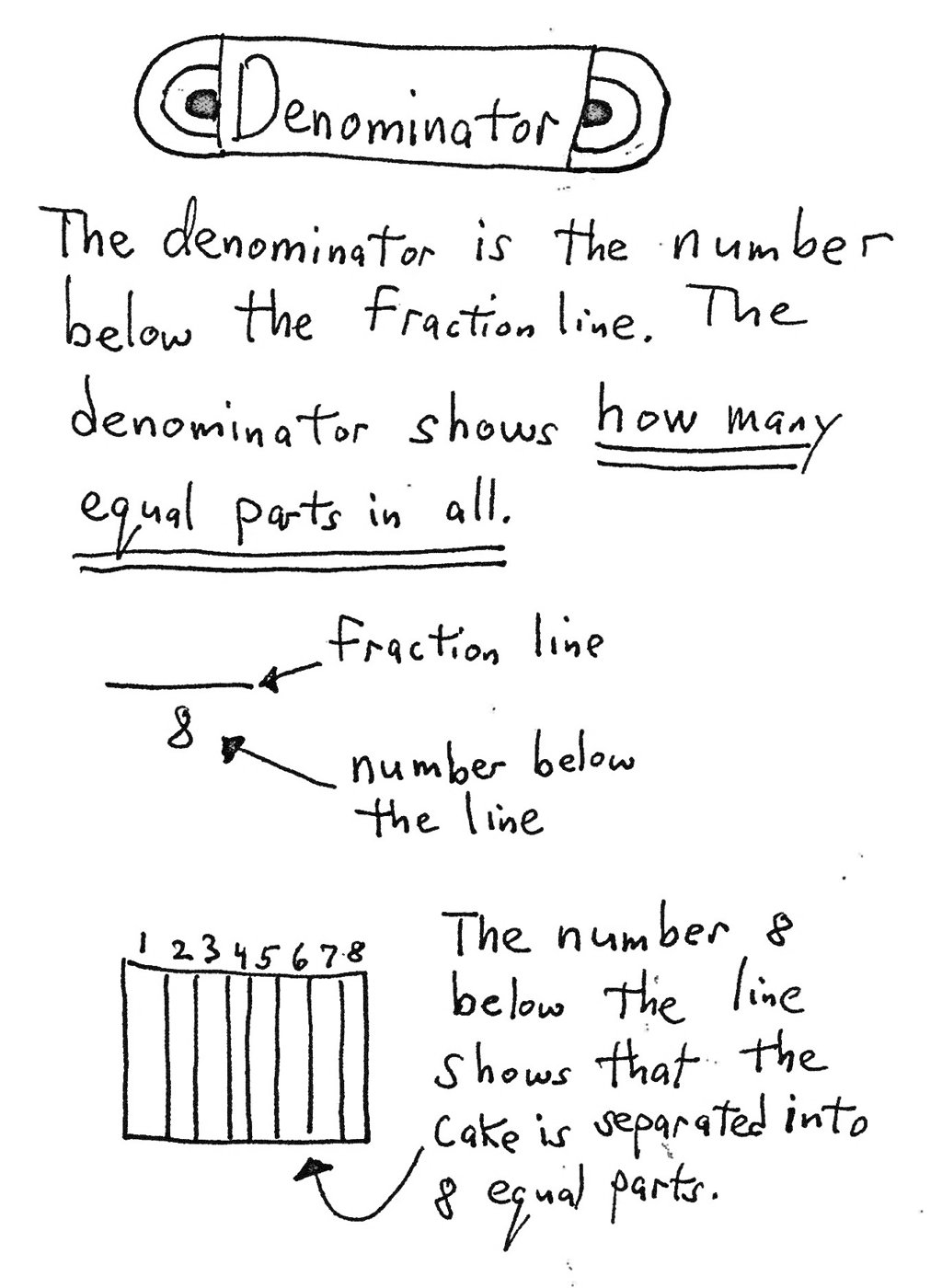
One part of a common fraction is the bottom number. The bottom number is called the DENOMINATOR.
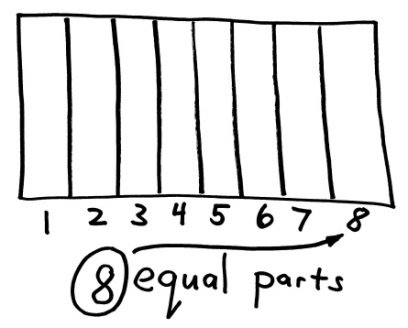
▒ DEFINITION OF “DENOMINATOR”: A NUMBER THAT SHOWS THE TOTAL NUMBER OF EQUAL PARTS THE FRACTION-THING IS SEPARATED INTO. HOW MANY EQUAL PARTS IN ALL?
SENTENCE: THE DENOMINATOR OF A FRACTION ANSWERS THIS QUESTION: WHAT IS THE TOTAL NUMBER OF EQUAL PARTS THE FRACTION-THING IS SEPARATED INTO?
THE NUMERATOR
The second part of the common fraction is the top number. The top number is called the “numerator.”
▒ DEFINITION OF “NUMERATOR”: THE NUMERATOR OF THE COMMON FRACTION IS THE NUMBER THAT SHOWS HOW MANY EQUAL PARTS OF THE FRACTION-THING WE ARE COUNTING, TALKING OR THINKING ABOUT.
SENTENCE: THE NUMERATOR OF A COMMON FRACTION ANSWERS THIS QUESTION: HOW MANY EQUAL PARTS OF THE FRACTION-THING ARE WE COUNTING, TALKING ABOUT, OR THINKING ABOUT?
▒ DEFINITION OF “FRACTION LINE”: THE THIRD PART OF A COMMON FRACTION IS THE LINE ( ____________ ) BETWEEN THE DENOMINATOR AND THE NUMERATOR. THIS LINE HAS A NAME: FRACTION LINE. THE FRACTION LINE HAS ONLY ONE PURPOSE: TO SEPARATE THE NUMERATOR FROM THE DENOMINATOR.
SENTENCE: THE FRACTION LINE MAKES IT EASY TO SPOT THE NUMERATOR AND DENOMINATOR OF A COMMON FRACTION.
We now know the math words and math definitions of all three parts of the common fraction. We are ready to learn the complete definition of common fraction:
▒ COMPLETE DEFINITION OF A “COMMON FRACTION”:
● A COMMON FRACTION IS A NUMBER WITH THE DENOMINATOR WRITTEN BELOW THE FRACTION LINE AND THE NUMERATOR WRITTEN ABOVE THE FRACTION LINE.
● A COMMON FRACTION REPRESENTS A FRACTION-THING.
SENTENCE: FIRST GRADE STUDENTS LEARN ABOUT COMMON FRACTIONS BECAUSE IT IS EASY TO SEE THE NUMERATORS AND THE DENOMINATORS.
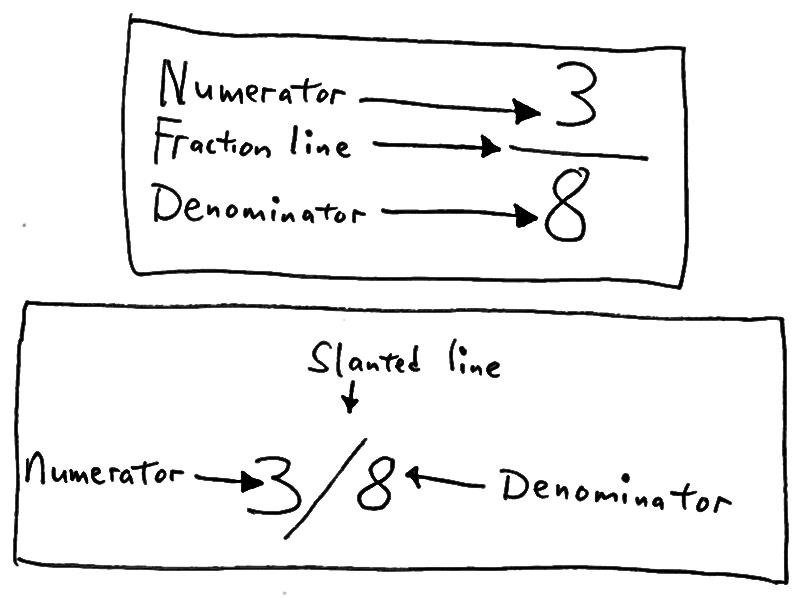
A SECOND KIND OF FRACTION LINE
Sometimes, instead of using a fraction line (______ ) to separate the numerator from the denominator of a common fraction, a slanted line ( / ) is used.
Here’s an example of using a slanted line compared to using a fraction line.
● When using a slanted line, the numerator is written first: 3
● Then the slanted line is written: 3/
● Finally, the denominator is written: 3/8
● 3/8 and 38 mean exactly the same thing
WHAT A FRACTION IS NOT!
Most dictionaries give two different definitions of the word “fraction.” Dictionaries always give a math definition. Dictionaries also give a non-math definition. The math definition is the definition to use when you are doing math.
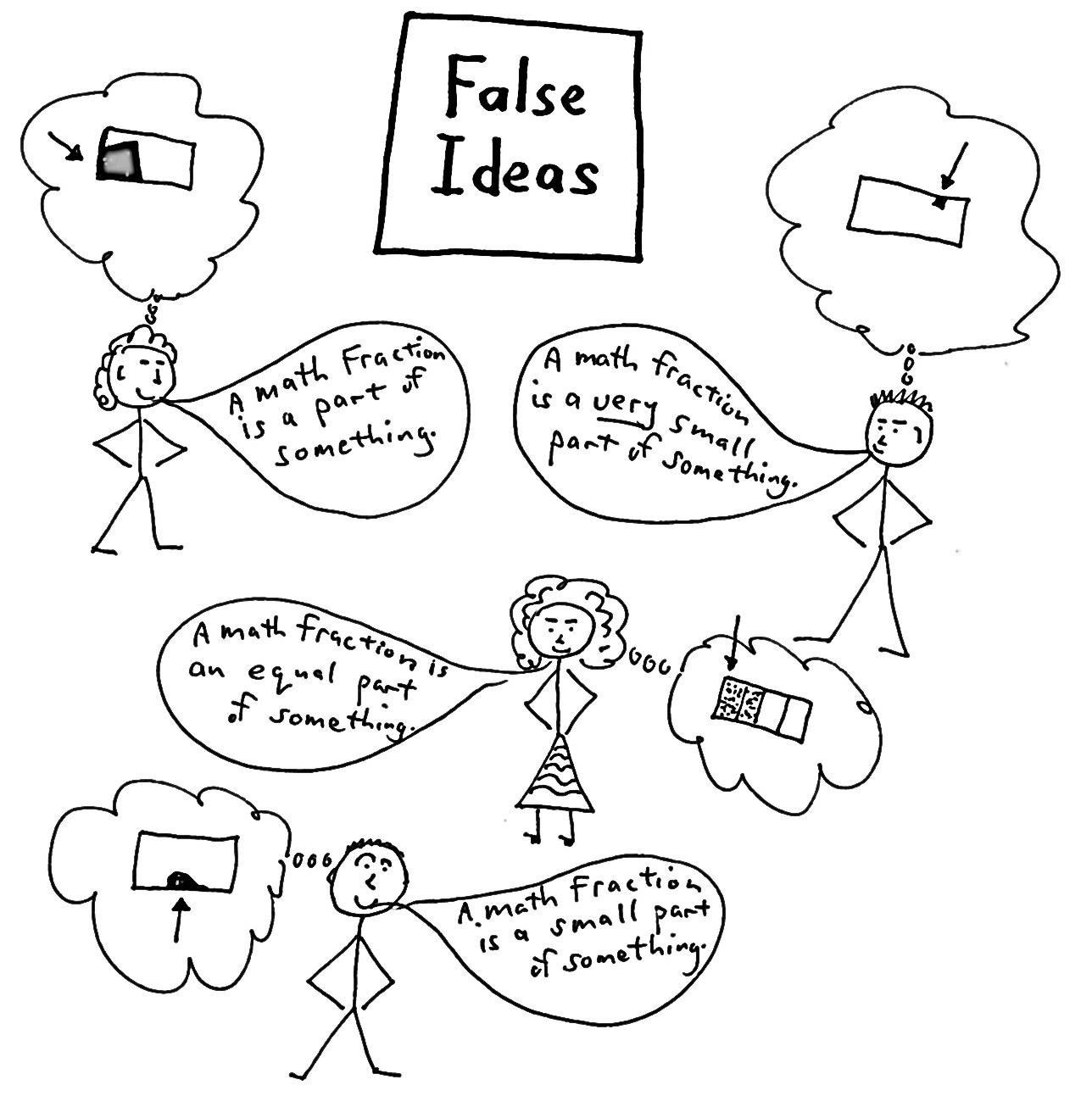
▒ HERE ARE NON-MATH DEFINITIONS OF “FRACTION”:
● A FRACTION IS A PART OF SOMETHING.
● A FRACTION IS A SMALL PART OF SOMETHING.
● A FRACTION IS AN EQUAL PART OF SOMETHING.
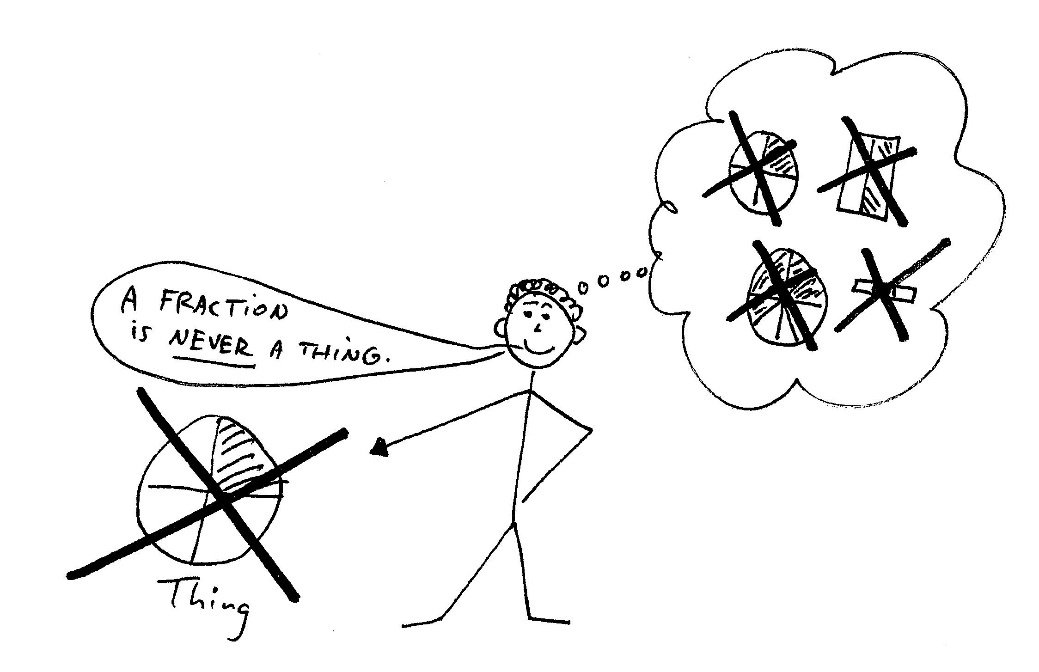
SENTENCE: WE DO NOT USE NON-MATH DEFINITIONS OF FRACTIONS WHEN DOING MATH BECAUSE MATH FRACTIONS ARE ONLY AND ALWAYS NUMBERS — NOT THINGS, PARTS OF THINGS, OR EQUAL PARTS OF THINGS.
Some students and parents (and perhaps even a few teachers) have a wrong idea and a wrong definition for a fraction. They think a fraction is a thing or a part of a thing or an equal part of a thing.
Some students have the idea that the actual cake (the food made of flour, sugar, water, etc.) divided into equal parts is a fraction.
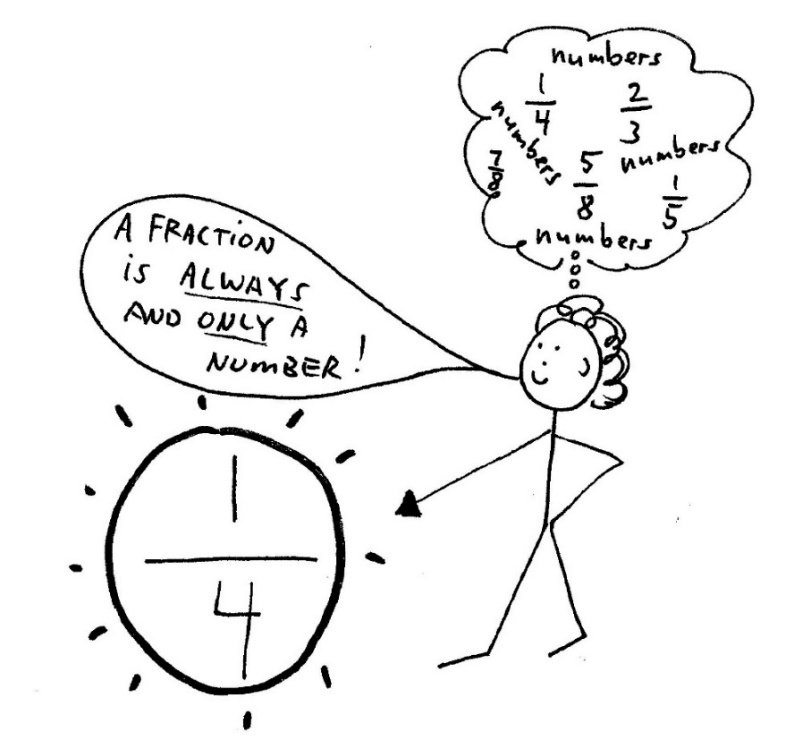
BUT IT IS NOT TRUE THAT A FRACTION IS A THING, A PART OF A THING, OR AN EQUAL PART OF A THING.
A FRACTION IS ALWAYS AND ONLY A NUMBER!
THE DECIMAL FRACTION
Remember, there are three major kinds of fractions.
In 1st, 2nd, 3rd, and 4th grades, all students learn about common fractions.
In 3rd grade and 4th grade, students learn about the second kind of fraction.
The second kind of fraction is the “decimal fraction.” Some books shorten the real name “decimal fraction” to the word “decimal.” This is OK to do, BUT YOU SHOULD REMEMBER THAT THE WORD “DECIMAL” IS FREQUENTLY A SHORT WAY OF SAYING “DECIMAL FRACTION.”
TO REALLY UNDERSTAND DECIMAL FRACTIONS, YOU FIRST NEED TO UNDERSTAND “PLACE VALUE.”
Place Value
WHAT IS IT?
This drawing shows three places: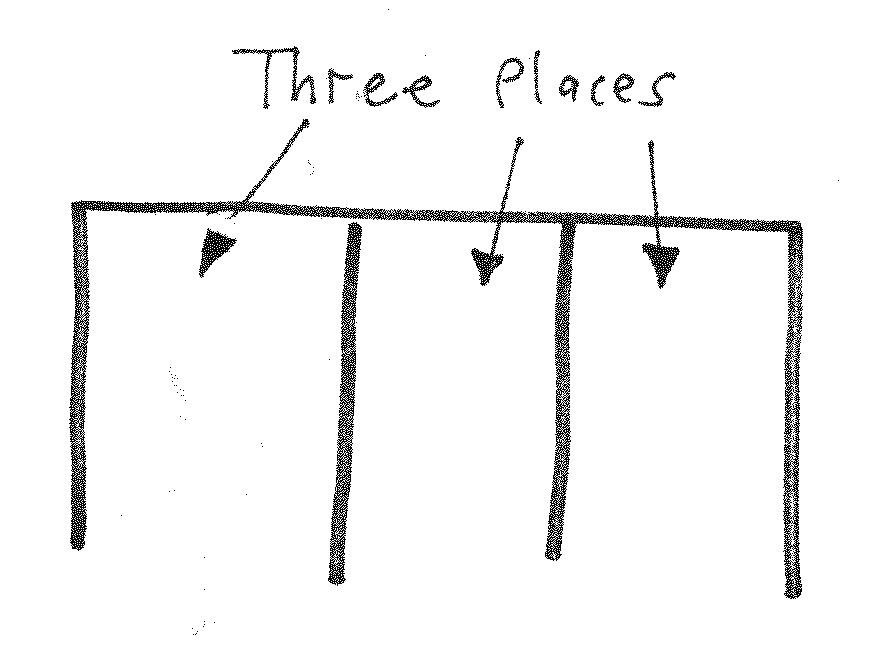
These three places are special places. They are “MATH PLACES.”
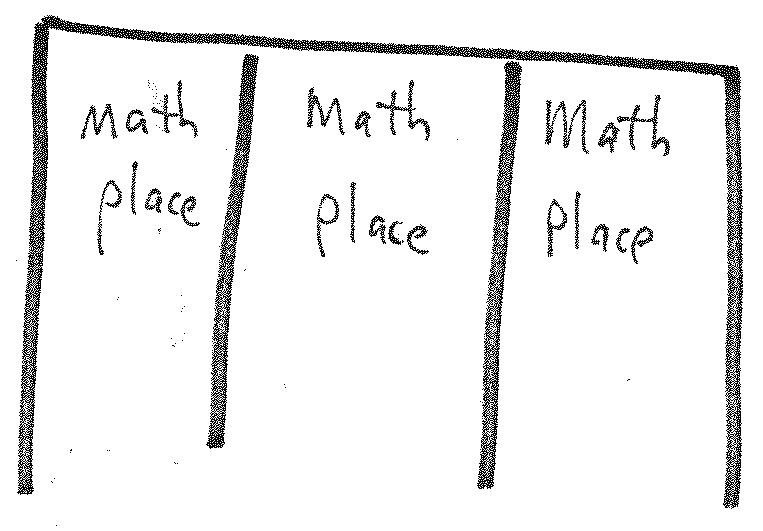
DEFINITION OF A MATH PLACE: A MATH PLACE IS A SPECIAL PLACE WHERE WE WRITE THE DIGITS (0, 1, 2, 3, 4, 5, 6, 7, 8, and 9).
SENTENCE: LET’S PUT THE DIGITS IN ALL THREE MATH PLACES.
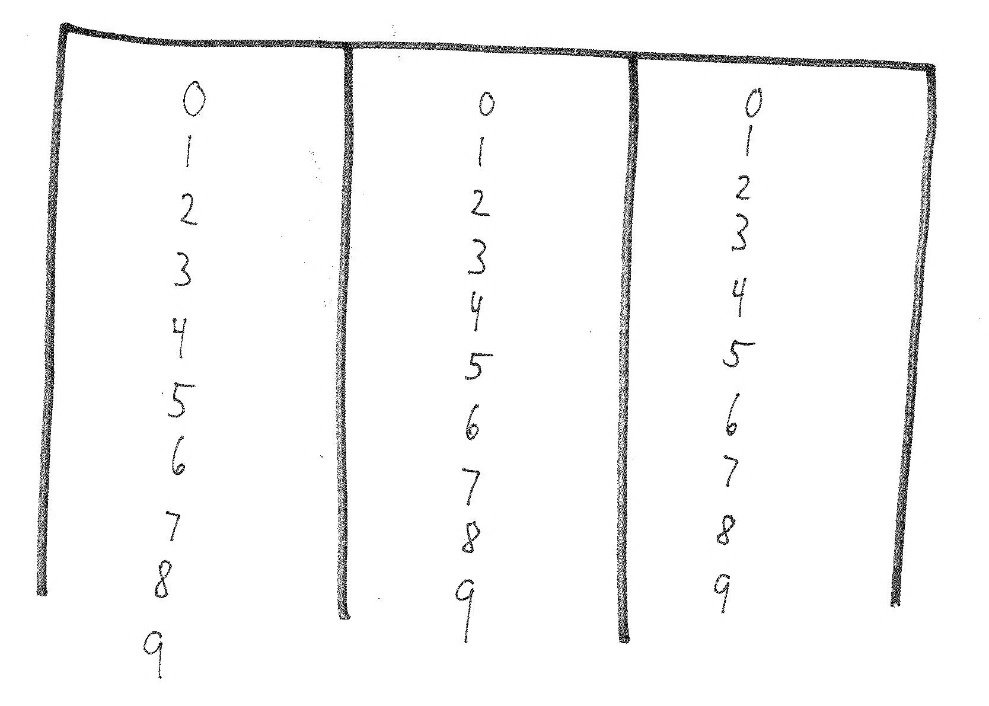
Oopsie! We forgot to give each math place its own special number! So, what number goes with each place? Hmmm…
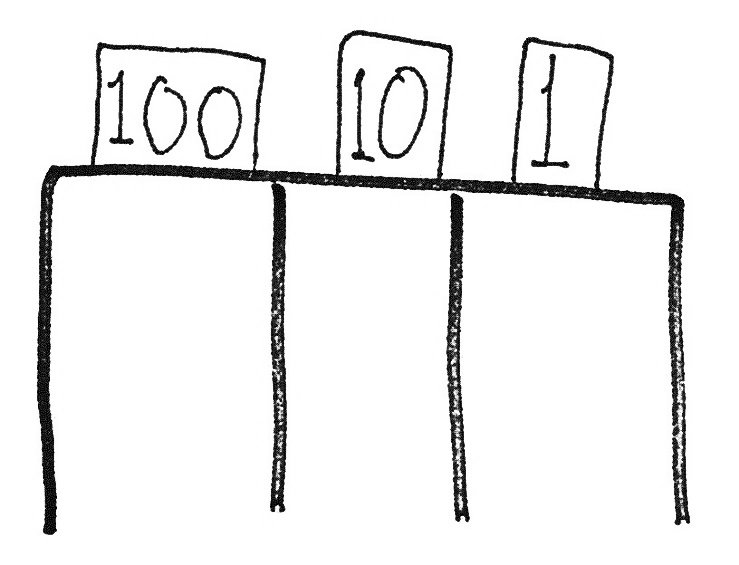
• The place on the right gets the number 1
• The place in the middle gets the number 10
• The place on the left gets the number 100
Yes! We did it! Now each place has its own number! Yay!
But how do we use the 1, the 10, and the 100?
First, we need to learn a new math idea. This new math idea has a name. The name of the idea is “value.”
Of course, we all know about money value: for example, cars, houses, and movie tickets have a value. That’s how much money you would probably pay if you wanted to buy the car ($10,000.00) or the house ($125,000.00) — or see the movie in the movie theatre ($15.00). That’s money value.
Each math place also has its own value. That value is the number connected to the place. The value (the number of the place) is multiplied with the digits written in that place. It works like this:
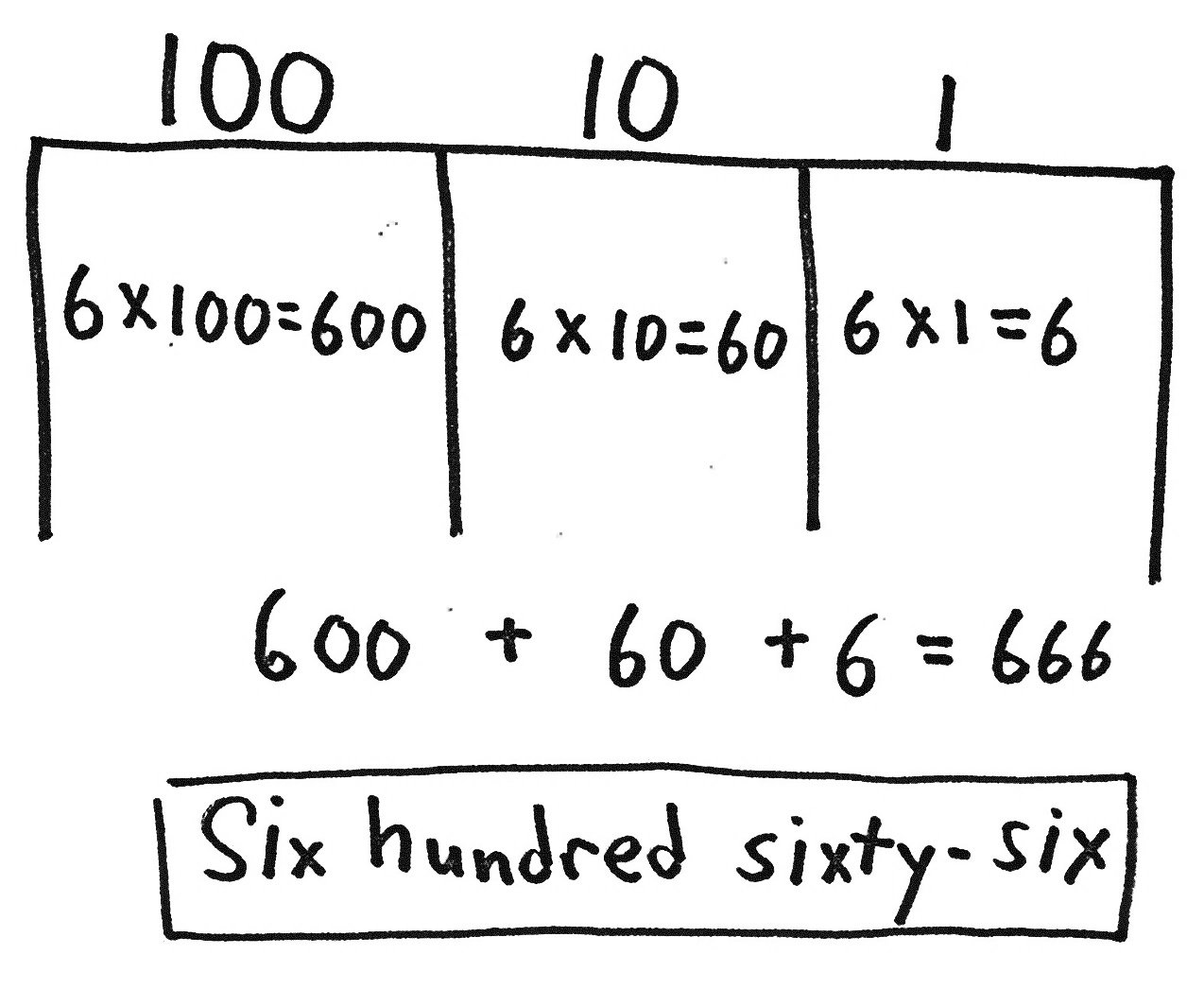
We multiply every digit in a place with the value — the number – of that place.
DEFINITION OF “VALUE”: THE WORD “VALUE” DOES NOT MEAN “MONEY VALUE” WHEN WE ARE STUDYING MATH PLACES. “VALUE” MEANS THE NUMBER CONNECTED TO A MATH PLACE THAT IS MULTIPLIED BY THE DIGIT WRITTEN IN THAT PLACE.
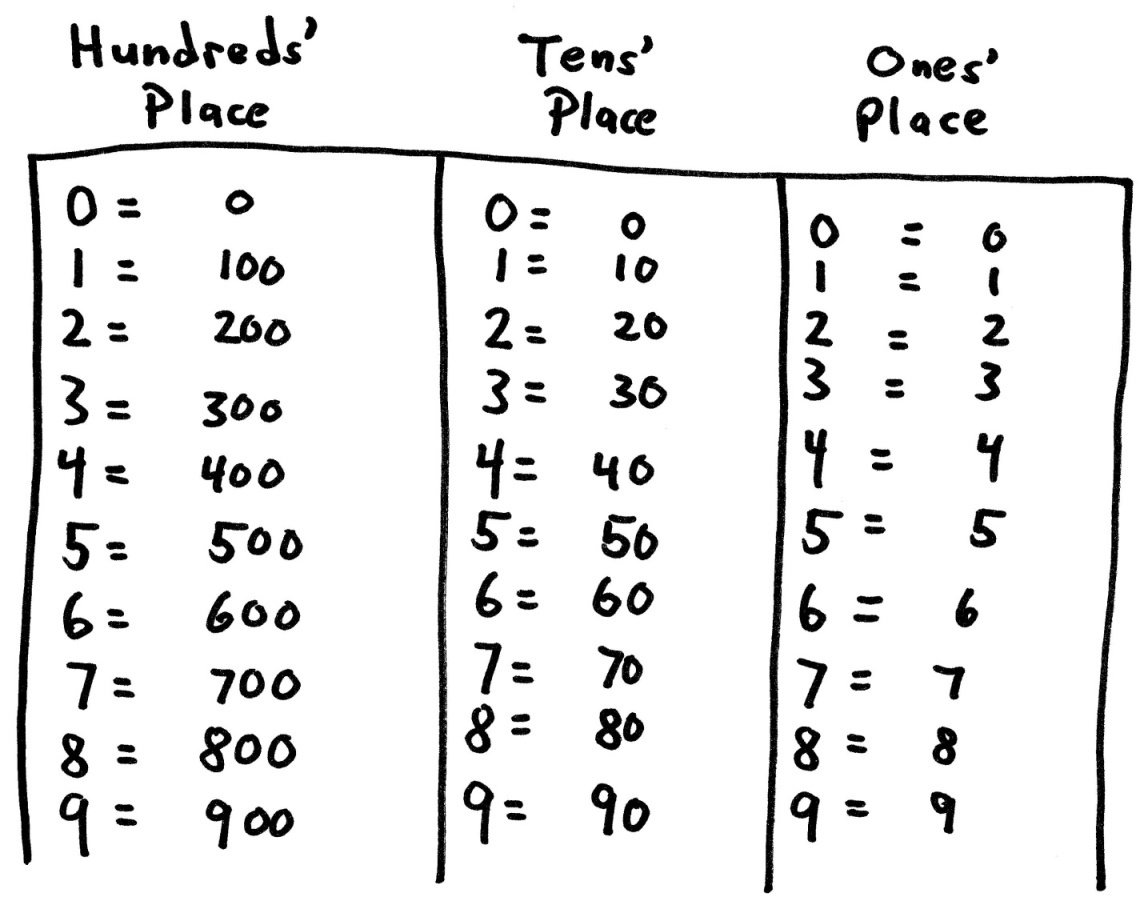
Here are all the digits written down in each math place. Notice that each digit is multiplied with the value – the number — of that place.
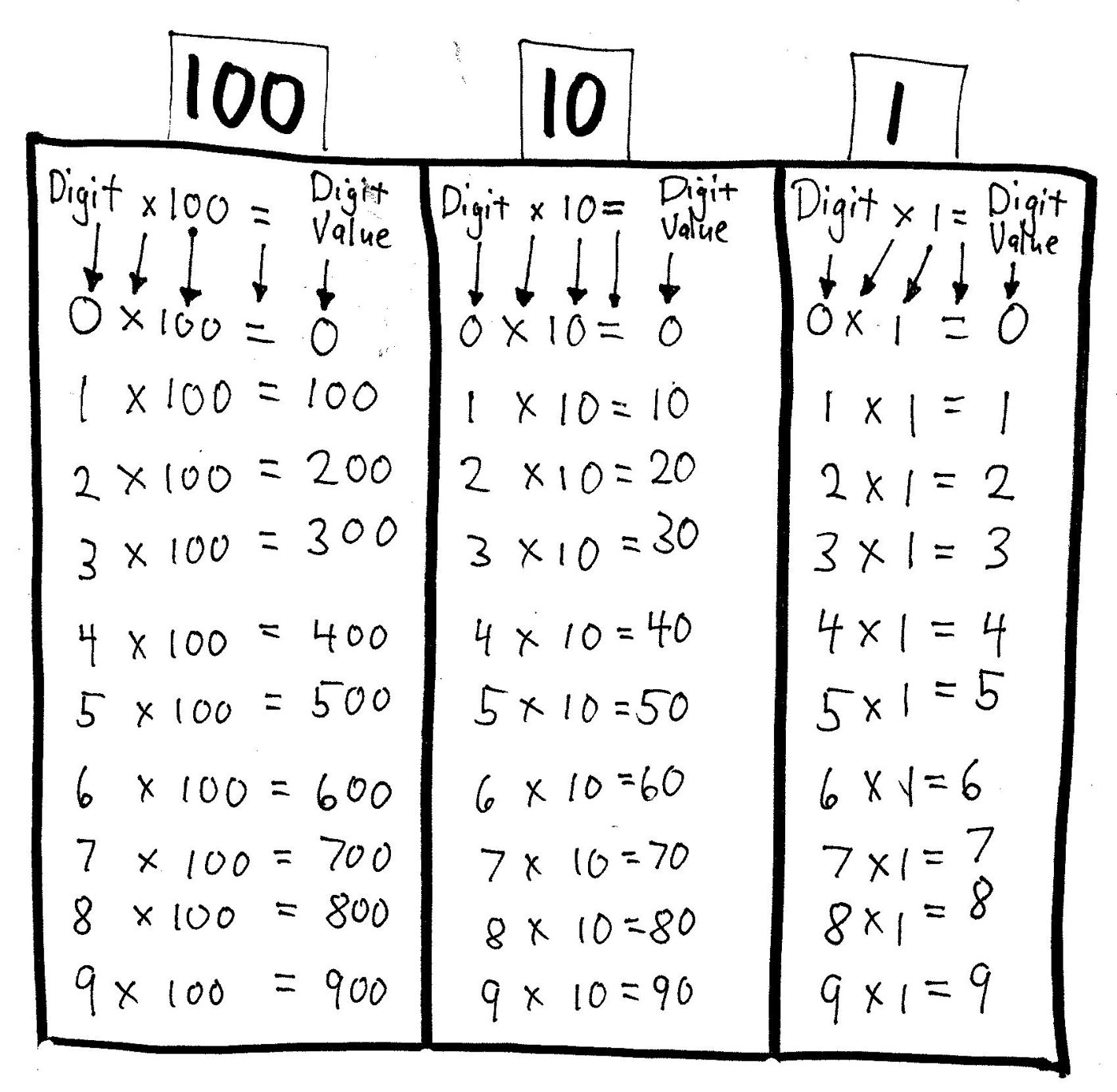
• So, the values of the places are multiplied by the digits written in those places.
• The multiplication of place value with digit gives us the true value of that digit when it is written in that specific place.
• When the number of the place is multiplied by the digit in that place, the digit now has its own “DIGIT VALUE.”
DEFINITION OF “DIGIT VALUE”: THE VALUE OF A DIGIT AFTER IT HAS BEEN MULTIPLIED WITH THE VALUE OF A MATH PLACE.
● SENTENCE: WHEN THE DIGIT 3 IS WRITTEN IN THE PLACE ON THE RIGHT, IT GETS MULTIPLIED WITH 1 AND THEN HAS A DIGIT VALUE OF 3 BECAUSE
3 X 1 = 3
Digit times place value equals digit value
● SENTENCE: WHEN THE DIGIT 6 IS WRITTEN IN THE MIDDLE PLACE, IT GETS MULTIPLIED WITH 10 AND THEN HAS A DIGIT VALUE OF 60 BECAUSE
6 X 10 = 60
Digit times place value equals digit value
● SENTENCE: WHEN THE DIGIT 9 IS WRITTEN IN THE LEFT PLACE, IT GETS MULTIPLIED WITH 100 AND THEN HAS A DIGIT VALUE OF 900 BECAUSE
9 X 100 = 900
Digit times place value equals digit value
DEFINITION OF PLACE VALUE: THE VALUE OF THE PLACES WHERE WE WRITE THE DIGITS.
SENTENCE: 1, 10, and 100 ARE THE PLACE VALUES OF THE FIRST THREE MATH PLACES.
We give special names to the 1, the 10, and the 100:
• The numeral 1 becomes “ones.” Then that math place becomes the “ONES’ PLACE.”
• The numeral 10 becomes “tens”. Then that math place becomes the “TENS’ PLACE.”
• The numeral 100 becomes “hundreds.” Then that math place becomes the “HUNDREDS’ PLACE.”
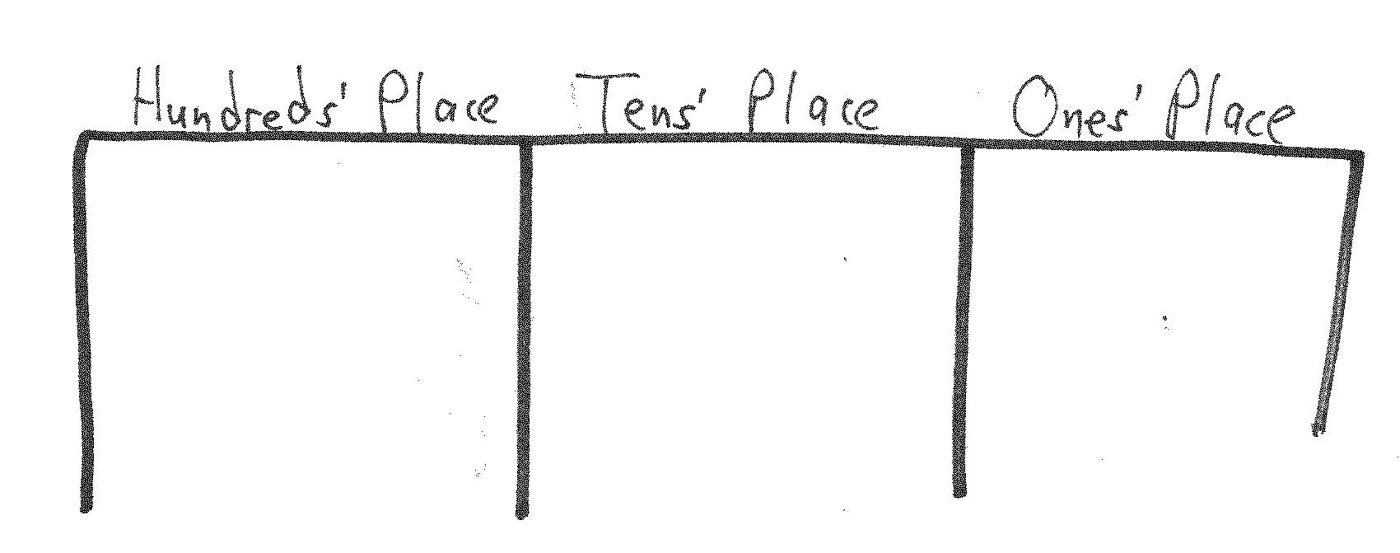
DEFINITION OF ONES: THE VALUE OF THE DIGITS WHEN THEY HAVE BEEN MULTIPLIED WITH 1. SO, THE ONES ARE 0, 1, 2, 3, 4, 5, 6, 7, 8, and 9.
SENTENCE: THE ONES ARE THE SINGLE NUMBERS LESS THAN 10.
DEFINITION OF ONES’ PLACE: THE MATH PLACE WHERE THE DIGITS ARE MULTIPLIED WITH 1 TO GET THEIR DIGIT VALUE.
SENTENCE: THE SMALLEST DIGIT VALUES ARE FOUND IN THE ONES’ PLACE.
DEFINITION OF TENS: THE VALUE OF THE DIGITS WHEN THEY HAVE BEEN MULTIPLIED WITH 10. SO, THE TENS ARE 10, 20, 30, 40, 50, 60, 70, 80, AND 90.
SENTENCE: THE BIGGEST TEN IS 90.
DEFINITION OF TENS’ PLACE: THE MATH PLACE WHERE THE DIGITS ARE MULTIPLIED WITH 10 TO GET THEIR DIGIT VALUE.
SENTENCE: THE TENS’ PLACE IS BETWEEN THE ONES’ PLACE AND THE HUNDREDS’ PLACE.
DEFINITION OF HUNDREDS: THE VALUE OF THE DIGITS WHEN THEY HAVE BEEN MULTIPLIED WITH 100. SO, THE HUNDREDS ARE 100, 200, 300, 400, 500, 600, 700, 800, AND 900.
SENTENCE: STUDENTS MEMORIZE THE HUNDREDS IN SECOND GRADE.
DEFINITION OF HUNDREDS’ PLACE: THE MATH PLACE WHERE THE DIGITS ARE MULTIPLIED WITH 100 TO GET THEIR DIGIT VALUE. THE HUNDREDS ARE 100, 200, 300, 400, 500, 600, 700, 800, AND 900.
SENTENCE: BECAUSE HE EARNED $700.00, HE WROTE THE DIGIT 7 IN THE HUNDREDS’ PLACE.
Summary: And now we all know that 555 means five hundred fifty-five…
not five five five!

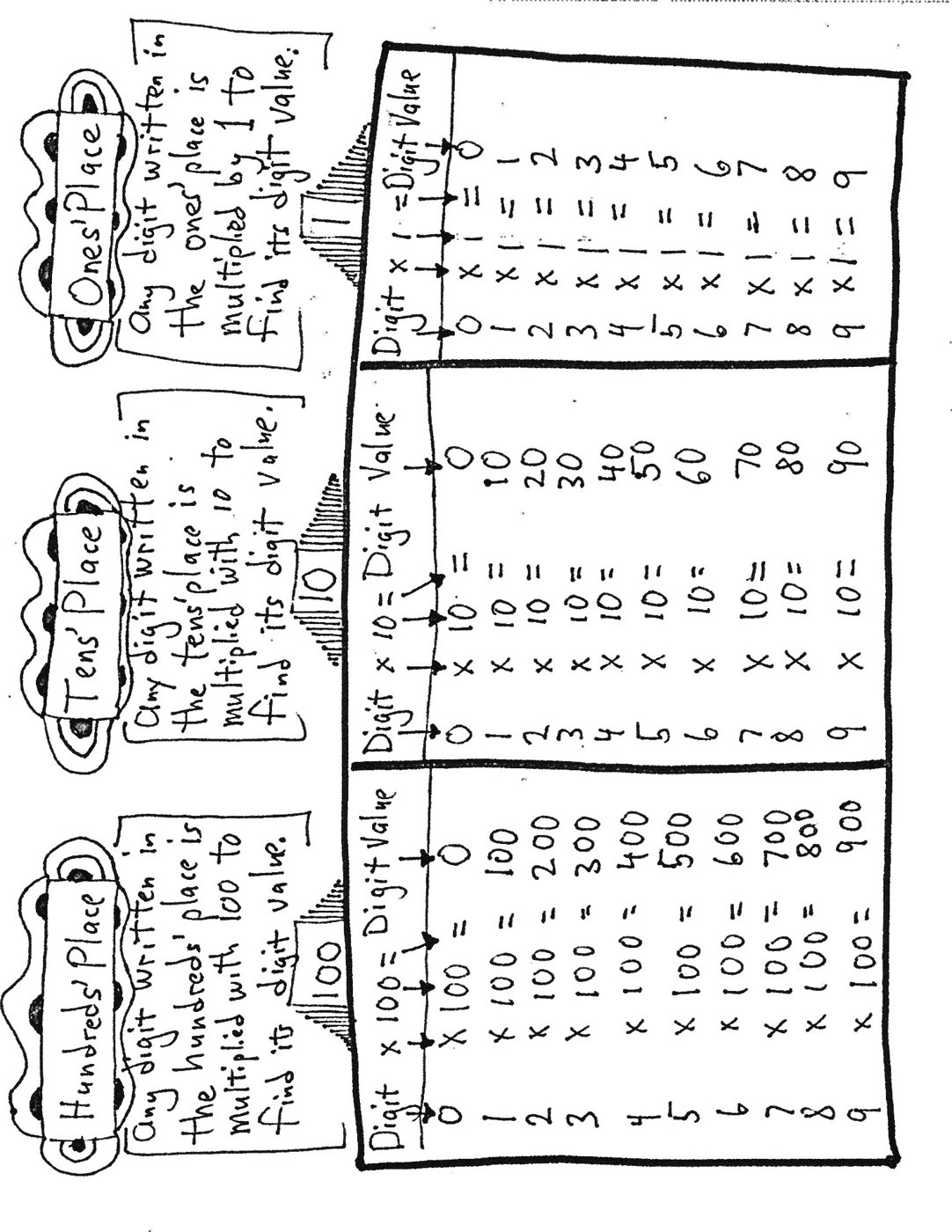
Next is a picture summary of this lesson on Place Value. (Be sure to turn the page sideways so you can study it in detail.)
THE DECIMAL FRACTION
The definitions of “decimal fraction” in some math books and glossaries are incomplete. The definition of decimal fraction in this glossary is both accurate and complete.
▒ DEFINITION OF A “DECIMAL FRACTION” (A COMPLETE DEFINITION FOR FIFTH GRADE AND UP)
● A DECIMAL FRACTION IS A FRACTION — A NUMBER — WITH THE NUMERATOR WRITTEN TO THE RIGHT OF A SPECIAL POINT CALLED THE DECIMAL POINT.
● THE DECIMAL POINT SEPARATES WHOLE NUMBERS (written to the left of the point) FROM THE FRACTIONS (written to the right of the point).
● THE DENOMINATOR OF A DECIMAL FRACTION IS THE PLACE VALUE OF THE DIGIT WRITTEN FARTHEST TO THE RIGHT OF THE DECIMAL POINT.
● IN 3RD AND 4TH GRADES, THE DECIMAL FRACTION DENOMINATORS ARE USUALLY 10 AND 100. IN 5TH GRADE, DECIMAL FRACTION DENOMINATORS 0F 1000 ARE OFTEN INTRODUCED.
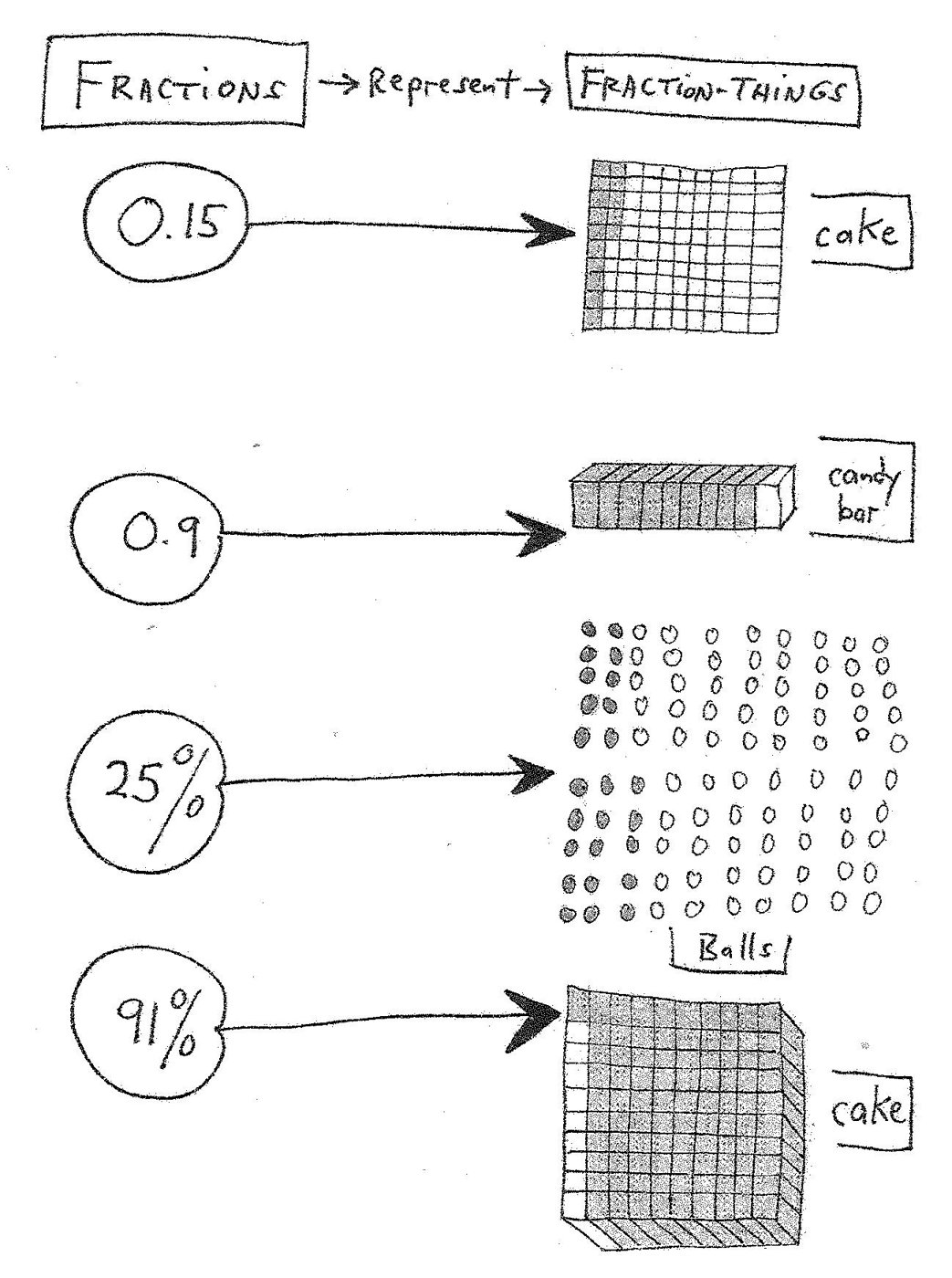
● A DECIMAL FRACTION REPRESENTS A FRACTION-THING.
SENTENCE: DECIMAL FRACTIONS ARE USED IN SKI RACES TO DECIDE WHO IS THE FASTEST SKIER
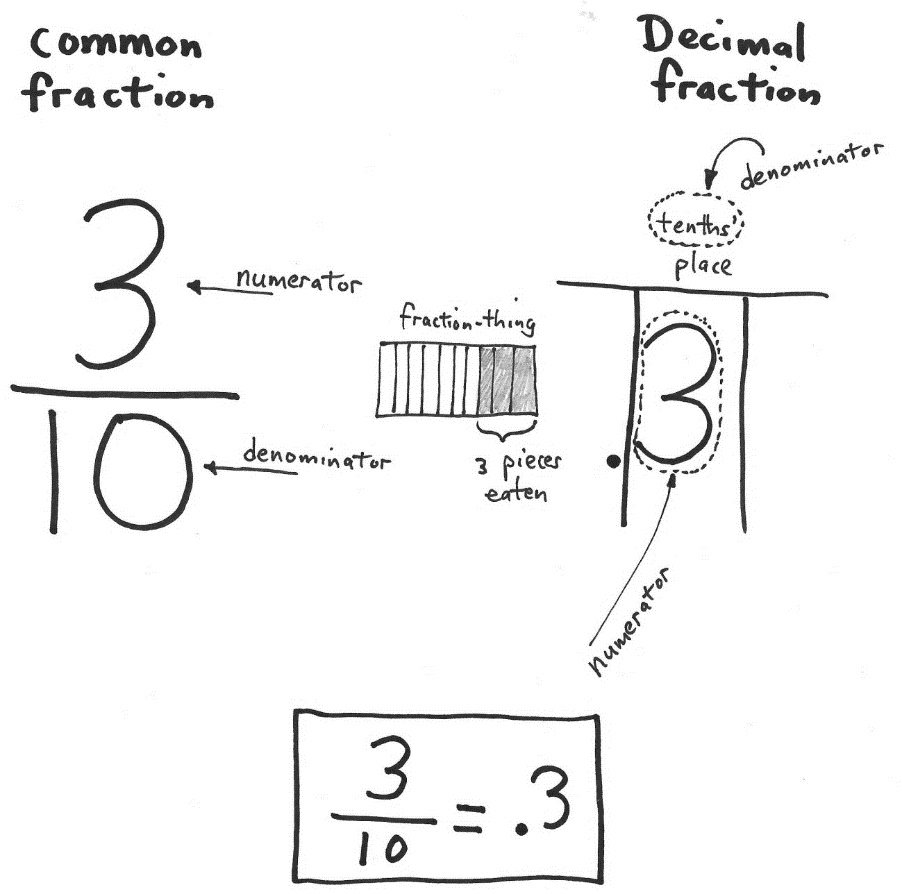
Comparing Common Fractions and Decimal Fractions
MORE ABOUT DECIMAL FRACTIONS
Let’s find out more about the decimal fraction. We’ll start with the “decimal point”:
THE DECIMAL POINT
The decimal point is used to write the second kind of fraction, the decimal fraction.
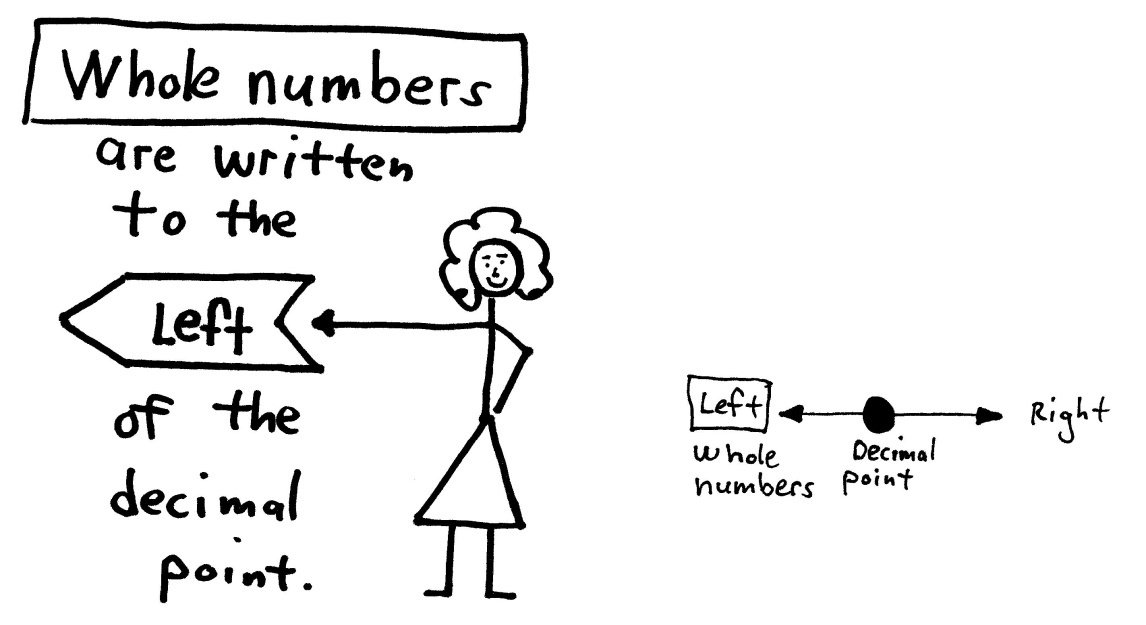
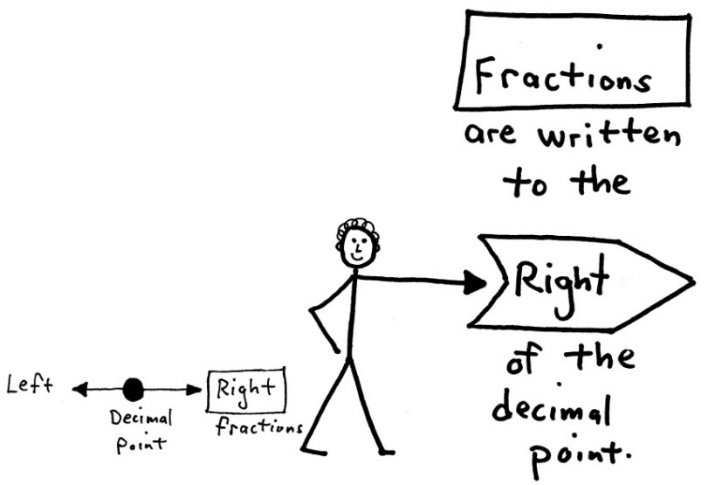
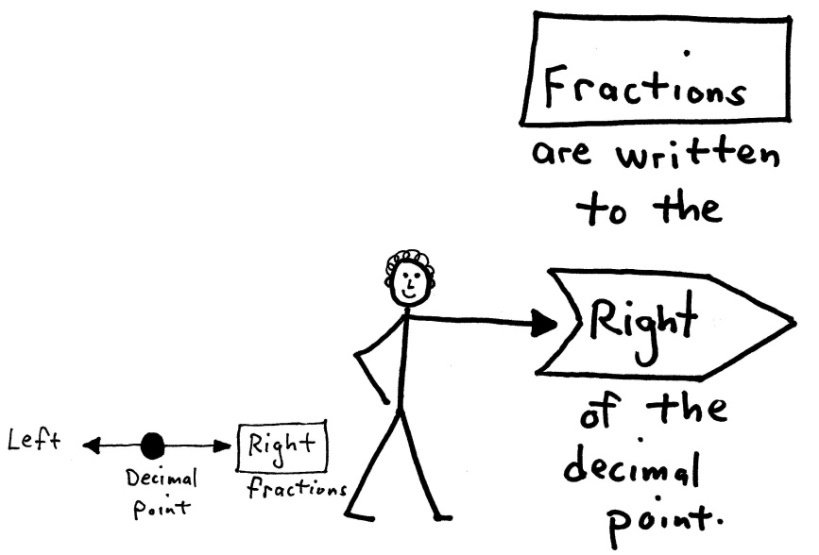
▒ DEFINITION OF “DECIMAL POINT”: A POINT (.) THAT SEPARATES WHOLE NUMBERS FROM FRACTIONS. WHOLE NUMBERS ARE WRITTEN TO THE LEFT OF THE POINT. FRACTIONS ARE WRITTEN TO THE RIGHT OF THE POINT.
SENTENCE: Decimal points are used to clearly show the fraction part of a number.
WHOLE NUMBERS ARE WRITTEN
TO THE LEFT OF THE DECIMAL POINT.
FRACTIONS ARE WRITTEN
TO THE RIGHT OF THE DECIMAL POINT
Example: 4.3 is a number that has a whole number and a decimal fraction.
► 4. (written to the left of the decimal point) is the whole number.
►.3 (written to the right of the decimal point) is the decimal fraction.
DECIMAL FRACTION NUMERATORS
ALL FRACTIONS USE A NUMERATOR AND A DENOMINATOR TO REPRESENT THE EQUAL PARTS OF A THING OR A GROUP OF THINGS — THE FRACTION-THING.
The numerator of any fraction shows how many of the equal parts of something we are talking about. In the common fraction 3/10, the top number 3 shows that we are talking about 3 of the 10 equal parts of something.
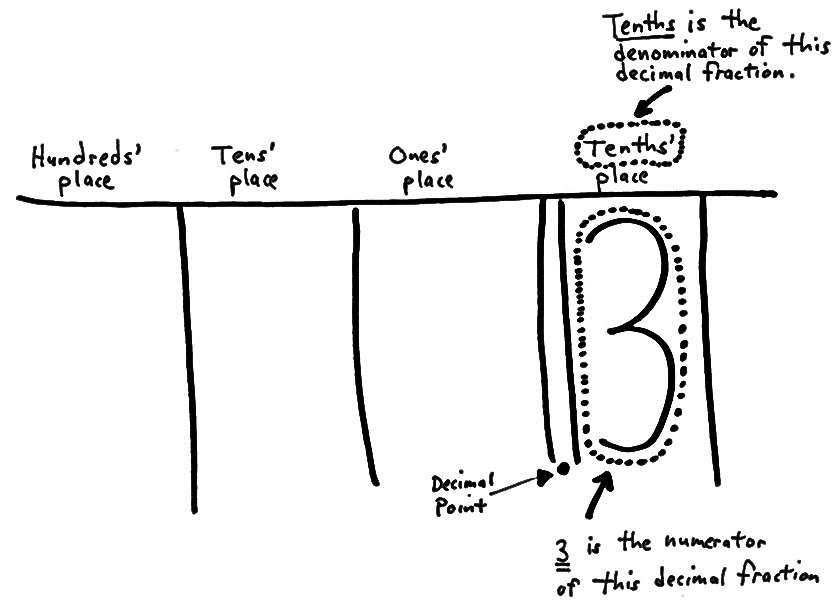
A decimal fraction is a little different. THE NUMERATOR OF THE DECIMAL FRACTION IS THE ENTIRE NUMBER WRITTEN TO THE RIGHT OF THE DECIMAL POINT.
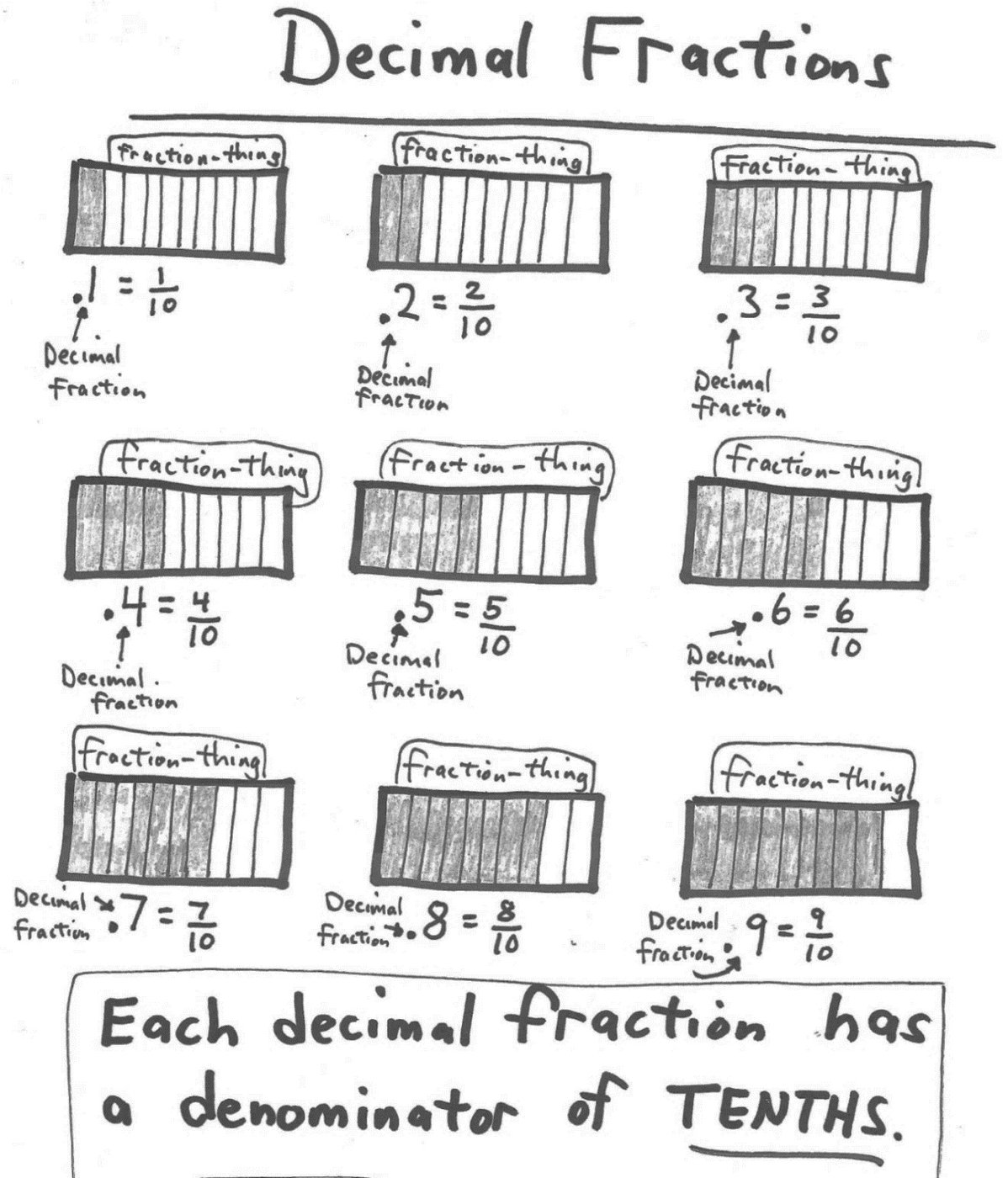
For example, in the decimal fraction 0.3, the digit 3 is the numerator. The digit 3 written to the right of the decimal point means we are talking about 3 of the 10 equal parts of something. The decimal fraction 0.3 can be written as the common fraction 3/10
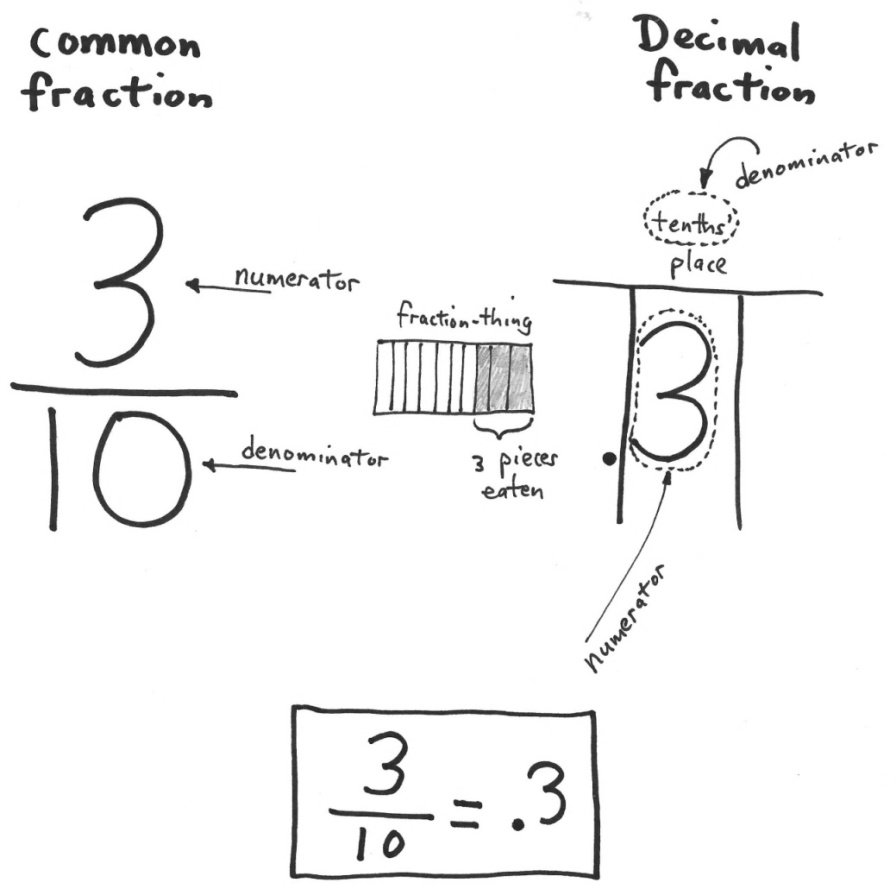
The 3 in 0.3 means the same thing as the 3 in 3/10
DECIMAL FRACTION DENOMINATORS
Remember, all fractions use a numerator AND a denominator to represent the equal parts of a thing or a group of things — a fraction-thing. Common fractions have numerators and denominators. Decimal fractions also have numerators and denominators.
The denominator of any fraction shows the total number of equal parts the fraction-thing is separated into.
In the common fraction 3/10, the number 10 is the denominator because the number 10 shows that the fraction-thing is separated into 10 equal parts.
But where is the decimal fraction denominator? Where is the denominator of the decimal fraction .3?
The denominator of a decimal fraction .3 is sort of hidden. It is only a small secret. But you have to know the secret of finding the denominator of a decimal fraction to really understand decimal fractions.
THE SECRET TO FINDING DECIMAL FRACTION DENOMINATORS
Here is the secret to understanding decimal fraction denominators:
MORE ABOUT PLACE VALUE
You have learned a lot about place values in 1st, 2nd, and 3rd, grades. But all those place values – the ones, the tens, the hundreds – are all whole number place values.
Now you must learn about DECIMAL FRACTION PLACE VALUES. Knowing FRACTION PLACE VALUES is the secret to finding the denominators of all decimal fractions.
FRACTIONS ARE WRITTEN
TO THE RIGHT OF THE DECIMAL POINT
THE DENOMINATOR OF ANY DECIMAL FRACTION IS
THE PLACE VALUE OF THE DIGIT WRITTEN FARTHEST TO THE RIGHT OF THE DECIMAL POINT.
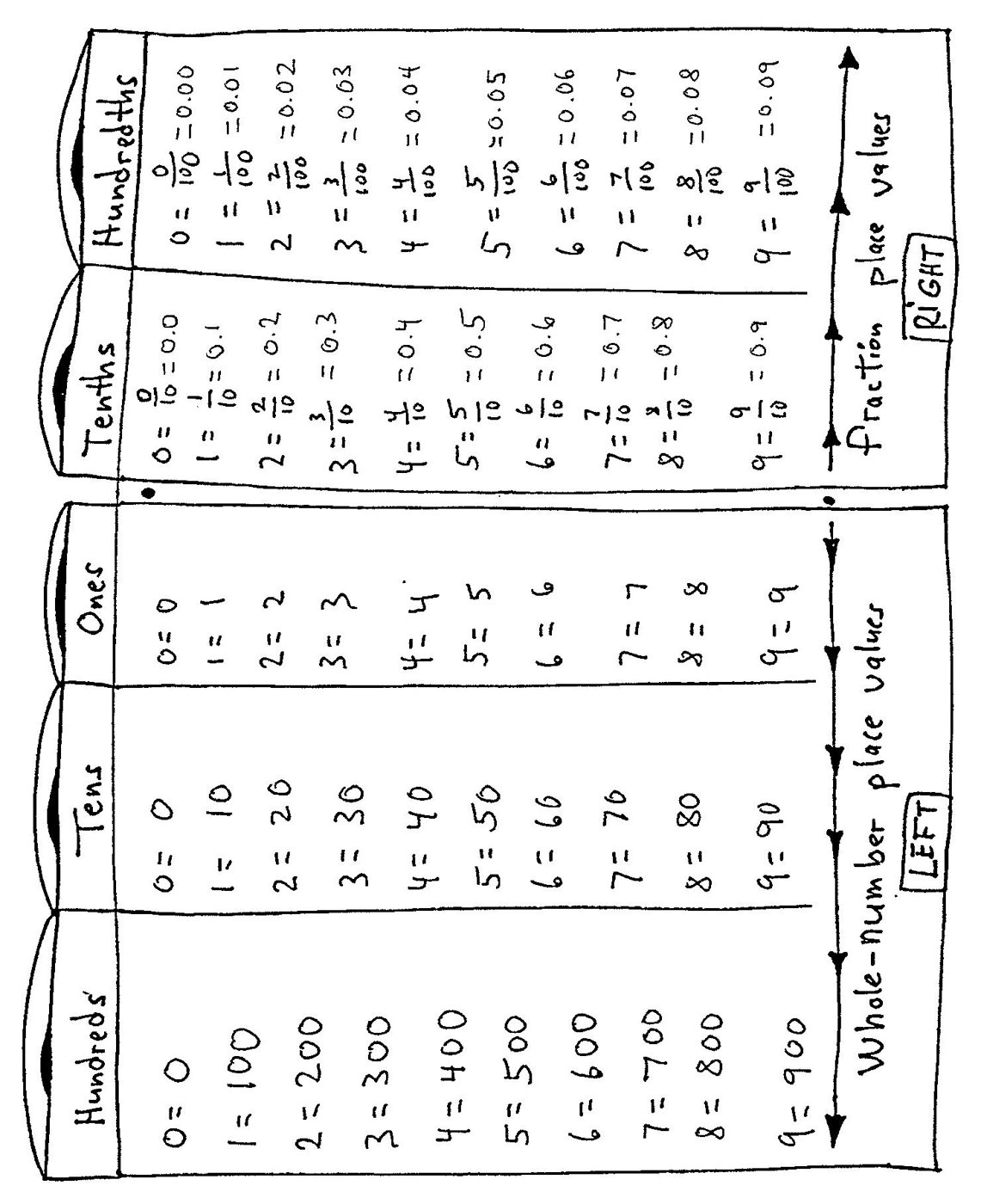
The following picture shows the whole number place values PLUS the decimal fraction place values.
In this picture, the places values to the LEFT of the decimal point are whole number place values: ONES, TENS, AND HUNDREDS.
PLACE VALUES TO THE RIGHT OF THE DECIMAL POINT
ARE THE DECIMAL FRACTION PLACE VALUES:
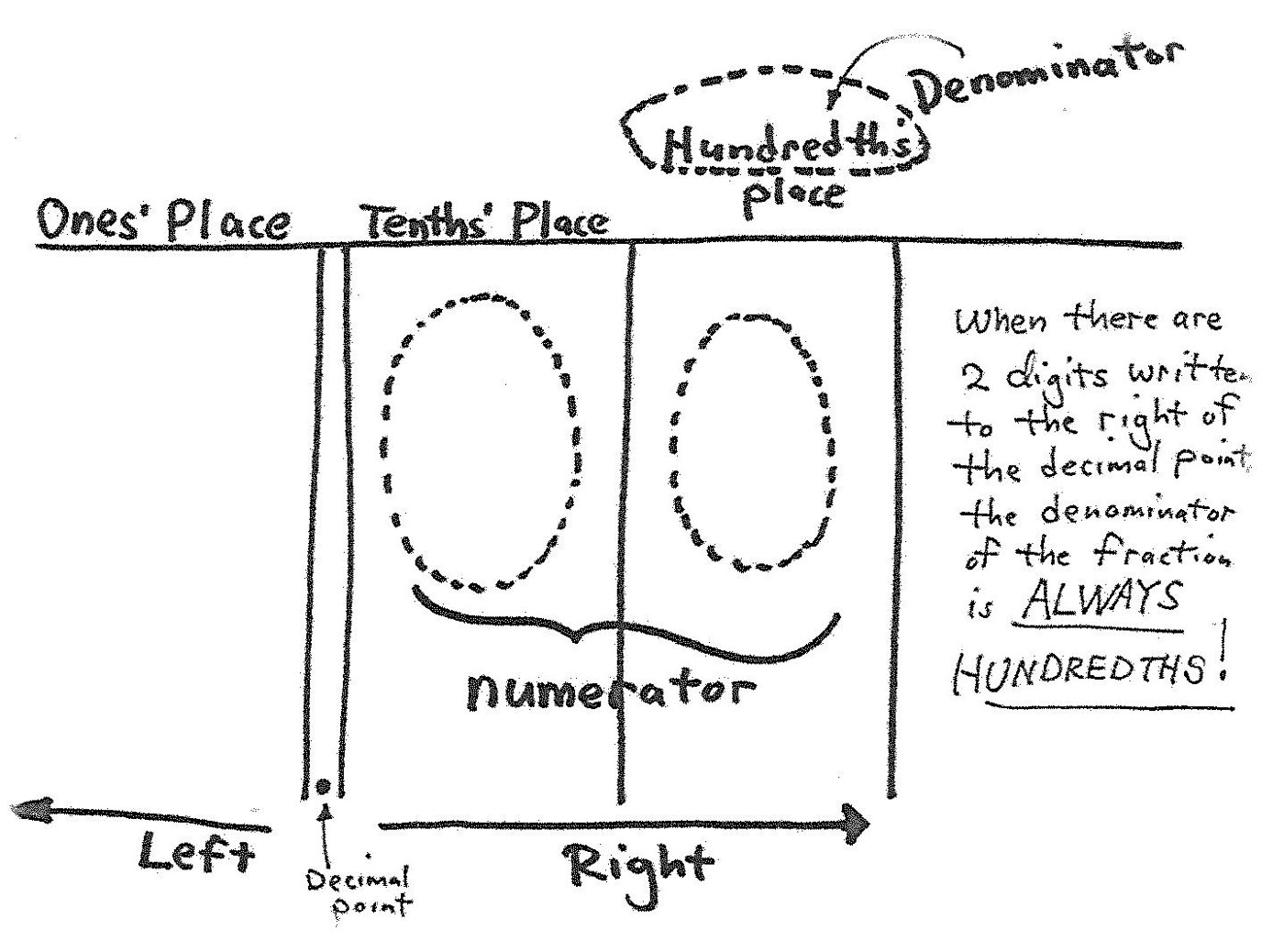
• TENTHS • HUNDREDTHS
WHAT ARE TENTHS?
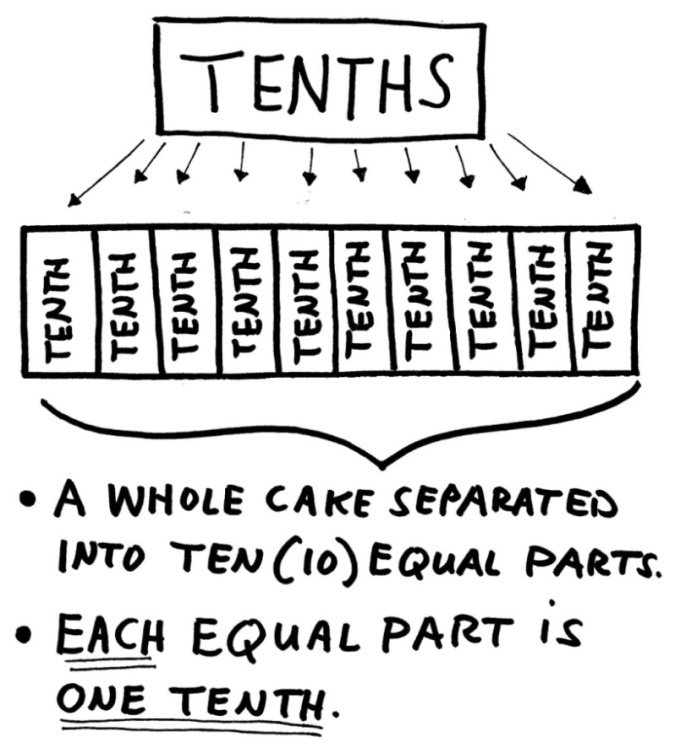
▒ DEFINITION OF “TENTHS”: WHEN A FRACTION-THING HAS BEEN SEPARATED INTO TEN EQUAL PARTS, THOSE PARTS ARE CALLED “TENTHS.” ONE OF THOSE TEN EQUAL PIECES IS NAMED “ONE-TENTH.”
SENTENCE: EACH ONE OF THE TEN EQUAL SLICES OF BIRTHDAY CAKE IS A TENTH OF THE WHOLE CAKE.
HUNDREDTHS
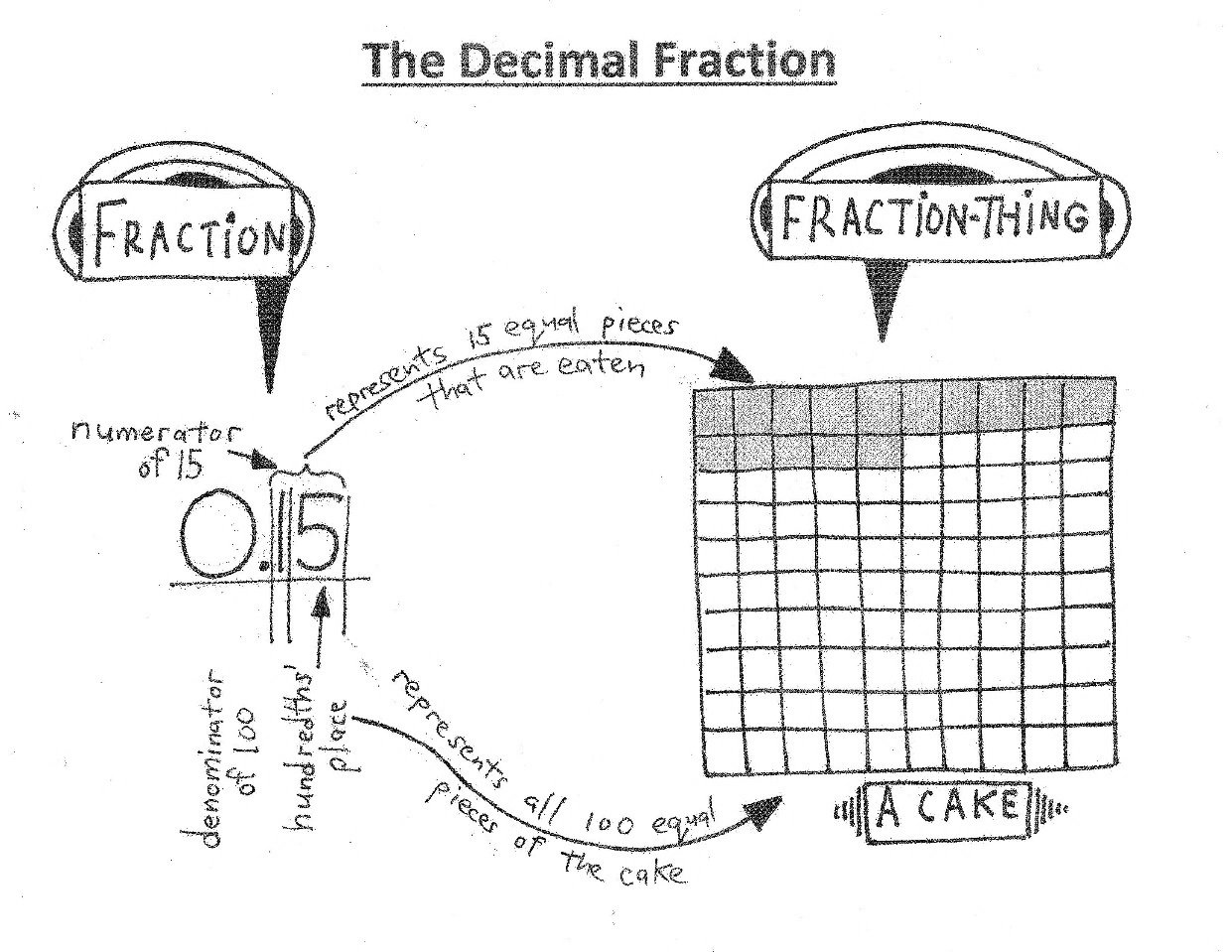
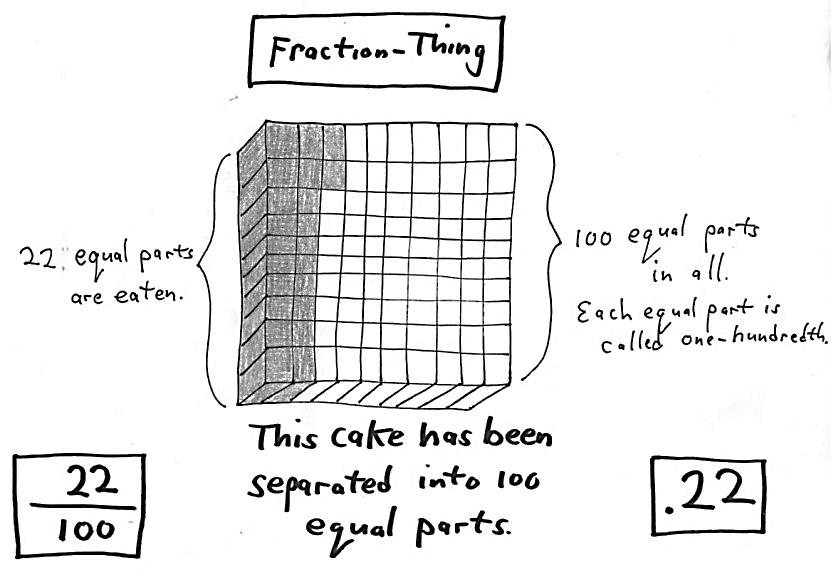
▒ DEFINITION OF HUNDREDTH: WHEN A FRACTION-THING HAS BEEN SEPARATED INTO 100 EQUAL PARTS, EACH SEPARATE EQUAL PART IS NAMED “ONE HUNDREDTH.”
SENTENCE: EACH OF THE 100 EQUAL PIECES OF THE BIRTHDAY CAKE IS ONE HUNDREDTH OF THE WHOLE CAKE.
The cake in the following picture is a fraction-thing which has been separated into 100 equal pieces. Each piece of cake is one hundredth of the whole cake.
Not all decimal fractions have a one-digit numerator written to the right of the decimal point. Some decimal fractions have a two-digit numerator written to the right of the decimal point.
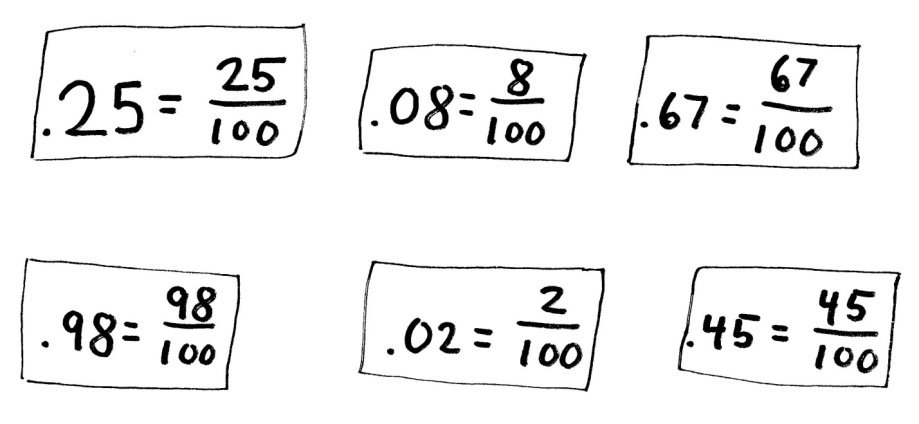
Here are some decimal fractions with two-digit numerators written to the right of the decimal point:
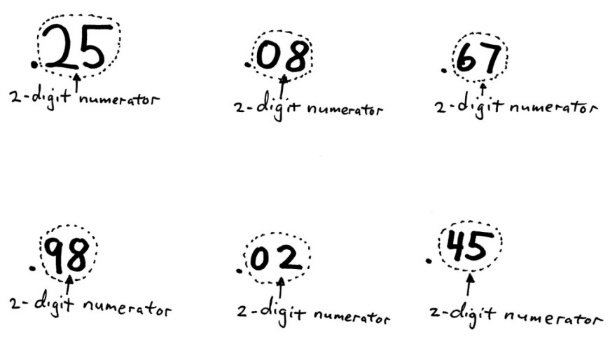
We can easily see the two-digit numerators of these decimal fractions. The two-digit numerators are:
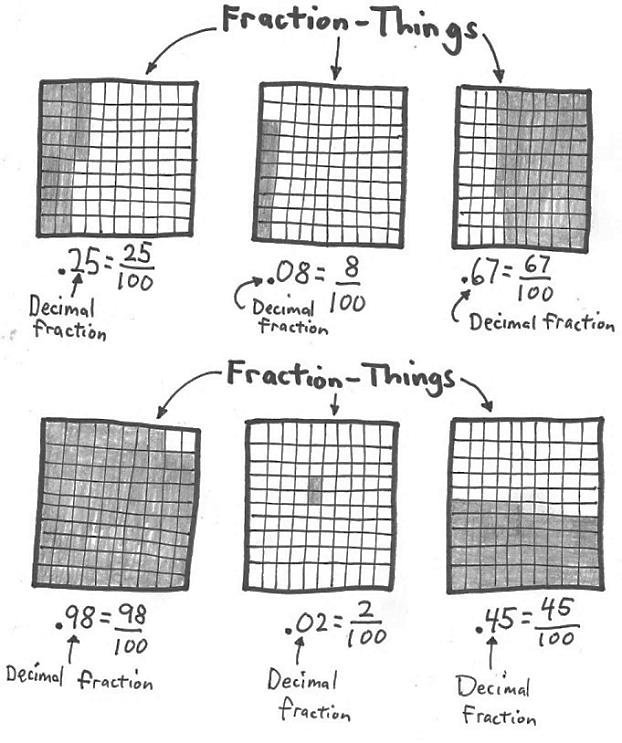
The six cakes in the next picture (the fraction-things) have been separated into 100 equal parts. Each of the 100 small parts in each cake is one-hundredth of the cake.
ANOTHER WAY OF WRITING A DECIMAL FRACTION
Sometimes you will see a decimal fraction written like this: .3
Sometimes the same decimal fraction is written like this: 0.3
The decimal fractions .3 and 0.3 mean exactly the same thing.
So why do we need two ways to write the same thing? You write a 0 in the ones’ place when you want the reader to know for sure that there are NO whole number parts in a number which contains a decimal fraction.
Look back at the place value chart on page 83. Can you find the digit 4 in the hundreds’ place? • in the tens’ place? • in the ones’ place?
• in the tenths’ place? • and in the hundredths’ place?
Ask yourself this question: What is the digit value of the 4 in each different place? The same digit 4 has a completely different digit value when it is written in a different math place.
● The digit 4 in the hundreds’ place has a digit value of 400
● The digit 4 in the tens’ place has a digit value of 40
● The digit 4 in the ones’ place has a digit value of 4
● The digit 4 in the tenths’ place has a digit value of 410
● The digit 4 in the hundredths’ place has a digit value of4100
THAT IS WHY
THE NUMERAL 444.44 MEANS:
Here’s the same number (444.44) using letter numbers instead of numerals:
FOUR HUNDRED FORTY-FOUR
AND FORTY-FOUR HUNDREDTHS.
WHAT ARE THOUSANDTHS?
In fifth grade, students usually learn about the third place to the left of the decimal point: THE THOUSANDTHS’ PLACE.
DEFINITION OF “THOUSANDTH”: WHEN A FRACTION-THING HAS BEEN SEPARATED INTO 1,000 EQUAL PARTS, EACH SEPARATE PART IS CALLED “ONE THOUSANDTH.”
SENTENCE: IN ORDER TO MEASURE THE SIZE OF VERY SMALL THINGS, LIKE THE PARTS OF A HUMAN CELL, THE SCIENTIST USED THOUSANDTHS OF AN INCH
Here’s an example of a decimal fraction with a digit
in the thousandth’s place:
0.555
Using letter numbers, 0.555 is written:
“FIVE HUNDRED FIFTY-FIVE THOUSANDTHS”
The common fraction equivalent of 0.555 is 555/1000
Hmmm… 0.555 (555/1000). Let’s think about a fraction-thing separated into 1,000 equal pieces. The series of illustrations that starts on the next page can help you better understand the idea of thousandths – and even ten-thousandths!
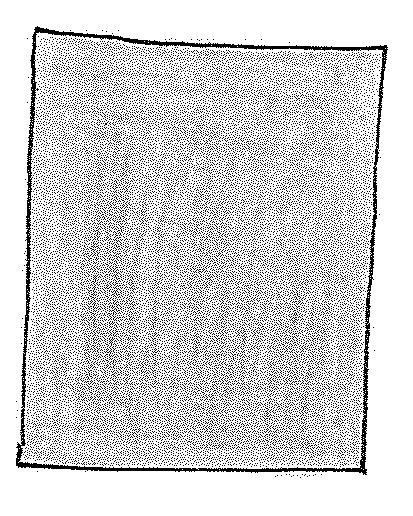
Let’s imagine that this next picture shows a whole cake. This cake is a single wedding cake – one (1) wedding cake. To show how many cakes we have, we write the digit 1 in the ones’ place.
1 WHOLE CAKE
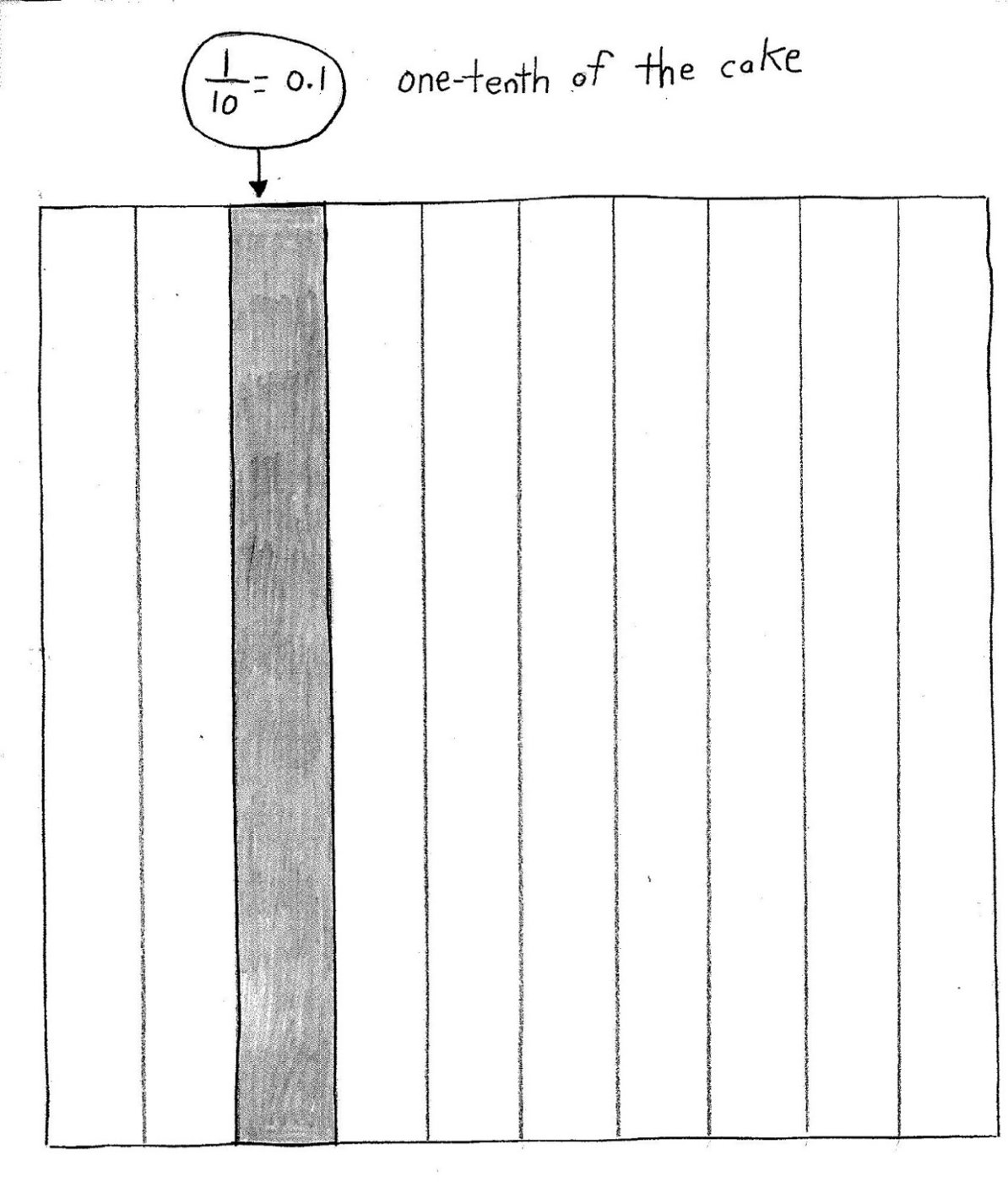
The following fraction-thing is the same wedding cake, but now the cake is separated into ten (10) equal parts. Each equal part of the cake is one tenth (1/10) of the cake. TO SHOW HOW MANY EQUAL PARTS OF THIS CAKE HAVE BEEN EATEN, WE WRITE THE DIGIT 1 IN THE TENTHS’ PLACE — THE FIRST PLACE TO THE RIGHT OF THE DECIMAL POINT: 0.1.
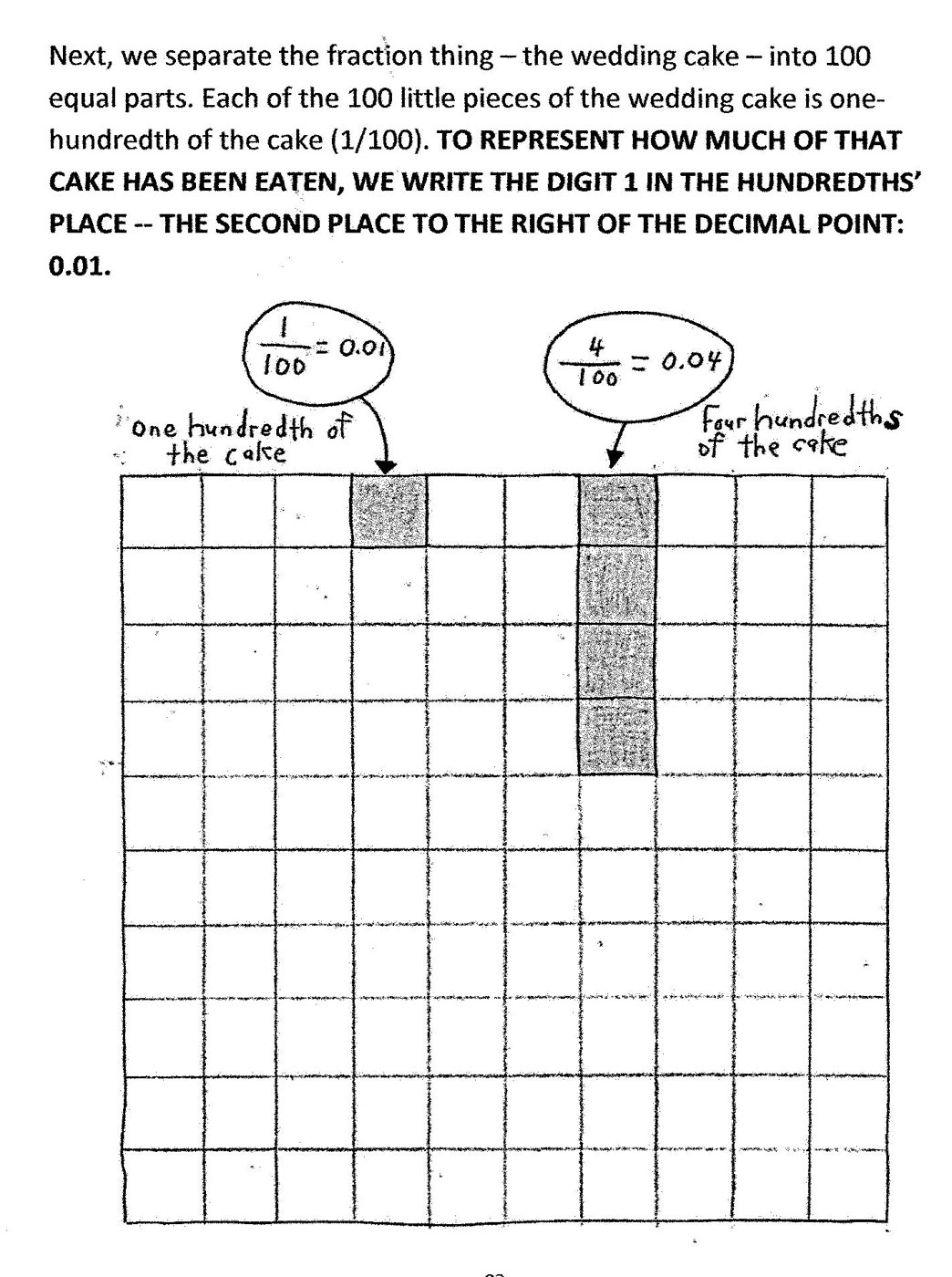
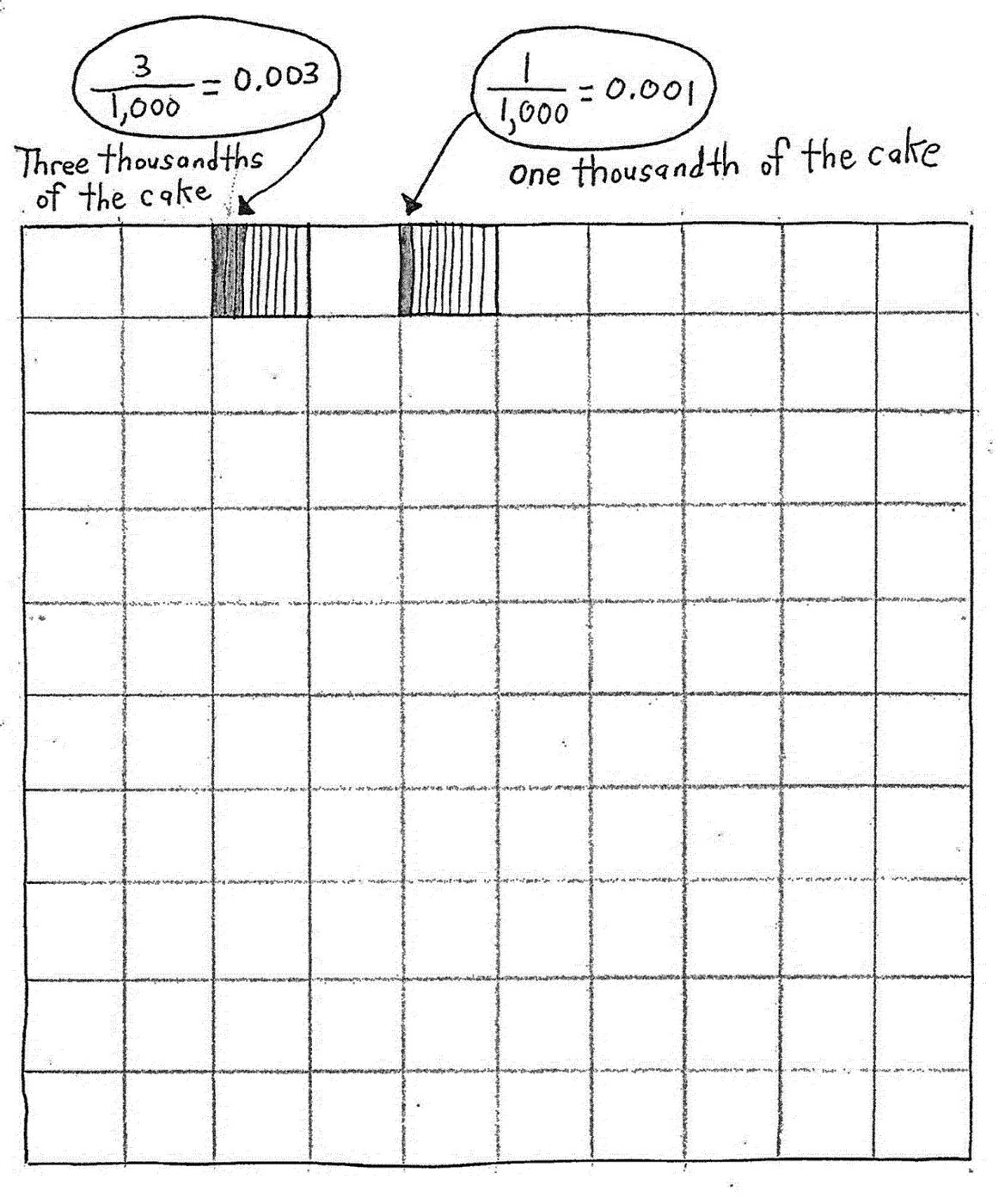
In the next fraction-thing, we have taken a single equal part of those hundred equal parts of the cake. We have separated that single equal part (one of the 100 equal parts) into ten (10) equal parts. Each of those 10 equal parts is 1/1000 of the wedding cake. Why? Here’s the arithmetic: 100 equal parts x 10 = 1000. TO SHOW ONE THOUSANDTH OF THE CAKE, WE WRITE THE DIGIT 1 IN THE THOUSANDTHS’ PLACE — THE THIRD PLACE TO THE RIGHT OF THE DECIMAL POINT: 0.001
TEN-THOUSANDTHS
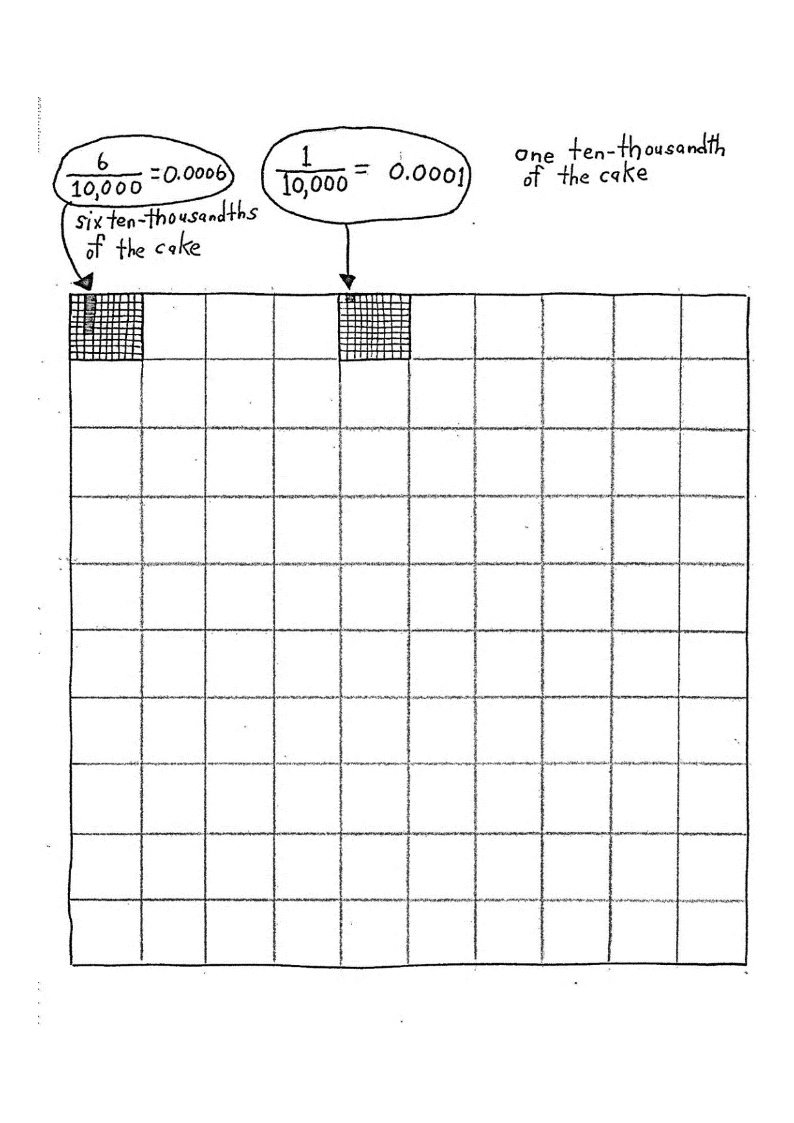
Finally, to demonstrate ten-thousandths, we separate each square of the cake that shows one hundredth of the cake into one hundred (100) equal parts.
100 x 100 = 10,000
So, each of those 100 equal parts is 1/10,000 of the wedding cake: (See the picture on the next page.)
TO SHOW ONE TEN-THOUSANDTH OF THE CAKE, WE WRITE THE DIGIT 1 IN THE TEN-THOUSANDTHS’ PLACE — THE FOURTH PLACE TO THE RIGHT OF THE DECIMAL POINT:
0.0001
DEFINITION OF “TEN-THOUSANDTH”: WHEN A FRACTION-THING HAS BEEN SEPARATED INTO 10,000 EQUAL PARTS, EACH PART IS CALLED “ONE TEN-THOUSANDTH.”
SENTENCE: ONE TEN-THOUSANDTH OF AN INCH IS A TINY, TINY LENGTH.
SUMMARY OF
DECIMAL FRACTION PLACE VALUES:
TENTHS, HUNDREDTHS & THOUSANDTHS
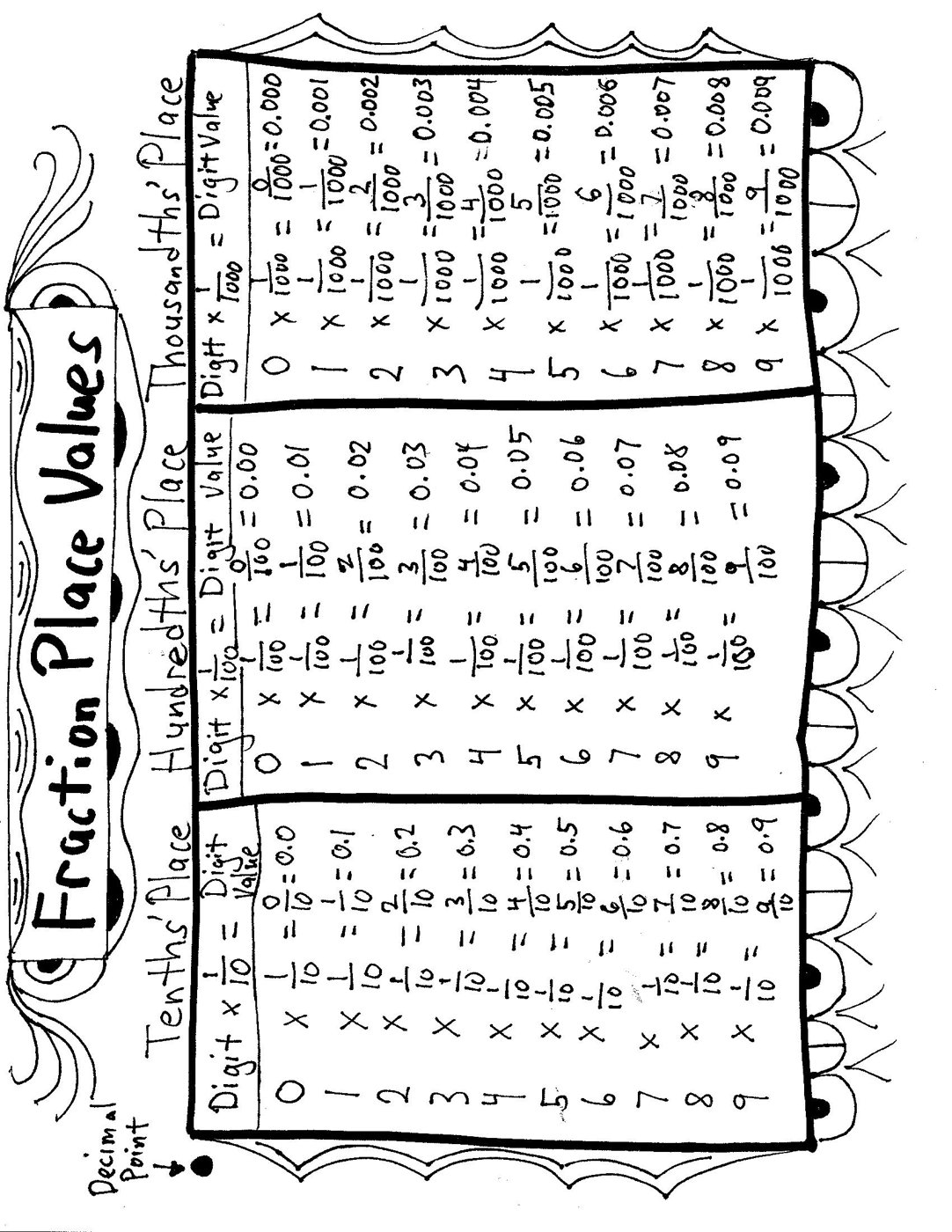
We have just added “thousandths” to our list of fraction place values. So, let’s take another look at place values. We remember that the value of a digit depends on the place where the digit is written. The digit 5 written in the hundreds’ place has a value of 500
The same digit 5 written in the hundredths’ place has a value of
5100or .05
And the same digit 5 written in the thousandths’ place has a value of
51000or .005
▒ DEFINITION OF PLACE VALUE: THE VALUE OF THE PLACES WHERE WE WRITE THE DIGITS. THE DIGITS WRITTEN IN A PLACE ARE MULTIPLIED WITH THE PLACE VALUE (100, 10, 1, 1/10, 1/100, 1/1000) TO FIND THE DIGIT VALUE. THESE ARE THE MOST COMMONLY USED PLACE VALUES: HUNDREDS, TENS, ONES, TENTHS, HUNDREDTHS AND THOUSANDTHS.
SENTENCE: UNDERSTANDING PLACE VALUE HELPS US READ BIG NUMERALS (LIKE 125,000), AND SMALL NUMERALS (LIKE 0.125).
DEFINITION OF TENTHS: THE VALUE OF THE DIGITS WHEN THEY HAVE BEEN MULTIPLIED WITH 1/10. SO, THE TENTHS are 0.1 (1/10), 0.2 (2/10), 0.3 (3/10), 0.4 (4/10), 0.5 (5/10), 0.6 (6/10), 0.7 (7/10), 0.8 (8/10), 0.9 (9/10).
SENTENCE: THE PIE WAS SEPARATED INTO TENTHS SO ALL 10 GUESTS COULD HAVE ONE PIECE OF PIE.
DEFINITION OF TENTHS’ PLACE: THE MATH PLACE WHERE THE DIGITS ARE MULTIPLIED WITH 1/10 TO GET THEIR DIGIT VALUE.
SENTENCE: THE TENTHS’ PLACE IS THE FIRST DECIMAL FRACTION PLACE TO THE RIGHT OF THE DECIMAL POINT.
DEFINITION OF HUNDREDTHS: THE VALUE OF THE DIGITS WHEN THEY HAVE BEEN MULTIPLIED WITH 1/100. SO, THE HUNDREDTHS are 0.01 (1/100), 0.02 (2/100), 0.03 (3/100), 0.04 (4/100), 0.05 (5/100), 0.06 (6/100), 0.07 (7/100), 0.08 (8/100), 0.09 (9/100).
SENTENCE: WHEN WE SEPARATE A BIG SQUARE CAKE INTO 100 EQUAL PARTS, THOSE PARTS ARE HUNDREDTHS
DEFINITION OF HUNDREDTHS’ PLACE: THE MATH PLACE WHERE THE DIGITS ARE MULTIPLIED WITH 1/100 TO GET THEIR DIGIT VALUE.
SENTENCE: THE HUNDREDTHS’ PLACE IS WHERE WE WRITE THE HUNDREDTHS, LIKE 0.02 (2/100) AND 0.09 (9/100).
DEFINITION OF THOUSANDTHS: THE VALUE OF THE DIGITS WHEN THEY HAVE BEEN MULTIPLIED WITH 1/1000. SO, THE THOUSANDTHS ARE 0.001 (1/1000), 0.002 (2/1000), 0.003 (3/100), 0.004 (4/1000), 0.005 (5/1000), 0.006 (6/1000), 0.007 (7/1000), 0.008 (8/1000), 0.009 (9/1000).
SENTENCE: WHEN WE SEPARATE A BIG SQUARE CAKE INTO 1000 EQUAL PARTS, THOSE PARTS ARE CALLED THOUSANDTHS.
DEFINITION OF THOUSANDTHS’ PLACE: THE MATH PLACE WHERE THE DIGITS ARE MULTIPLIED WITH 1/000 TO GET THEIR DIGIT VALUE.
SENTENCE: THE THOUSANDTHS’ PLACE IS OFTEN USED WHEN SCIENTISTS ARE MEASURING REALLY SMALL OBJECTS OR TINY DISTANCES.
The following fraction place value chart shows the fraction “place values” from tenths to thousandths. (Please turn the chart sideways to study it in detail!)
THE PERCENT FRACTION
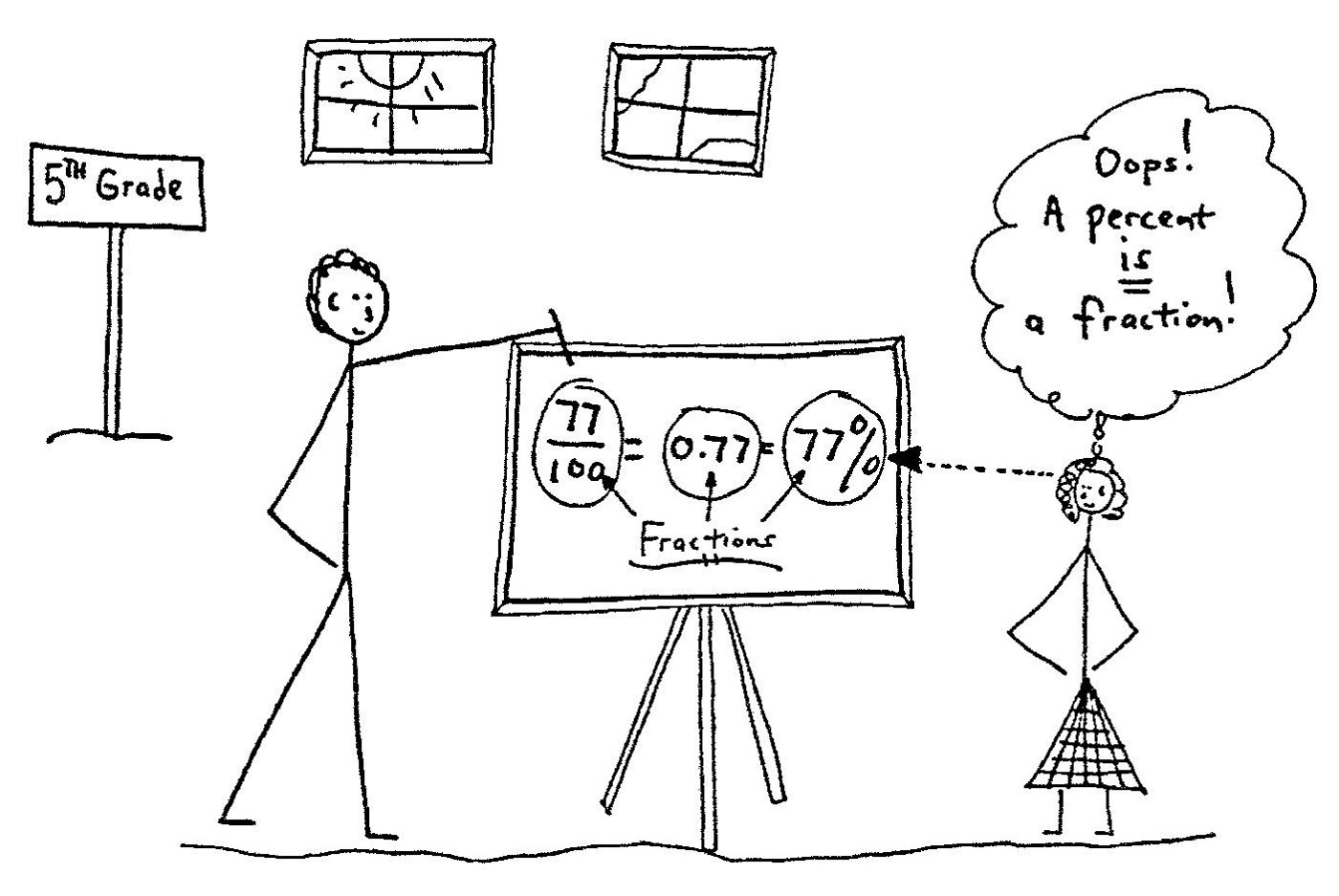
THE PERCENT IS A FRACTION
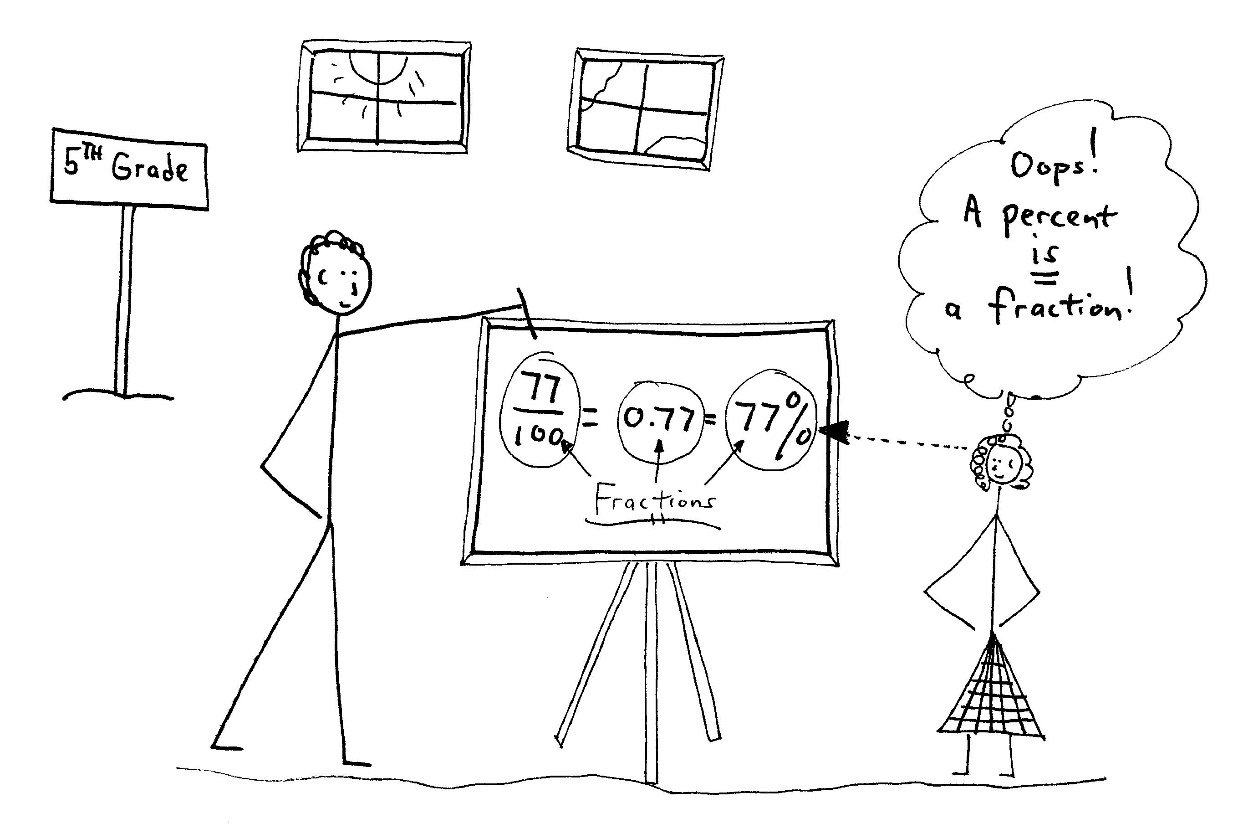
• COMPLETE DEFINITION OF PERCENT FRACTION: THE PERCENT FRACTION IS THE THIRD KIND OF FRACTION.
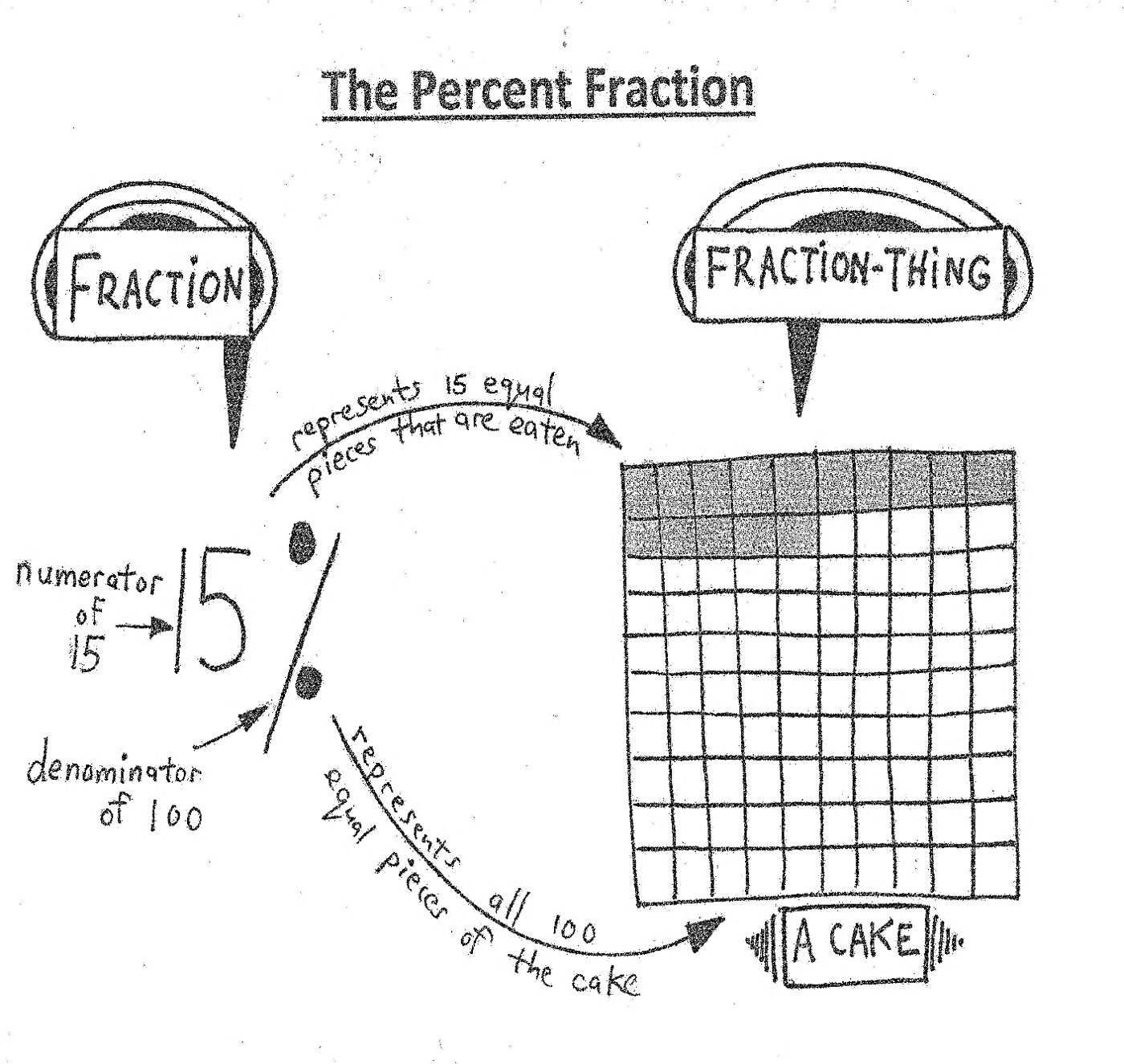
• LIKE ALL FRACTIONS, THE PERCENT FRACTION USES A NUMERATOR AND DENOMINATOR TO REPRESENT THE EQUAL PARTS OF A FRACTION-THING.
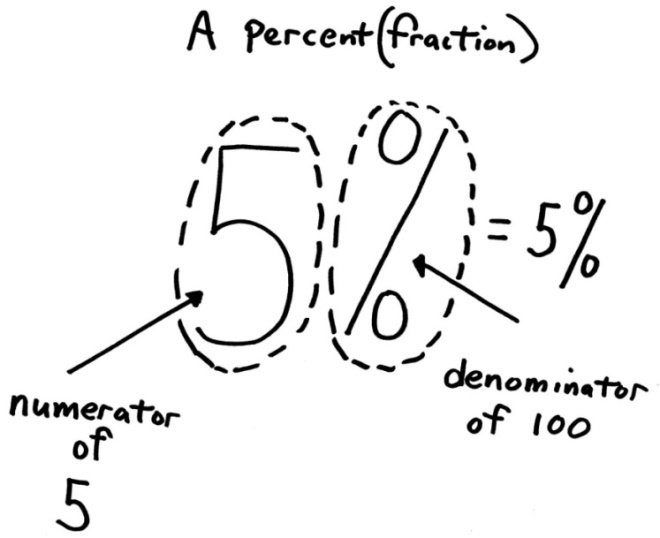
• THE NUMERATOR OF A PERCENT FRACTION IS THE NUMERAL WRITTEN TO THE LEFT OF A SPECIAL SIGN CALLED THE PERCENT SIGN. • THE PERCENT SIGN LOOKS LIKE THIS: %
• THE PERCENT SIGN TELLS US THAT THE DENOMINATOR OF THIS FRACTION IS 100 (meaning “hundredths”).
• % MEANS 100 EQUAL PARTS IN ALL
• PERCENT FRACTIONS REPRESENT FRACTION-THINGS THAT ARE SEPARATED INTO 100 EQUAL PARTS
SENTENCE: ALL PERCENT FRACTIONS HAVE THE VERY SAME DENOMINATOR – 100!
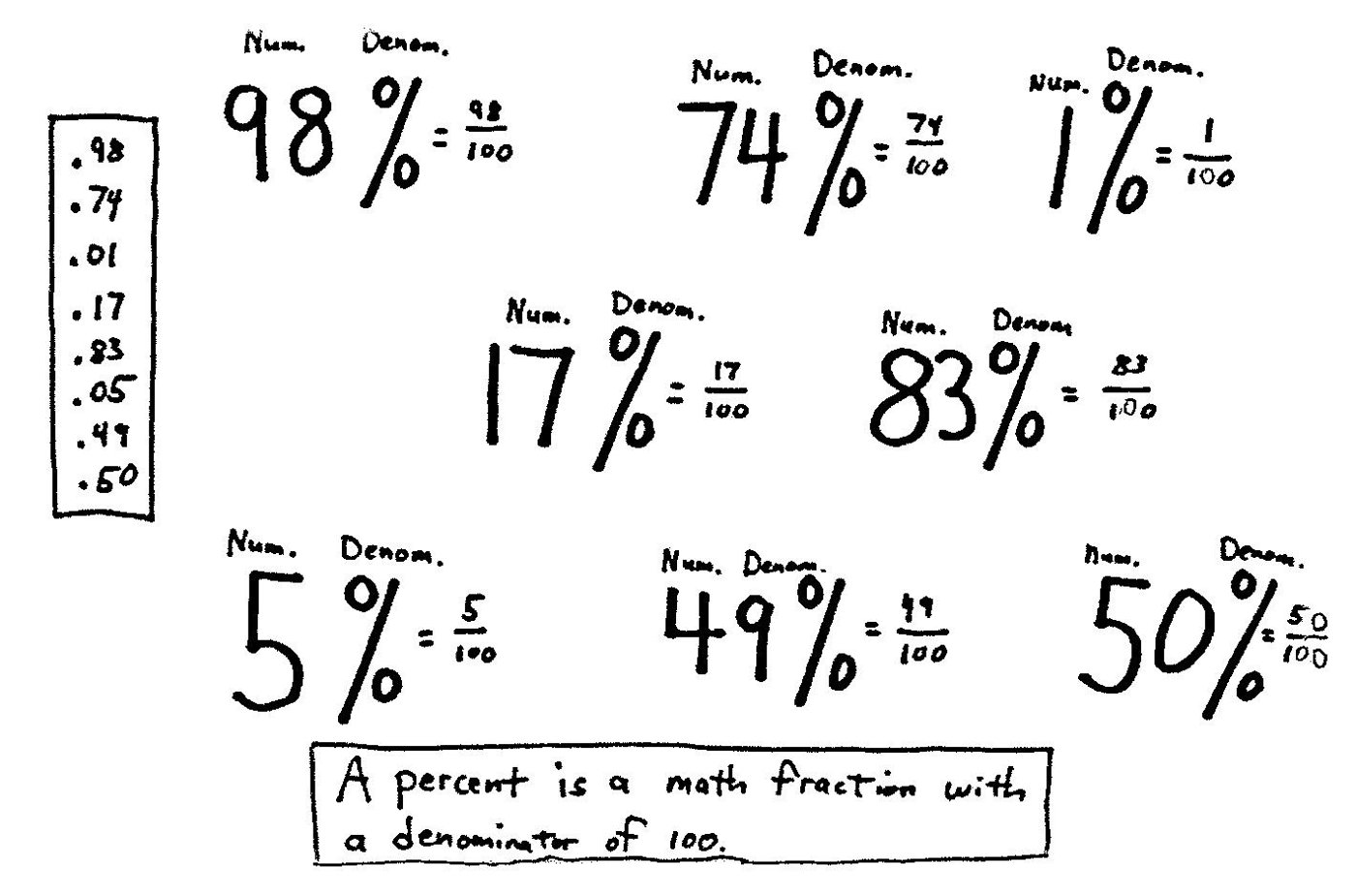
Percents are easy! A percent is a math fraction with a denominator that is always 100 (meaning “hundredths”.)
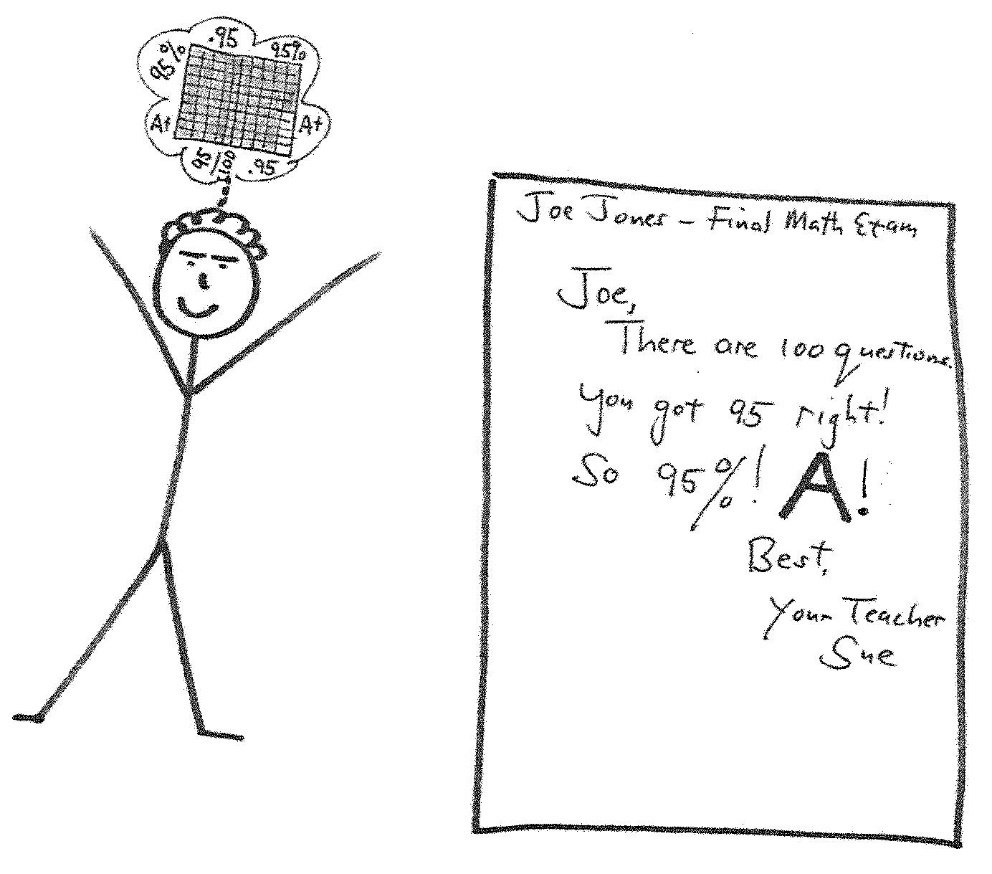
PERCENT OR PERCENT FRACTION?
In most math books the fractions that use a percent sign (75%, 3%, 92%, 16%, etc.) are just named a “percent.” They are not named a “percent fraction.”
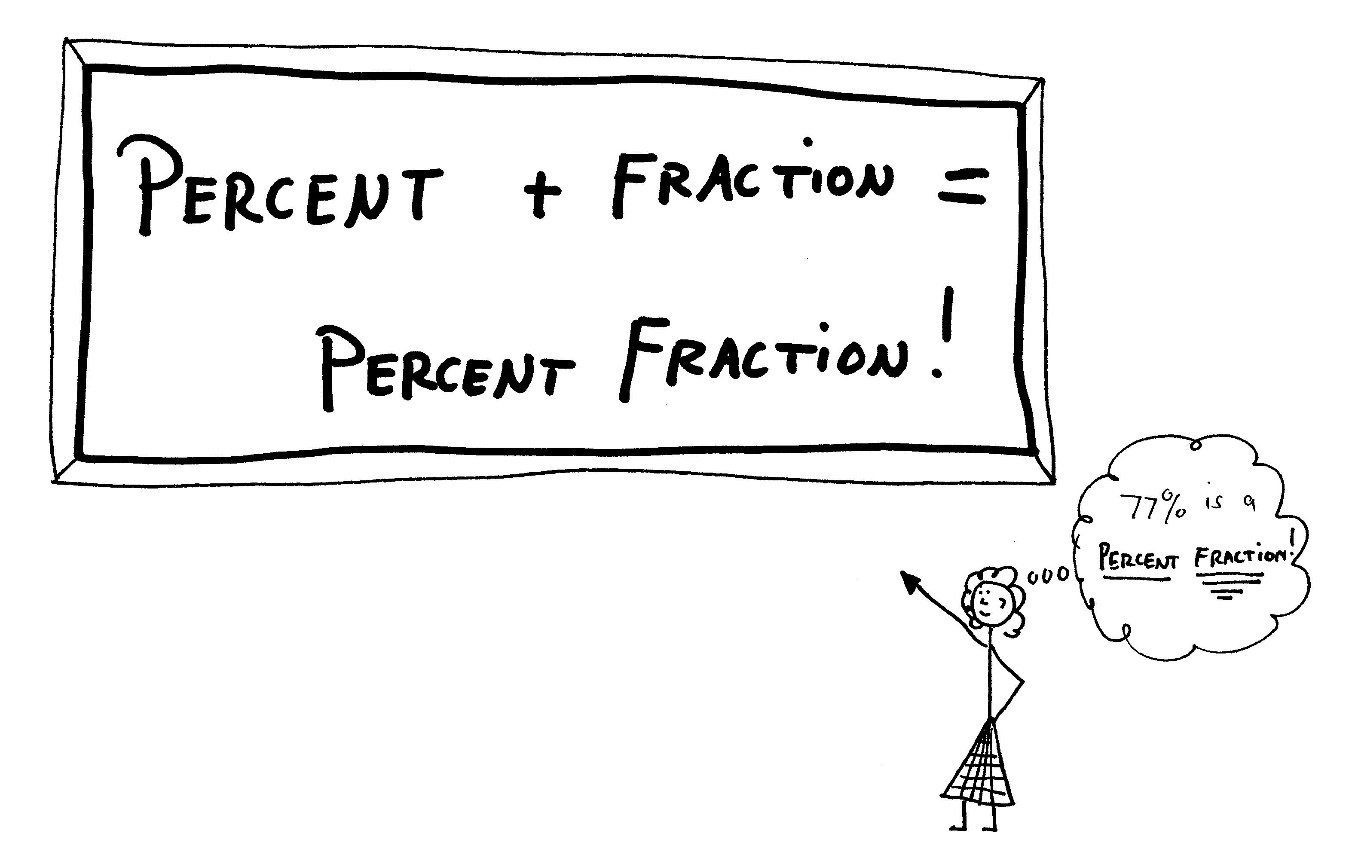
But, in this glossary the word “fraction” has been added to the word “percent” to make the new word, “percent fraction.”
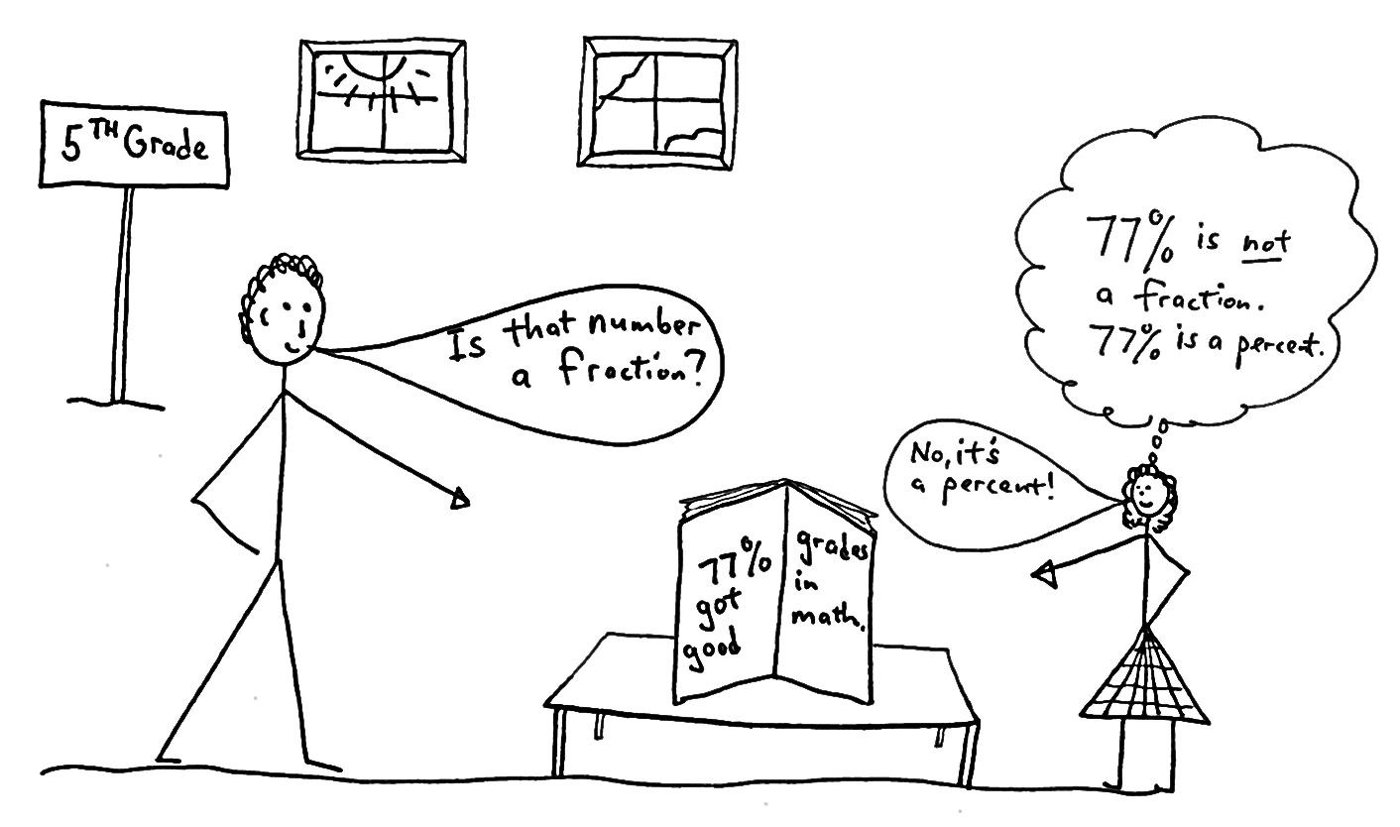
Why make a new word?
Here’s why: After tutoring hundreds of math students, I found that many students do not know that the percent numbers in their arithmetic books are actually fractions. This misunderstanding has caused many students to have trouble solving percent problems. But, if we use the new word “percent fraction,” students are always reminded that the percent is actually just another kind of a fraction.
COMPARING
FRACTION DENOMINATORS
The percent fraction is different from both the common fraction and the decimal fraction. The main difference is the percent fraction’s denominator. Now let’s compare the denominators of all three kinds of fractions.
COMMON FRACTION DENOMINATORS
A common fraction can have a denominator of any size:
58 525 963 25125 5250
The denominators of these common fractions are:
8 25 63 125 250
When we are doing math with common fractions, we can separate the fraction-thing of a common fraction into as many equal parts as we want. We can always show those equal parts as the denominators of common fractions.
DECIMAL FRACTION DENOMINATORS
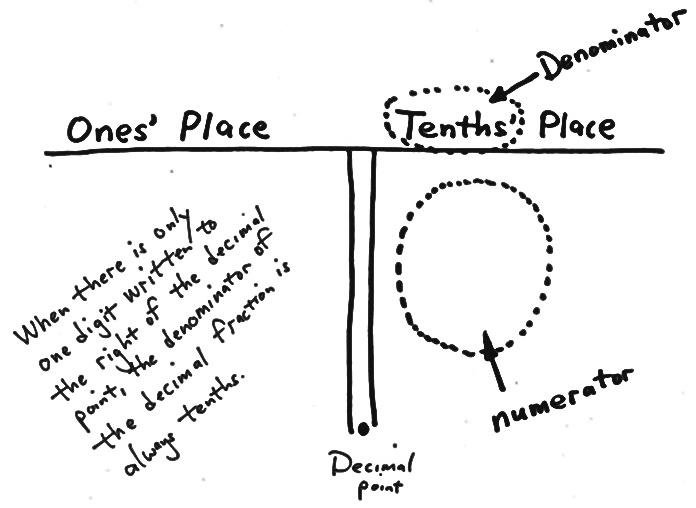
Here is the decimal fraction .7 or 0.7. We can easily see that there is only one digit (the digit 7) to the right of the decimal point.
So, the denominator of .7 or 0.7 is TENTHS — because tenths is the first place value to the right of the decimal point.
Here is the decimal fraction .52 or 0.52. We can easily see that 0.52 has two digits to the right of the decimal point (the digits 5 and 2). So, the denominator of 0.52 is HUNDREDTHS — because hundredths is the place value of the second place to the right of the decimal point.
Note: Not all decimal fractions have denominators of tenths and hundredths. Some other denominators of decimal fractions are thousandths and ten-thousandths. Students in 5th grade and above learn to use thousandths and even ten-thousandths.
PERCENT FRACTION DENOMINATORS
PERCENT FRACTIONS ALWAYS HAVE ONE DENOMINATOR: 100
All percent fractions have the same denominator: 100.
The following fractions are all percent fractions:
1% 5% 17% 49% 83% 98%
The percent sign (%) tells us that the denominator is 100
So, each of the percent fractions written above has exactly the same denominator: 100
The numerators of the percent fractions written above are:
1 5 17 49 83 98
When you see a numeral written to the left of a percent sign (for example: 50%) that numeral is the numerator of a percent fraction. THE NUMERATOR IS 50. THE DENOMINATOR IS 100.
Example: 5% means the same thing as the common fraction5100.
5% also means the same thing as the decimal fraction 0.05
The numeral 5 is the numerator. the % sign means that the denominator IS 100.
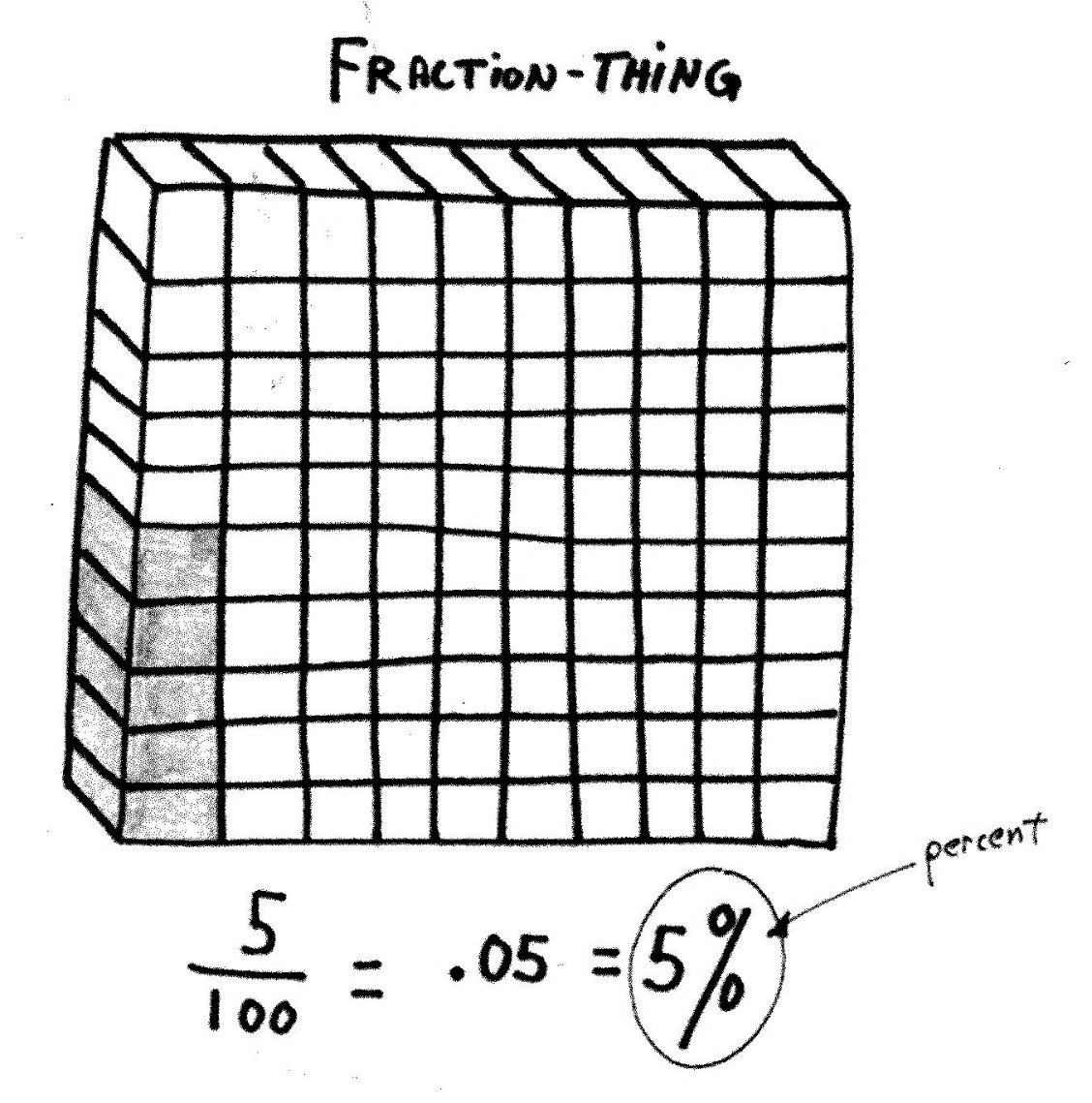
5% = 5100= 0.05
Example:
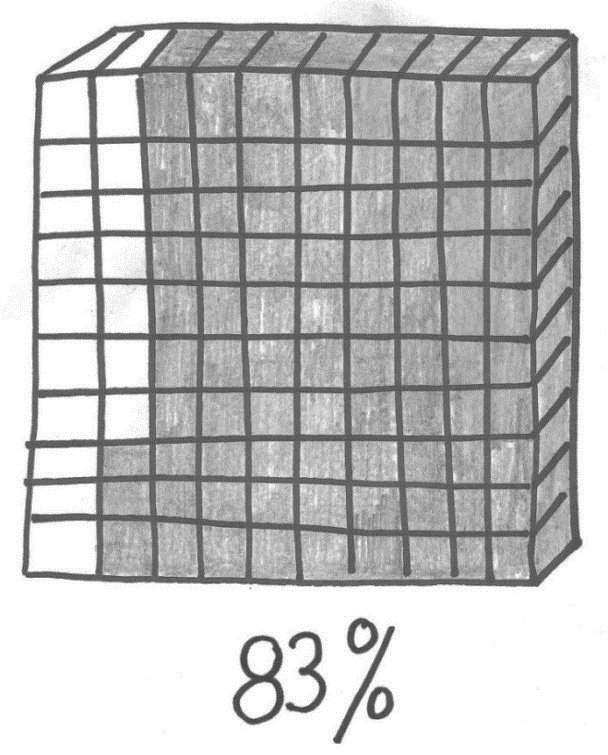
• 83% means the same thing as the common fraction83100.
• The numeral 83 is the numerator.
• The % sign means that the denominator is 100.
• 83% also means the same thing as the decimal fraction 0.83.
Here is a percent fraction representing a group of 100 apples. 18% are bad!
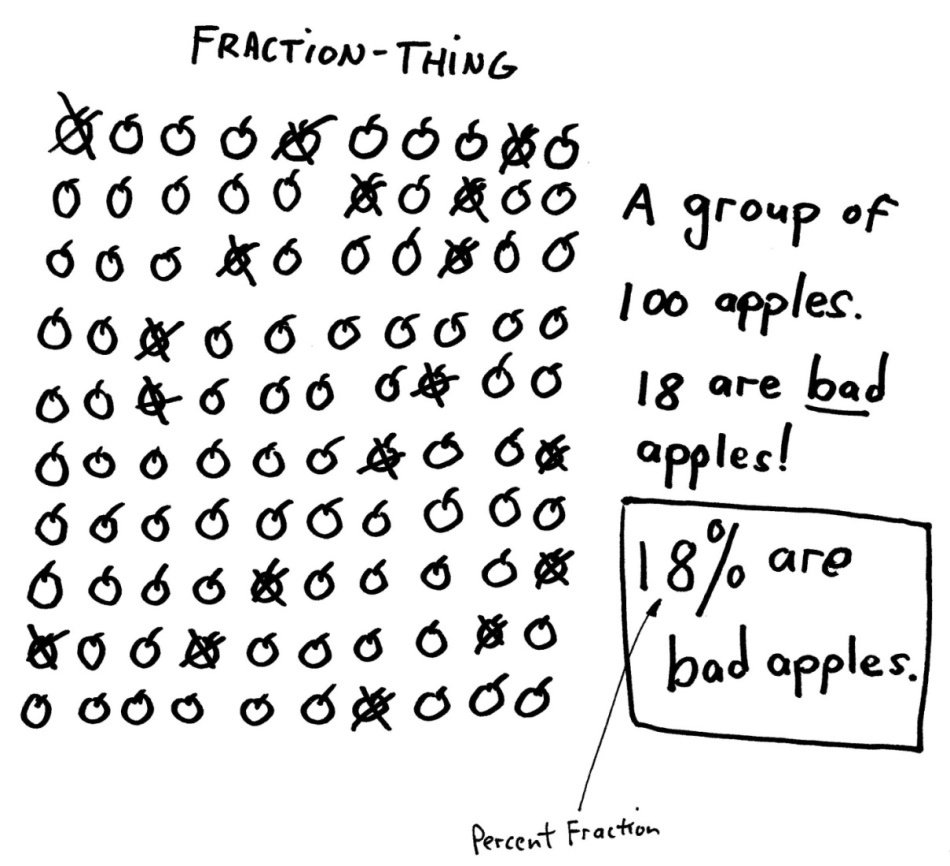
18100= 0.18 = 18%
THE FAMILY OF FRACTIONS
▒ DEFINITION OF “FAMILY OF FRACTIONS”: THE COMMON FRACTION, THE DECIMAL FRACTION, AND THE PERCENT FRACTION ARE MEMBERS OF THE “FAMILY OF FRACTIONS.” COMMON FRACTIONS, DECIMAL FRACTIONS, AND PERCENT FRACTIONS ALL SHARE FIVE IMPORTANT FACTS. THESE FIVE IMPORTANT FACTS ARE CALLED THE FAMILY OF FRACTIONS FIVE FRACTION FACTS.
SENTENCE: IF A NUMBER USES A NUMERATOR AND DENOMINATOR TO REPRESENT A FRACTION-THING, THEN THAT NUMBER IS A MEMBER OF THE FAMILY OF FRACTIONS.
You have now learned three different ways of writing math fractions.
● THE COMMON FRACTION
● THE DECIMAL FRACTION
● THE PERCENT FRACTION
You will learn more ways to write fractions in later math courses. But you will probably not be surprised when you learn the other ways to write fractions.
Why?
BECAUSE ALL FRACTIONS
ARE PART OF THE SAME FAMILY OF NUMBERS!
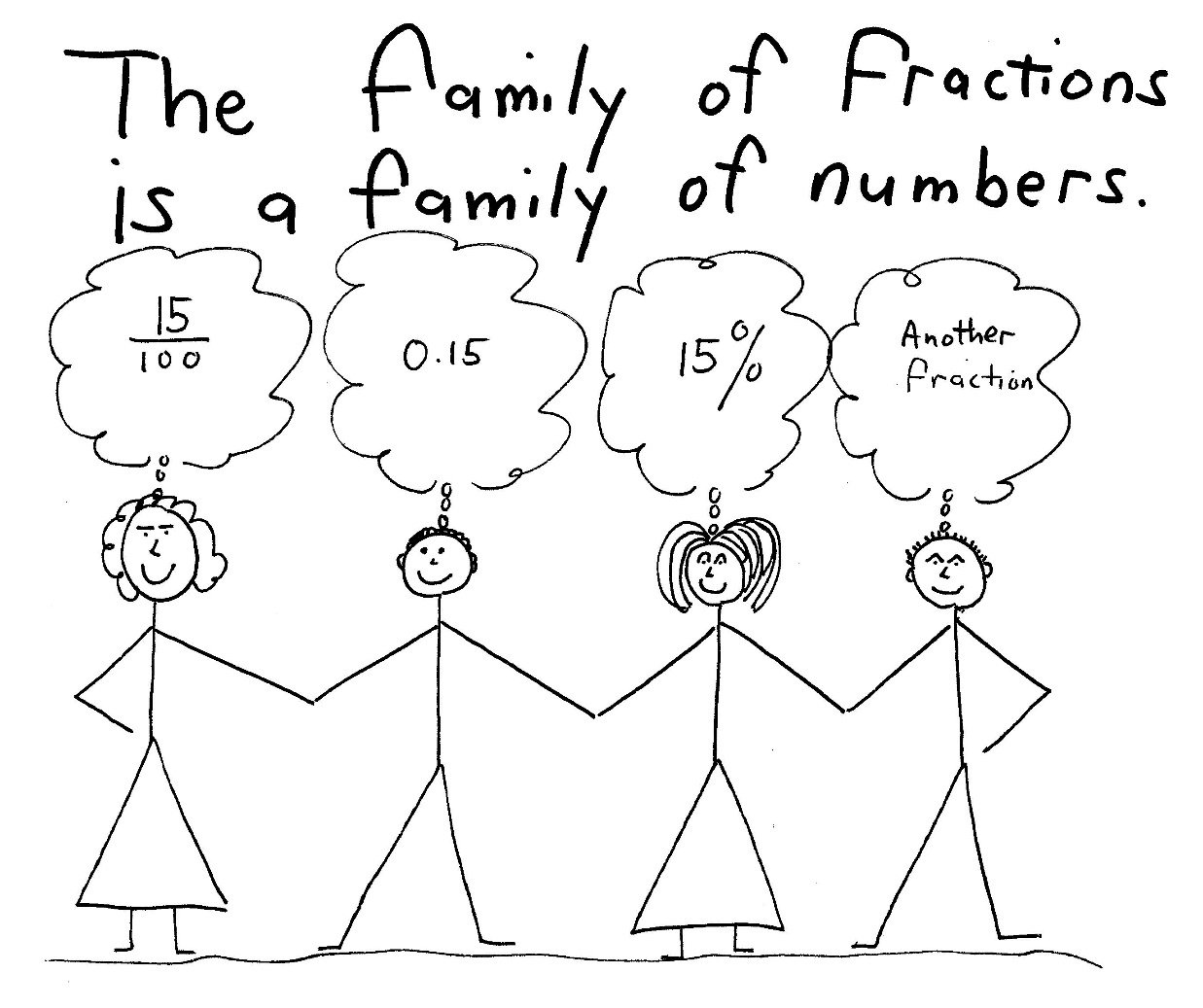
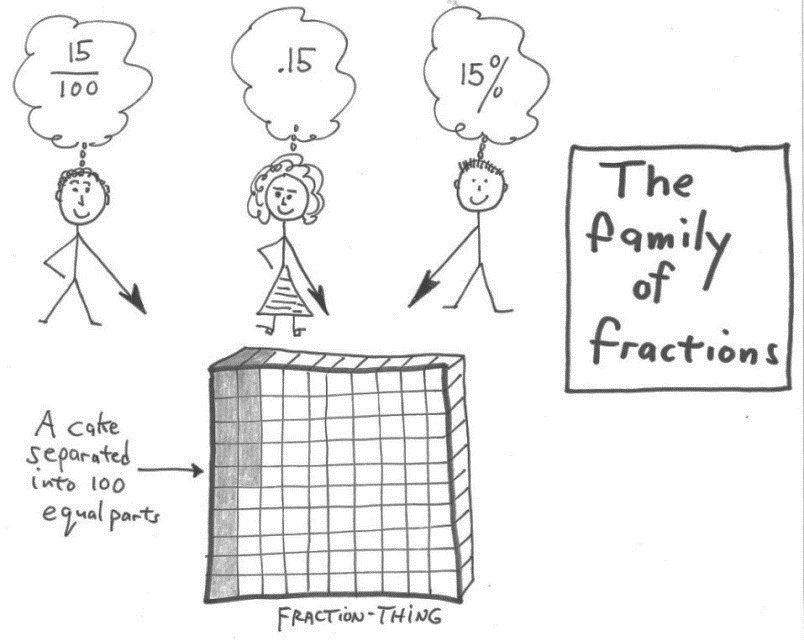
DEFINITION OF “FAMILY OF FRACTIONS FIVE FRACTION FACTS (FFFFF)”: FRACTIONS ARE A FAMILY OF NUMBERS BECAUSE THE FOLLOWING FIVE FRACTION FACTS (FFFFF’s) ARE TRUE FOR ALL FRACTIONS:
The Family of Fractions
Five Fraction Facts
(The Five F’s: FFFFF)
FRACTION FACT #1
A MATH FRACTION IS ALWAYS A NUMBER. THIS MEANS THAT THE FAMILY OF FRACTIONS IS A FAMILY OF NUMBERS.
FRACTION FACT #2
A MATH FRACTION IS NEVER A THING, A PART OF A THING, OR AN EQUAL PART OF A THING.
FRACTION FACT #3
A MATH FRACTION ALWAYS REPRESENTS (SHOWS, STANDS FOR) EQUAL PARTS OF THINGS OR EQUAL PARTS
OF GROUPS OF THINGS.
FRACTION FACT #4
ALL MATH FRACTIONS REPRESENT FRACTION-THINGS.
FRACTION FACT #5
ALL MATH FRACTIONS HAVE A NUMERATOR
AND A DENOMINATOR.
THREE USEFUL DEFINITIONS OF FRACTION
Let’s review the two different, useful definitions of the word “fraction” given in this glossary:
● Beginner’s definition: A MATH FRACTION IS ANY NUMBER THAT SHOWS THE EQUAL PARTS OF SOMETHING.
● A more complete definition: A MATH FRACTION IS ANY NUMBER THAT REPRESENTS THE EQUAL PARTS OF A THING OR THE EQUAL PARTS OF A GROUP OF THINGS.
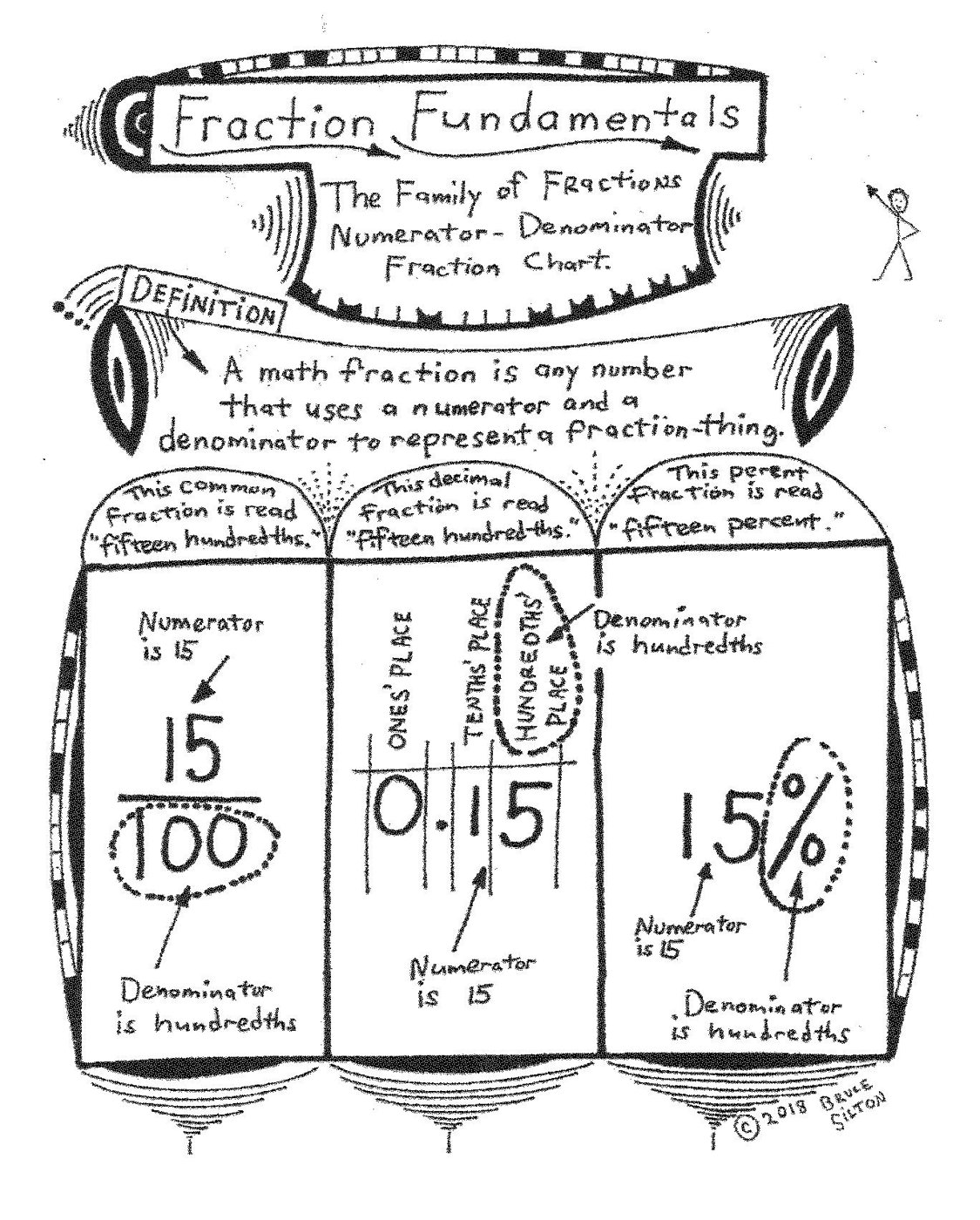
THE MOST IMPORTANT DEFINITION OF A MATH FRACTION
THERE IS ONE MORE DEFINITION OF A FRACTION TO LEARN — THE MOST IMPORTANT FRACTION IDEA OF ALL.
You have now learned about the common fraction, the decimal fraction, and the percent fraction. You know that the common fraction, decimal fraction, and percent fraction all represent fraction-things. You also know that common fractions, decimal fractions, and percent fractions all use a numerator and a denominator to represent the equal parts of something. So, we can say that:
MOST IMPORTANT DEFINITION OF A MATH FRACTION:
A FRACTION IS ANY NUMBER THAT USES A NUMERATOR AND A DENOMINATOR TO REPRESENT A FRACTION-THING.
SENTENCE: THIS DEFINITION IS THE MOST IMPORTANT DEFINITION OF A MATH FRACTION.
(YOU SHOULD MEMORIZE THIS DEFINITION.)
REVIEW OF THE FAMILY OF FRACTIONS
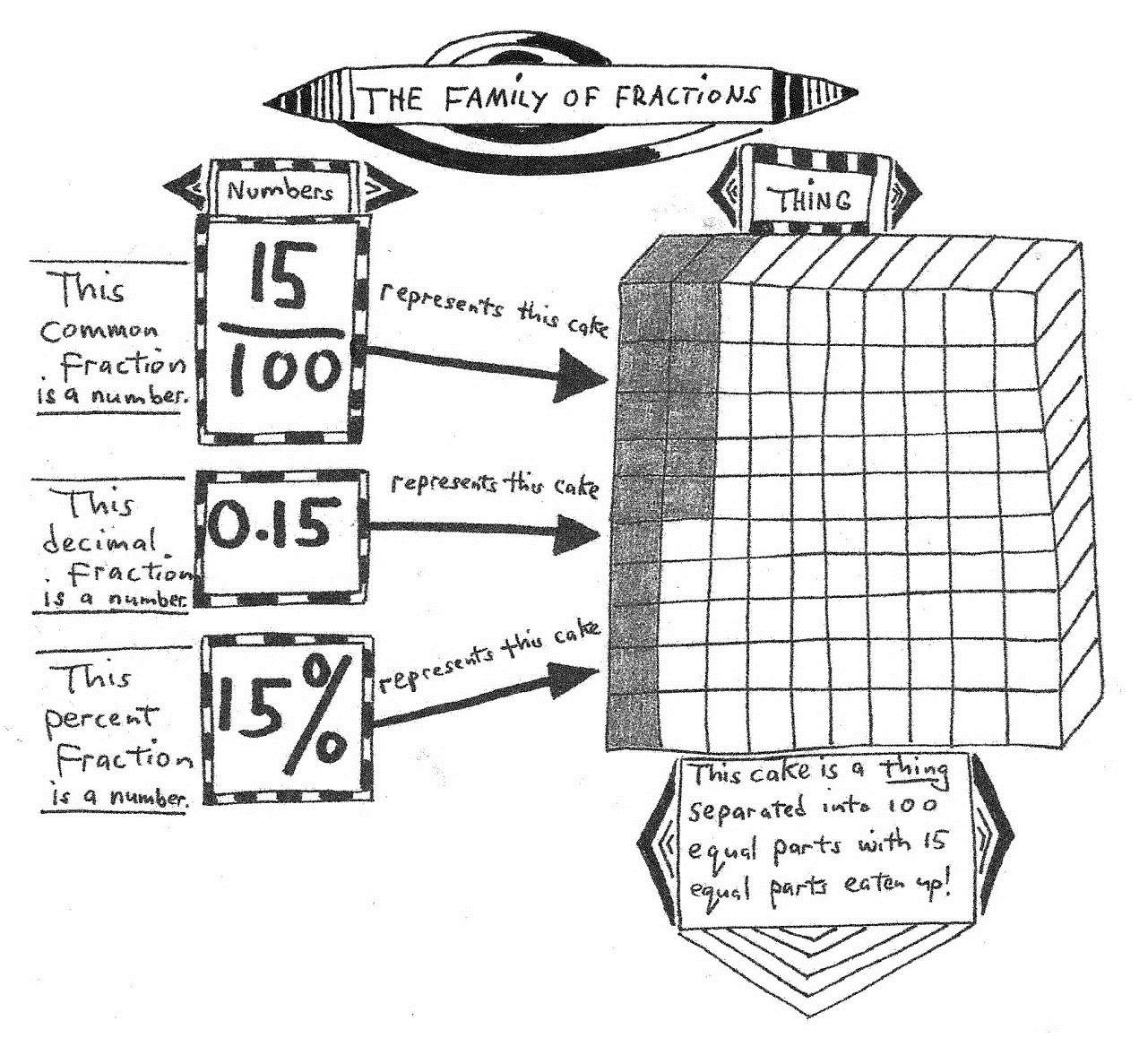
WHOLE NUMBERS
REPRESENT WHOLE THINGS
COMMON FRACTIONS REPRESENT
FRACTION-THINGS
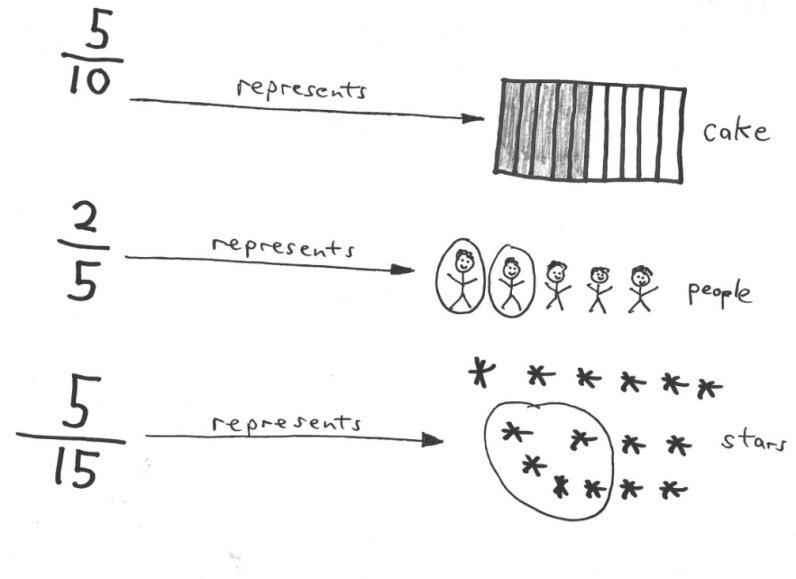
DECIMAL FRACTIONS
AND PERCENT FRACTIONS ALSO
REPRESENT FRACTION-THINGS
The Top Definition
of a Fraction-Thing
In this glossary, fraction-things are easy-to-recognize objects like cakes separated into equal parts or groups of apples separated into equal parts.
BUT A FRACTION-THING CAN ALSO BE A THING OR GROUP OF THINGS EXISTING ONLY AS AN IDEA OF SOMETHING SEPARATED INTO EQUAL PARTS.
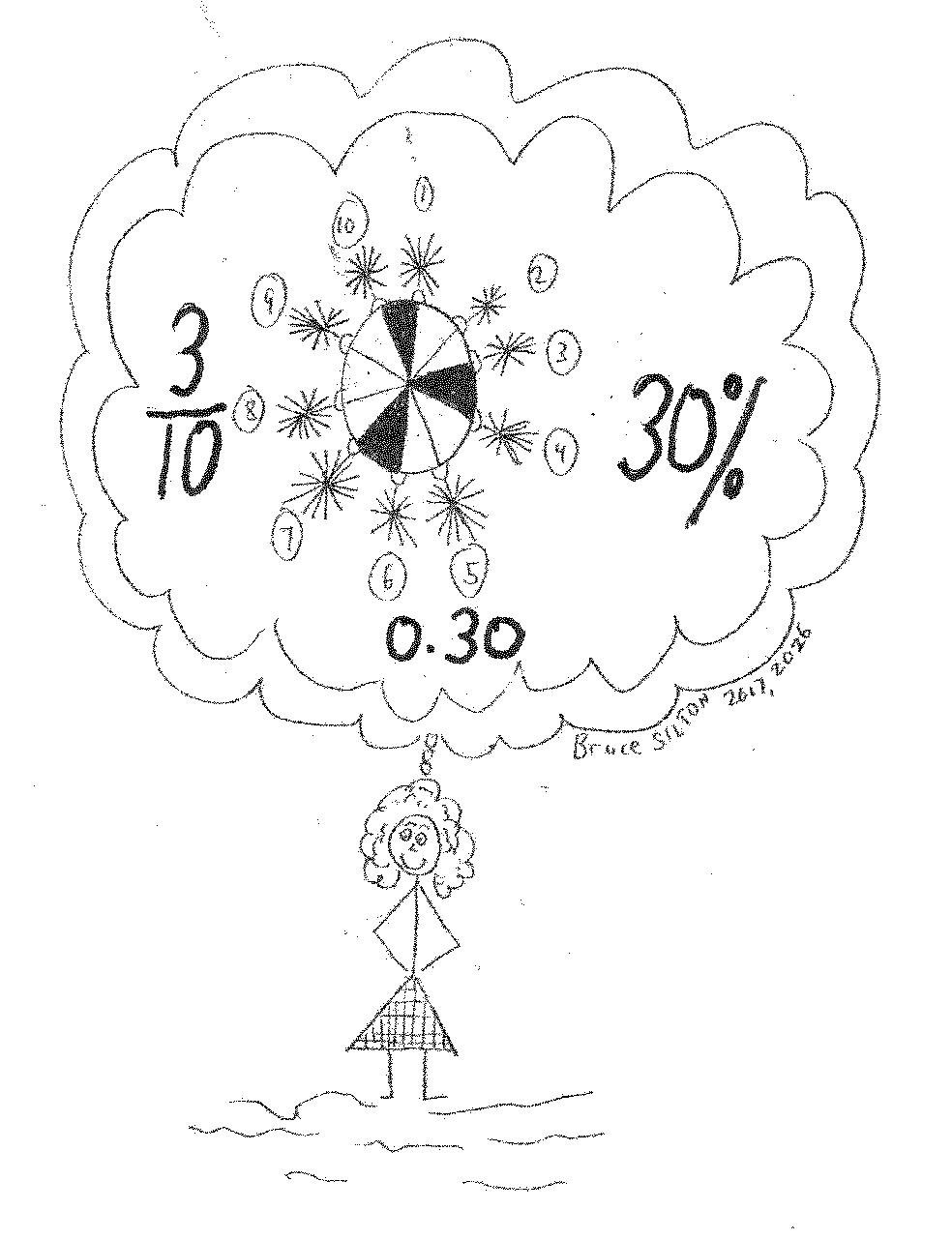
The following illustration shows a person with an idea of an object – NOT A REAL OBJECT, BUT THE IDEA OF AN OBJECT. The object she is creating in her mind is separated into 100 equal parts. She is thinking about 30 of those 100 equal parts.
Notice that she has three fraction ideas:
• The common fraction 30/100
• The decimal fraction .30
• The percent fraction, 30%
These three fractions represent her idea of the fraction-thing that she is creating in her mind.
SO, A FRACTION-THING CAN ALSO BE AN IDEA OF AN OBJECT OR GROUP OF OBJECTS THAT IS BEING MATHEMATICALLY — NOT PHYSICALLY — SEPARATED INTO EQUAL PARTS.
Clearly, the concept of the fraction-thing includes more than just cakes and apples. The following more comprehensive definition and description of a fraction-thing will be useful when studying advanced uses of fractions in high school and college math and science courses.
THE TOP DEFINITION OF A FRACTION-THING.
THE FRACTION-THING IS DEFINED AS THE REAL THING OR GROUP OF REAL THINGS SEPARATED INTO EQUAL PARTS THAT THE FRACTION (THE NUMBER) REPRESENTS.
ALSO, A FRACTION-THING CAN BE A THING OR GROUP OF THINGS THAT EXIST ONLY IN A PERSON’S MIND. IT IS MATHEMATICALLY — NOT PHYSICALLY — SEPARATED AND CALCULATED INTO EQUAL PARTS
SENTENCE: WHEN SCIENTISTS ARE RESEARCHING AND DISCOVERING NEW THINGS ABOUT THE PHYSICAL UNIVERSE, THEY MUST OFTEN CREATE IDEAS WHICH ARE ACTUALLY FRACTION-THINGS.
End of Glossary
What is Next?
FRACTION GLOSSARIES
You can learn more about math and fractions by studying my glossaries on the subject of fractions:
● Learning about Fractions (an Illustrated Introduction for 1st through 12th grades)
● Glossary of Illustrated Fraction Definitions for 1st and 2nd Grades
● Glossary of Illustrated Fraction Definitions for 3rd and 4th Grades
● Glossary of Illustrated Fraction Definitions for 5th Grade through 12th Grade
FRACTION BOOKS
You can learn more about math and fractions by studying my books on the subject of fractions:
● Fraction Fundamentals, Simple & Complete
● The Fraction Solution (student textbook.)
● The Fraction Solution Teachers’ Guide
If you cannot find these glossaries and books in your classroom or school, you can get them by visiting:
• The Bookstore at Clearwater Academy International, 801 Drew Street, Clearwater, FL 33755, phone: 727-446-1722
• The Bookstore of my math educator’s website, www.MathCreativity.com
• You can also contact me directly by email at:
SiltonFineArt@aol.com
• You can reach me by phone at 727-637-9584.
• You can even come to my office on the first floor of Clearwater Academy International. If the door is closed, please knock.
I will always have my books and glossaries for you.
I wish you good learning!
Bruce Silton
.
ABOUT THE AUTHOR
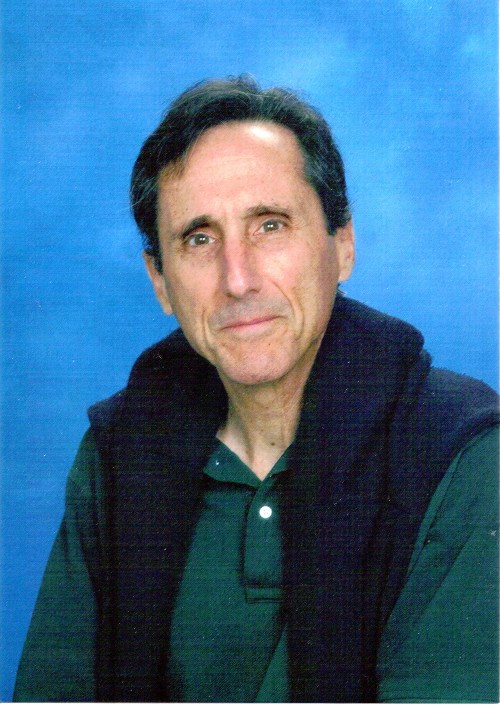
Bruce Silton, the author, is a tutor. He has been tutoring students at Clearwater Academy International (CAI) in Clearwater, Florida, for 26 years and has given more than 30,000 tutoring sessions.
From the Clearwater Academy International Parent Newsletter for February, 2020:
“If you don’t know Bruce, he works in our Lower School helping our students who are really stuck on their studies. He works one-on-one with them to help the students fully understand and get moving on their study again. Bruce has perfected his method over the years, and he is the ultimate example of care and effectiveness of what we do here at Clearwater Academy.”
You are invited to visit the author’s two websites:
● Math Educator’s website: www.MathCreativity.com
● Artist’s/Designer’s website: www.BruceSiltonFineArt.com